BEHIND THE STORY
History, with
the sources open.
An independent, researched tribute. The distinction between a document and an imagined image matters.
About this edition
This is the first volume of Is the Legend, a collection of independent tributes to remarkable lives. It is not affiliated with the Fundação Oscar Niemeyer or with the institutions whose buildings appear here. Chapter text links to institutional records, primary accounts and scholarly criticism at the relevant passage. Experiential descriptions are editorial readings, not invented historical testimony.
The architect’s own explanations are attributed as such. Institutional biographies are useful but are read critically alongside labor history and architectural criticism. No invented dialogue, private thoughts or purported archival photographs are used. This is a substantial editorial introduction, not an exhaustive catalogue or a critical edition of every project.
Dates and uncertainty
Project, construction and inauguration dates identify different events. We keep them separate where documented. Exile is treated as a sequence after the 1964 coup; the Fundação records Paris establishment in 1967 and the office opening in 1972. Sources disagree on some details of this transition. The disputed death toll in the 1959 camp violence is not resolved here. The Cathedral’s present glass is not presented as a 1970 feature.
Source review: 12 November 2026. Links lead to the supporting institutions; their external content and availability can change. Scholarship listed here has been consulted only to the extent available online. Niemeyer’s memoir is discussed as a historical work; no unverified quotations from it are reproduced.
Every image is a reconstruction
All raster storytelling images on this website were generated with OpenAI’s built-in image-generation tool. None is an archival photograph, original sketch, exact digital survey or evidence of a historical event. Portraits evoke Niemeyer at different ages; poses, clothes, companions and settings are imagined and do not document particular moments. Building forms were prompted using the institutional references below. Generated geometry, surroundings, material condition, lighting and art details may differ from the actual place. Read the historical text for architectural explanation.
The locator map and teaching diagram are schematic vector illustrations created for this edition. They are not archival documents, original Niemeyer drawings or measured plans. The full prompt and reference register is available as JSON ↗.
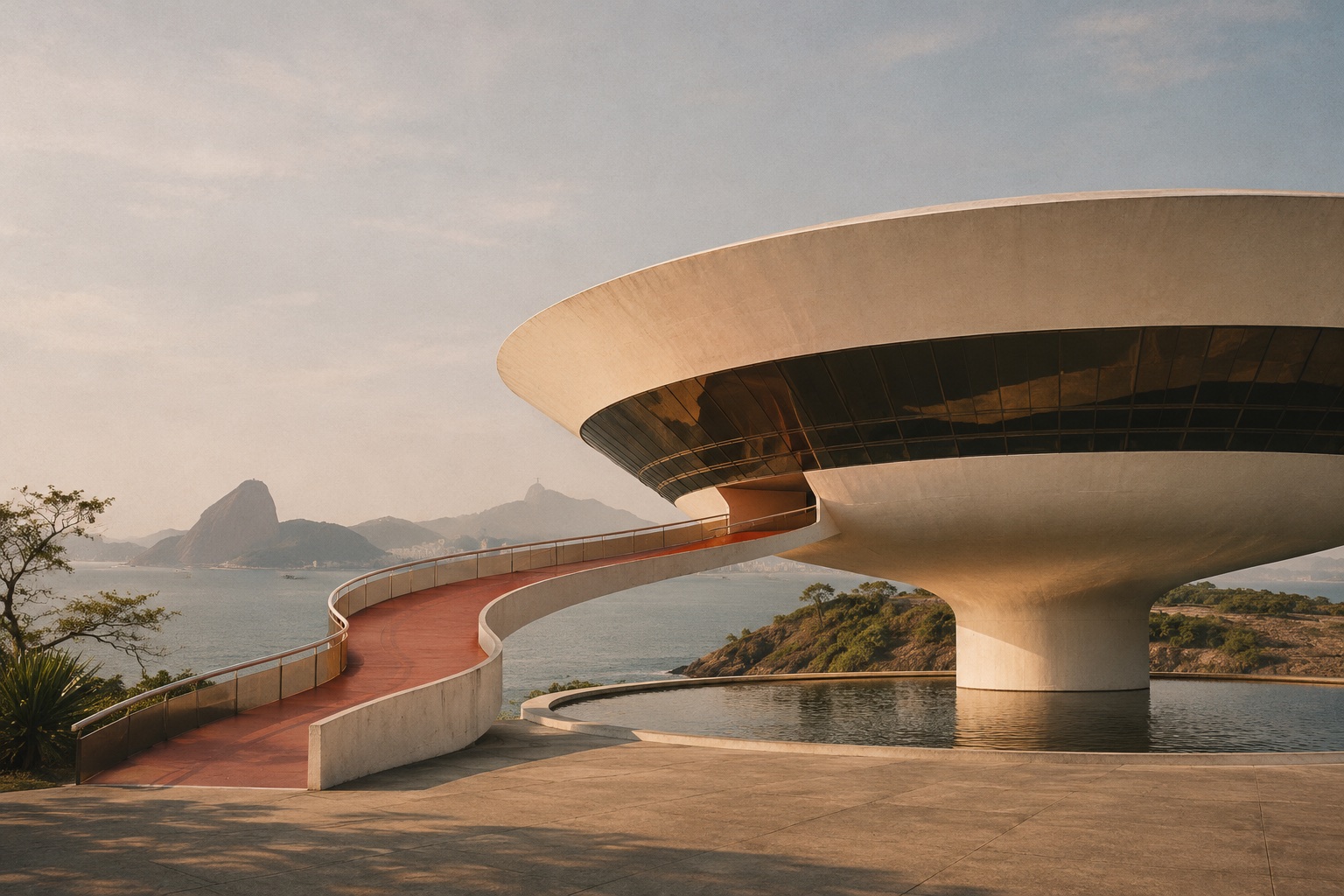
Niterói · based on Pritzker selected works and the architect’s account. Site, ramp and massing are interpretive; dimensions and internal layout are not verified by the image.
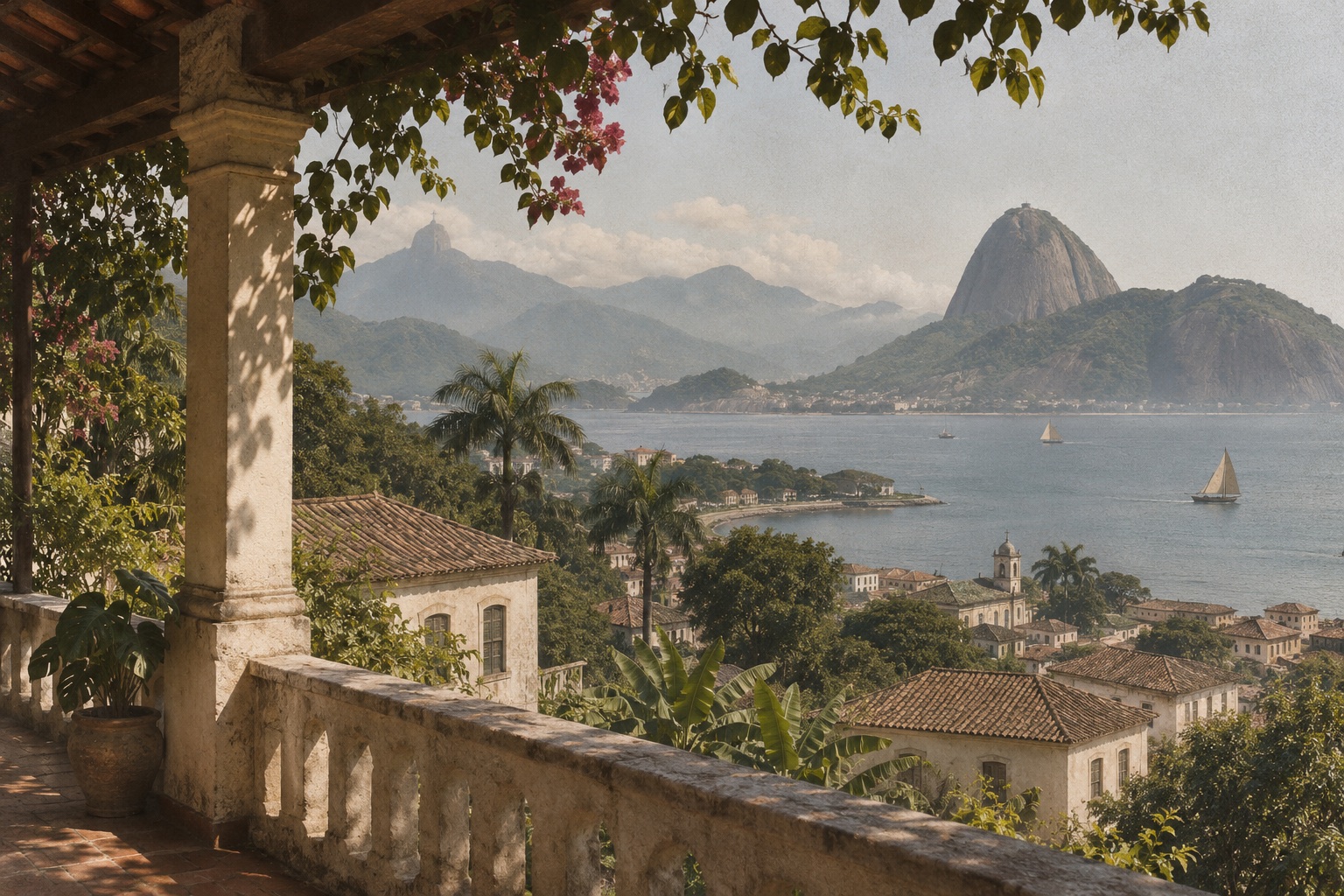
Rio · an imagined early-20th-century setting. Not Niemeyer’s actual childhood home, a documented viewpoint or a record of the city on a particular date.
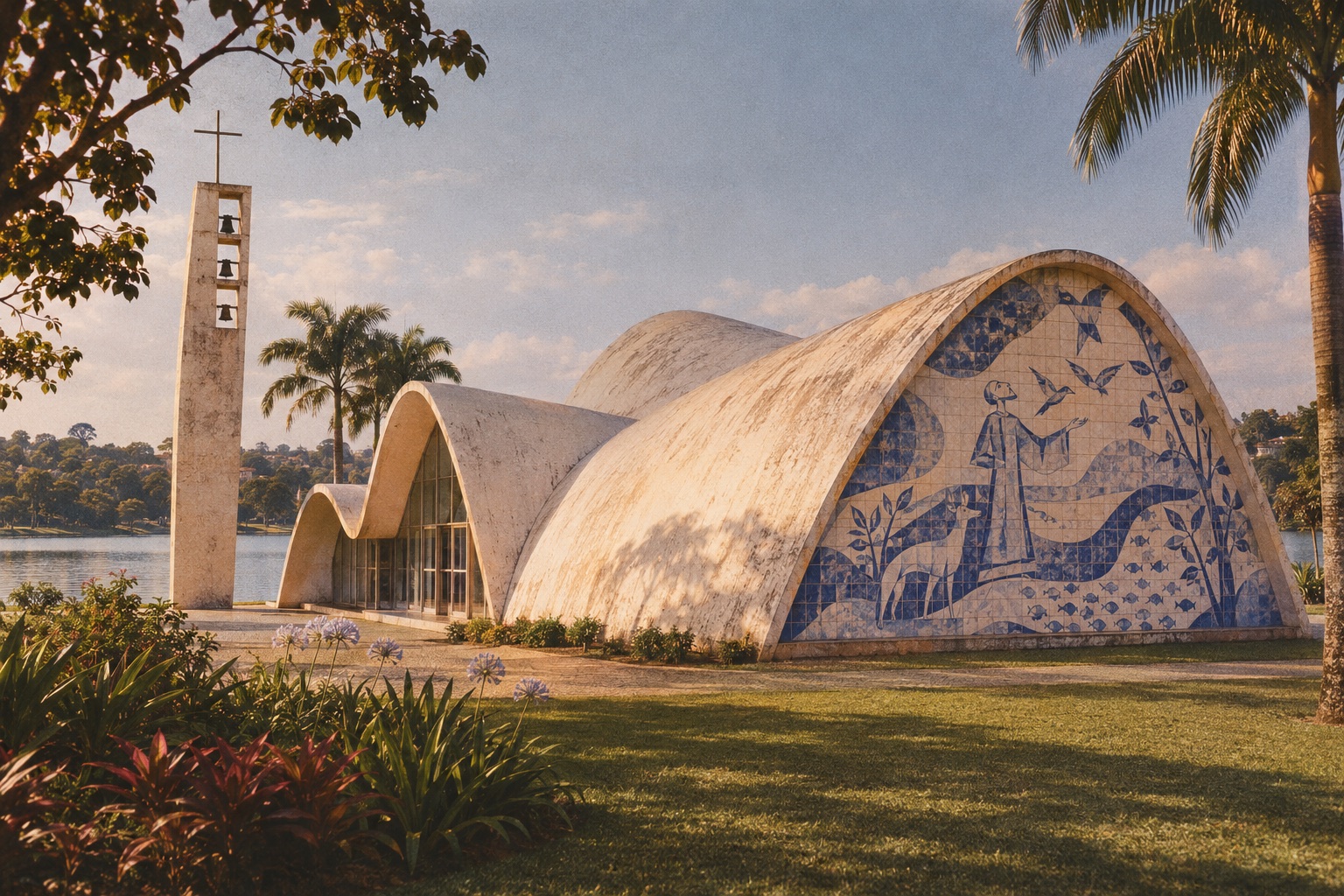
Pampulha · based on UNESCO ensemble description and institutional visual references. Tile imagery, garden arrangement and exact profile are approximate.
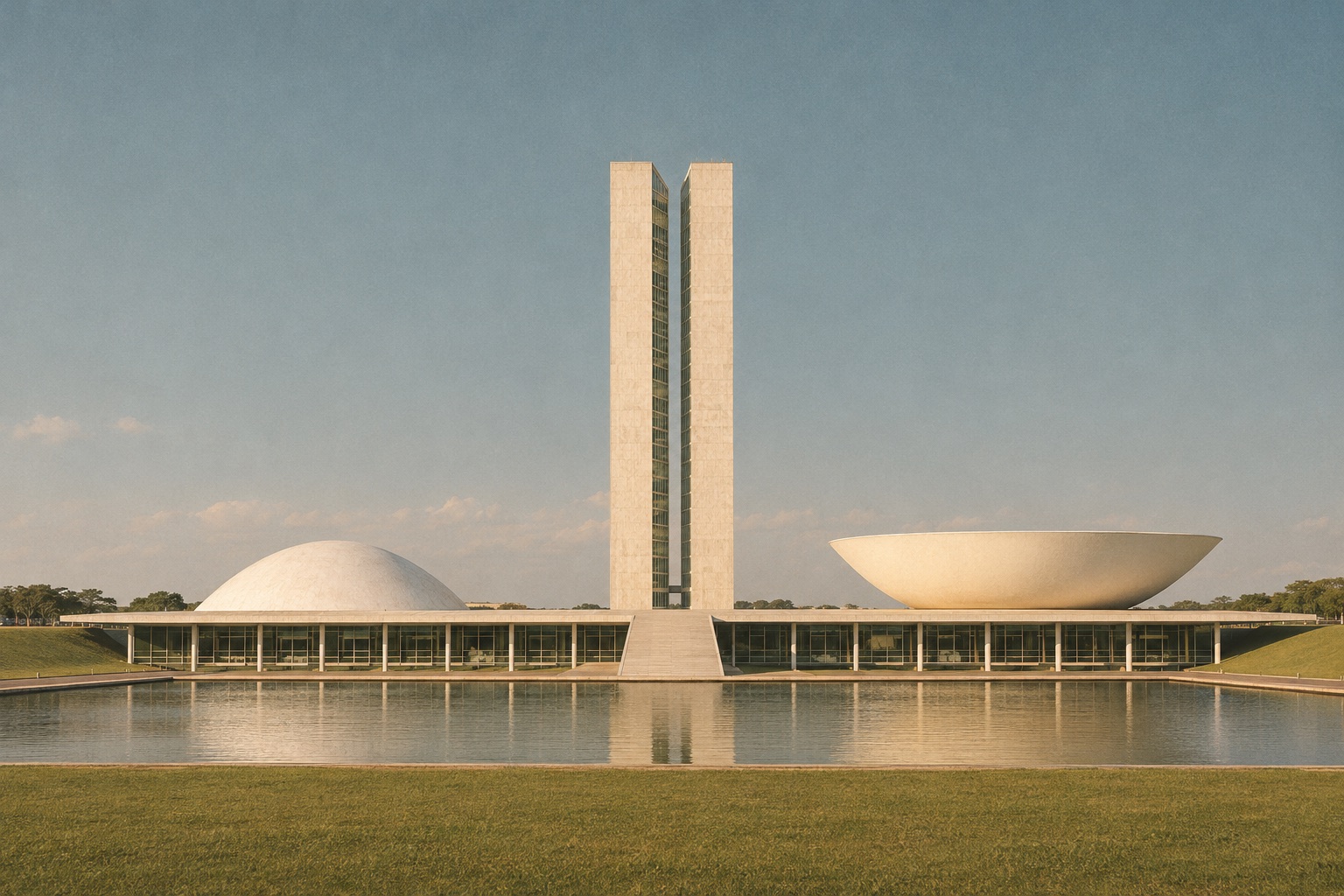
Congress · based on UNESCO and Pritzker references. Recognizable massing is retained; the image is not a source for structural or dimensional claims.
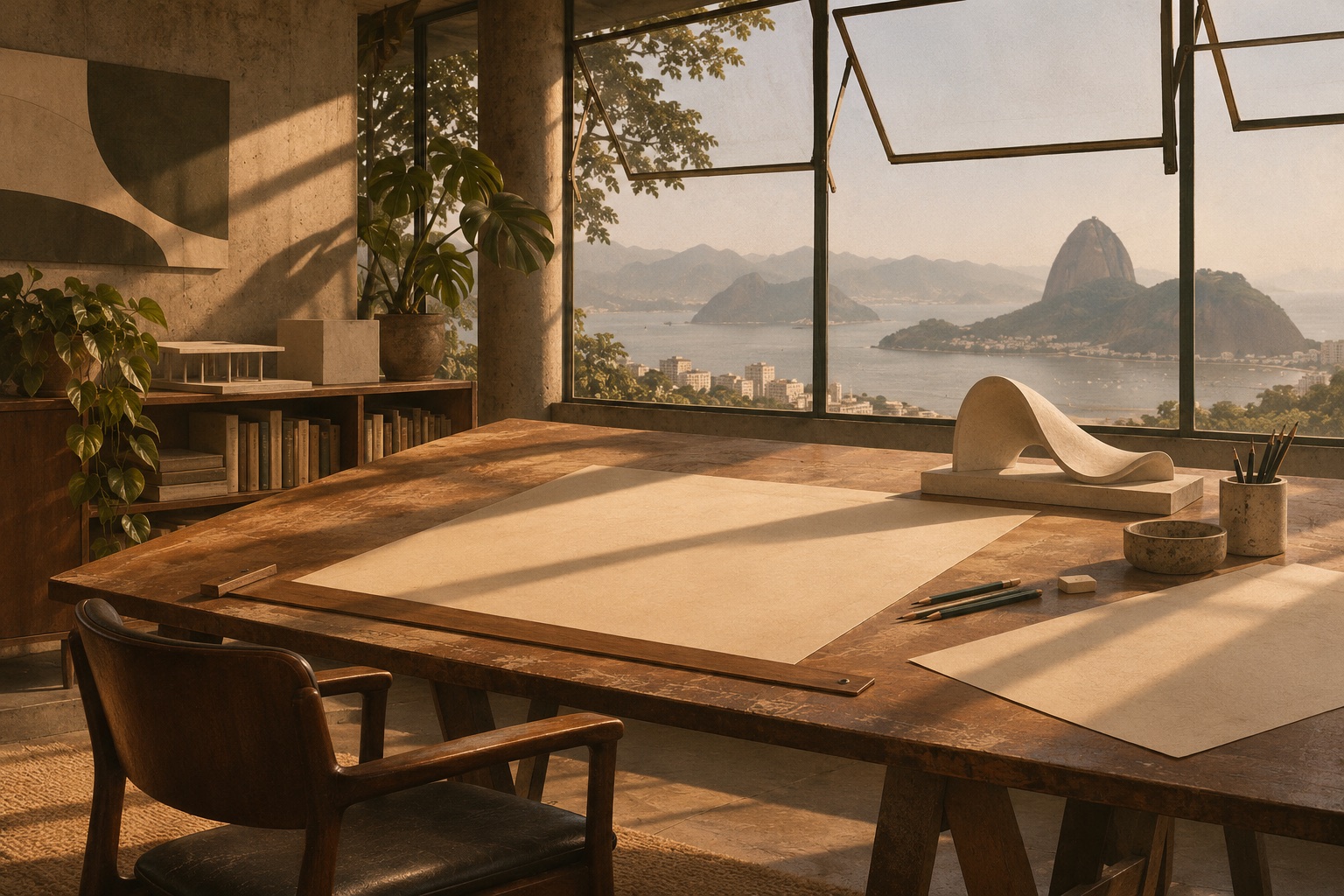
Studio · an imagined room, not a reconstruction of Niemeyer’s office. No paper shown is an original drawing or archival document.
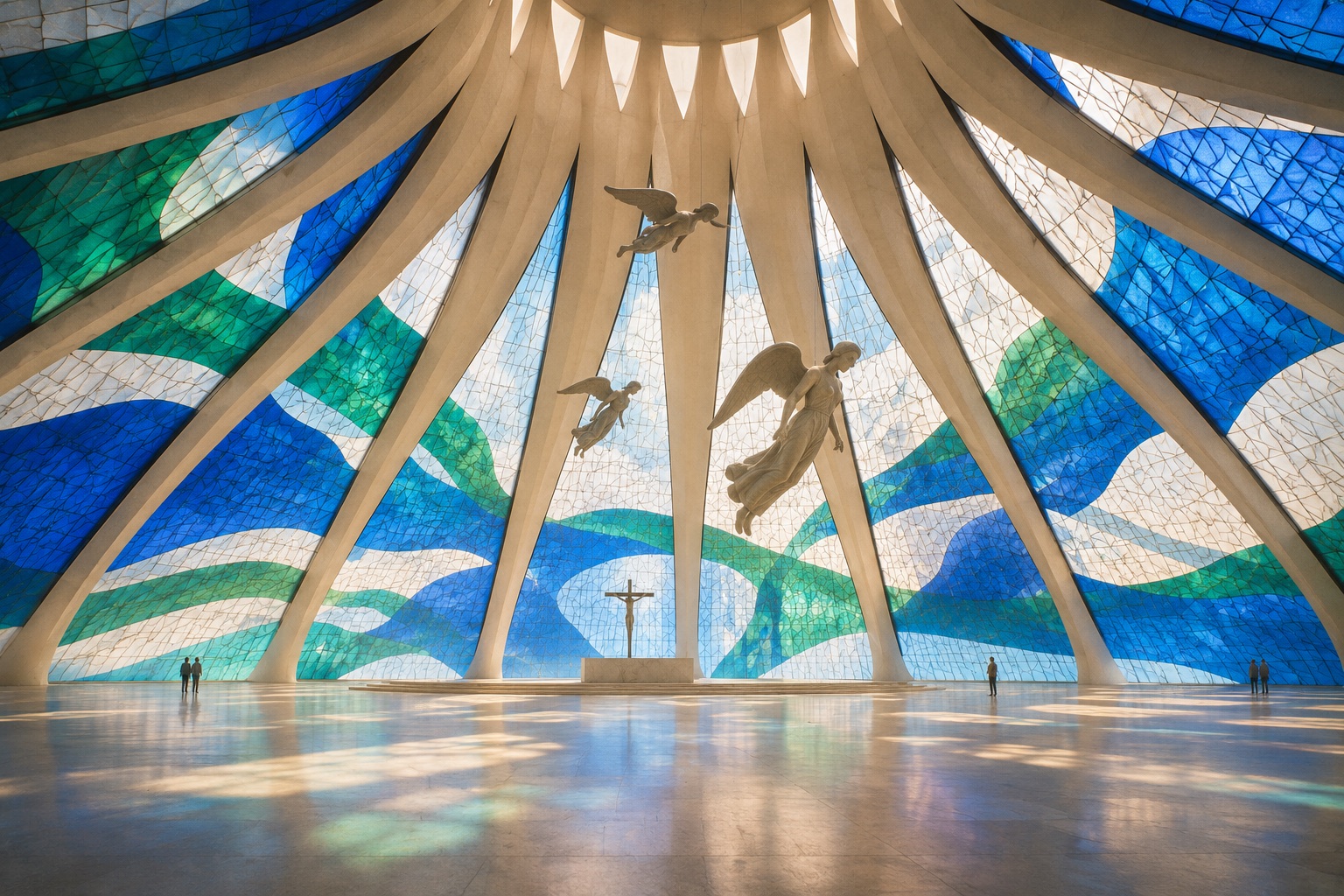
Cathedral · an evocation of the later interior. Colored glass does not reproduce Peretti’s artwork; lighting and furnishings are interpretive. Not a view of the 1970 inauguration.
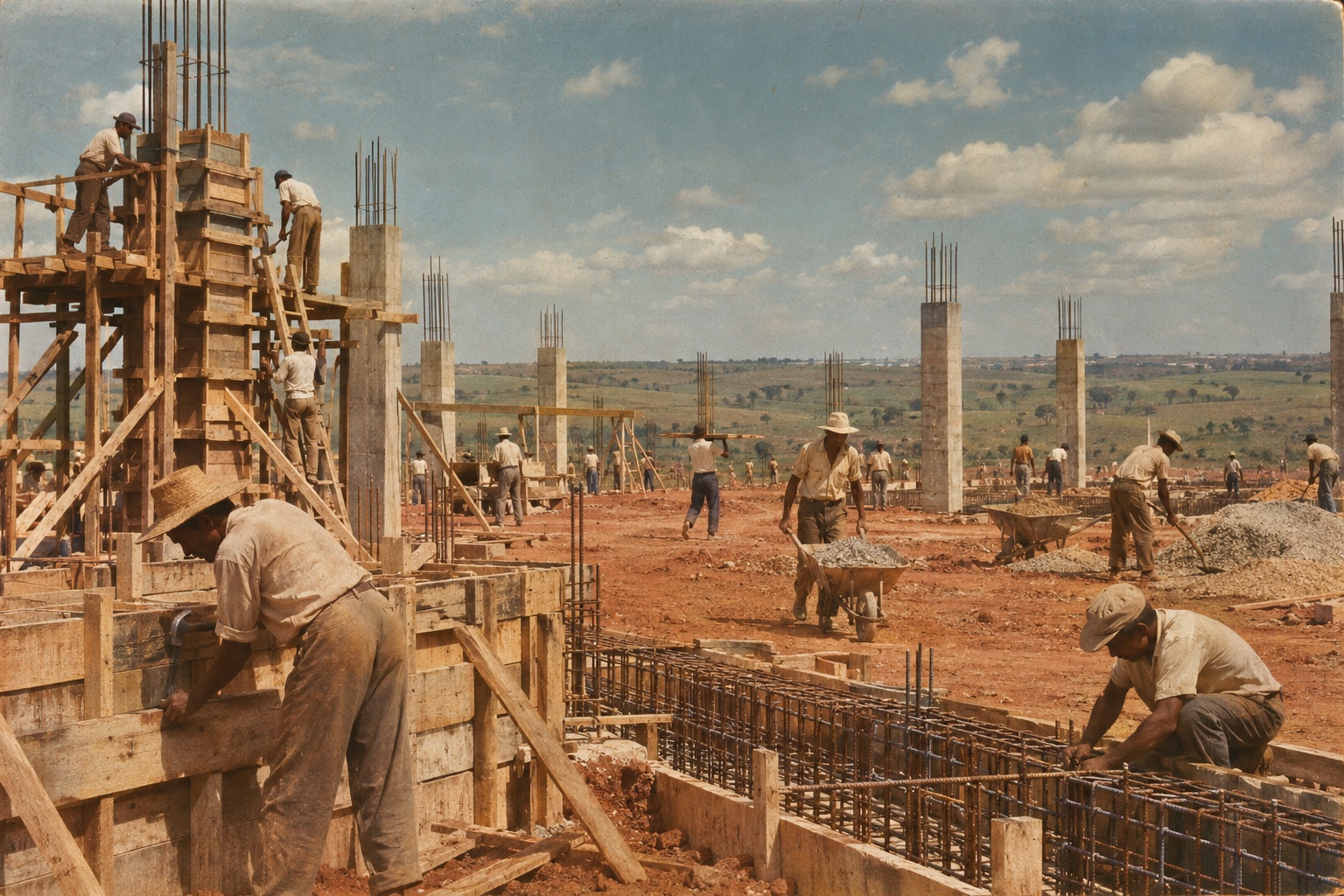
Construction · an imagined late-1950s site. No identifiable worker, specific accident, named construction site or documented event is represented.
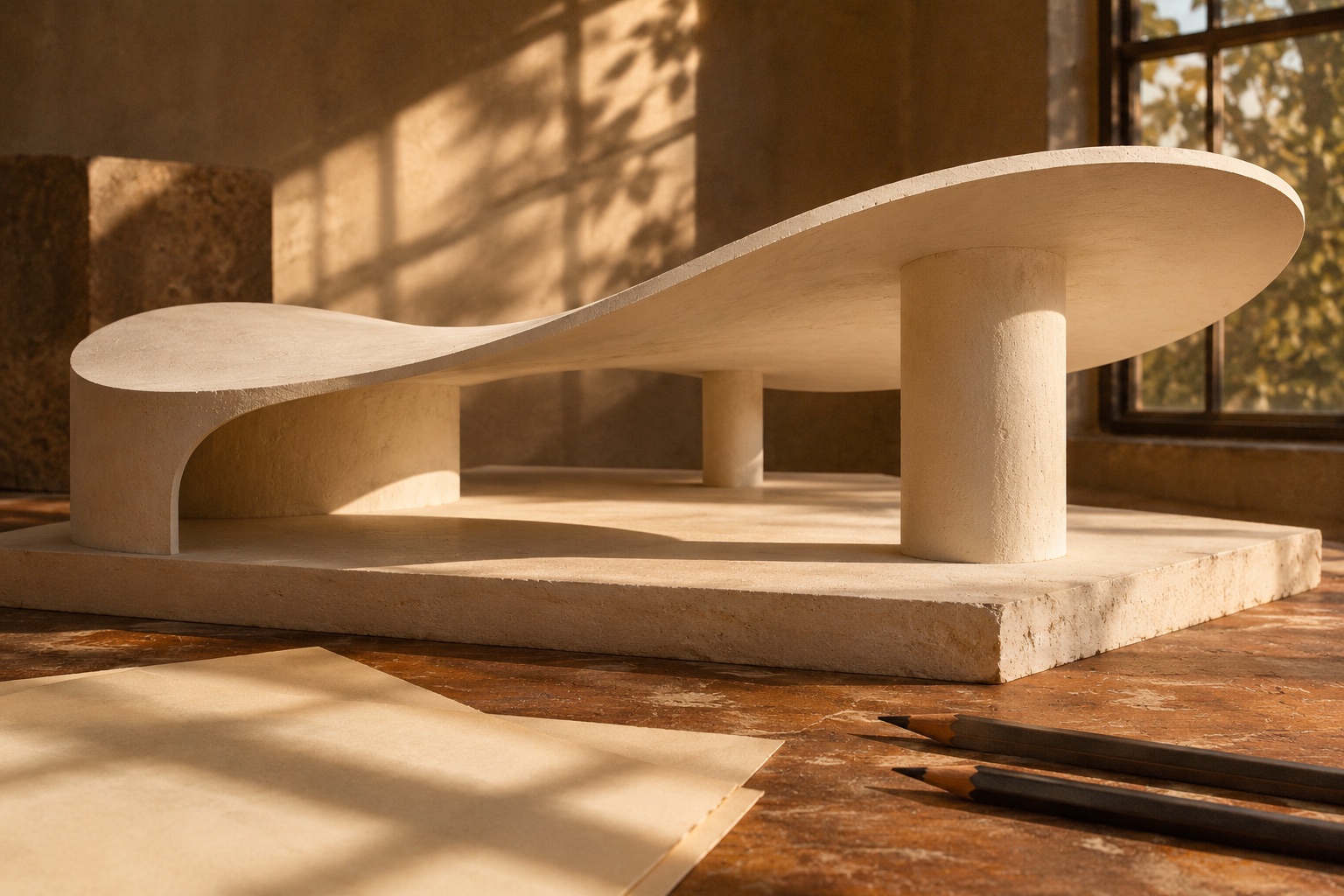
Model · a contemporary interpretive form study. Not an original object, historic artifact or a documented design by Niemeyer.
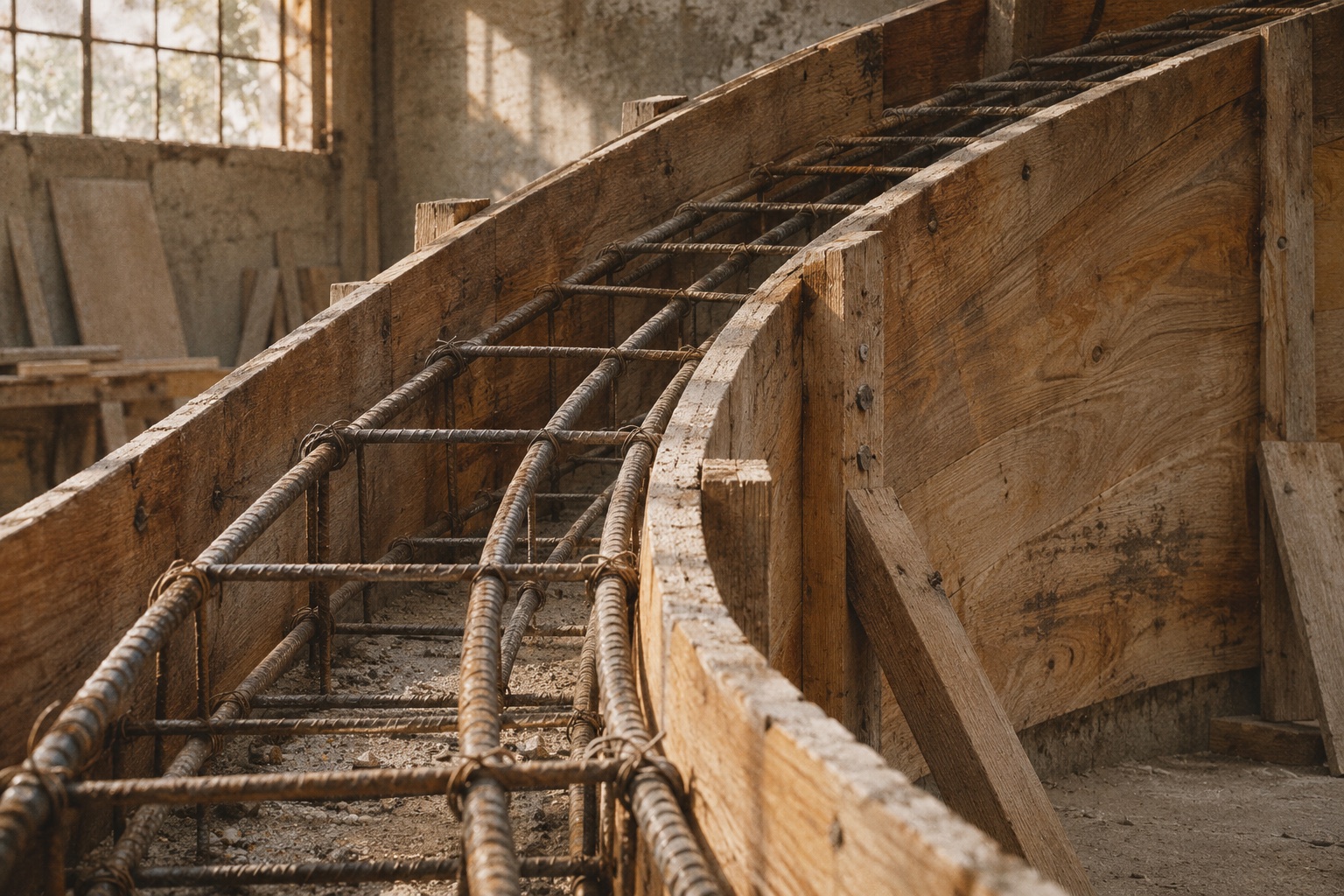
Concrete · an interpretive material study. Not a specific building, technical detail or construction instruction.
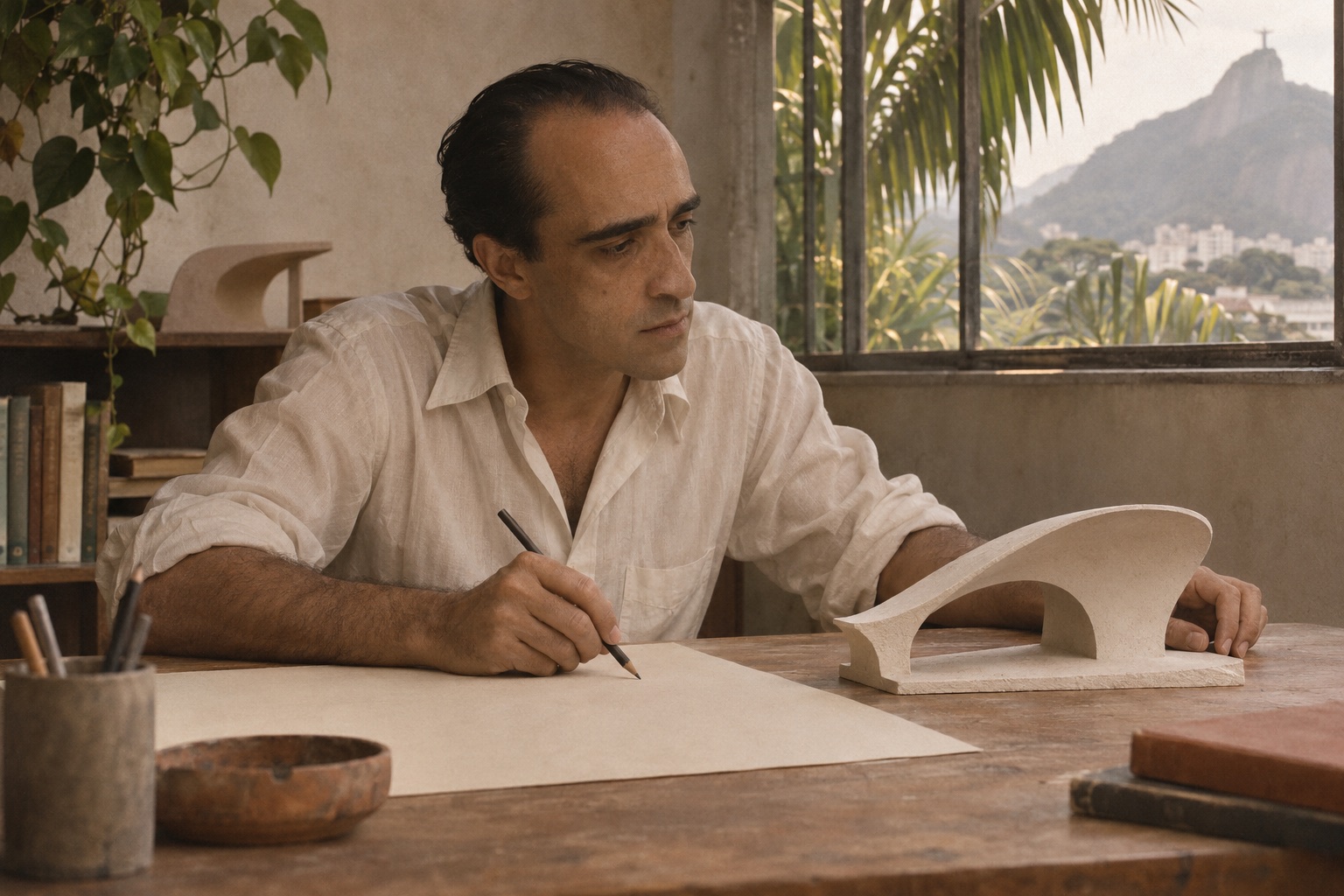
Oscar Niemeyer, imagined around 1950 at the drawing table. Setting, gesture and model are invented; no original sketch is reproduced.
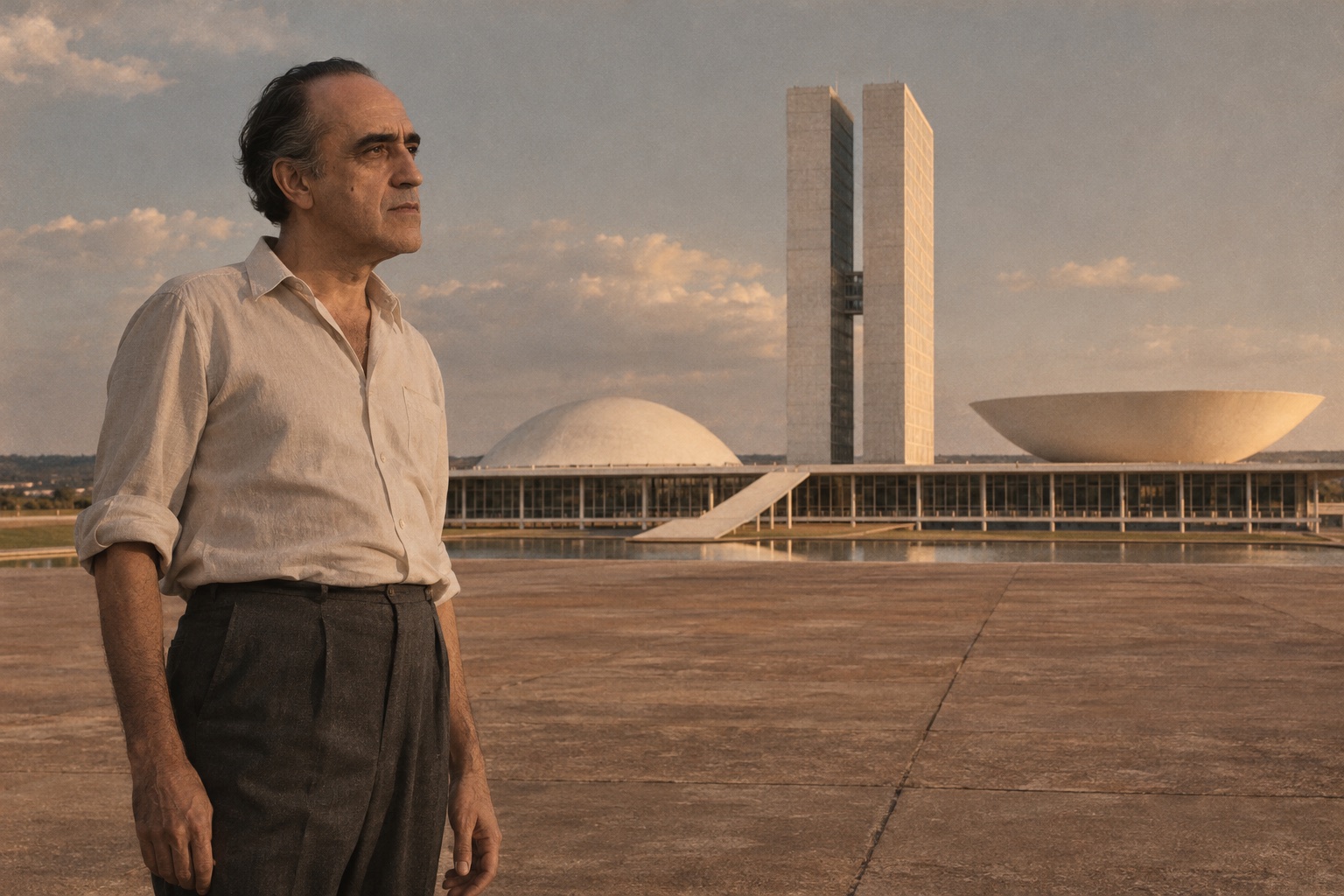
Niemeyer in the Brasília years. An imagined visit, not a record of an inauguration or a documented occasion.
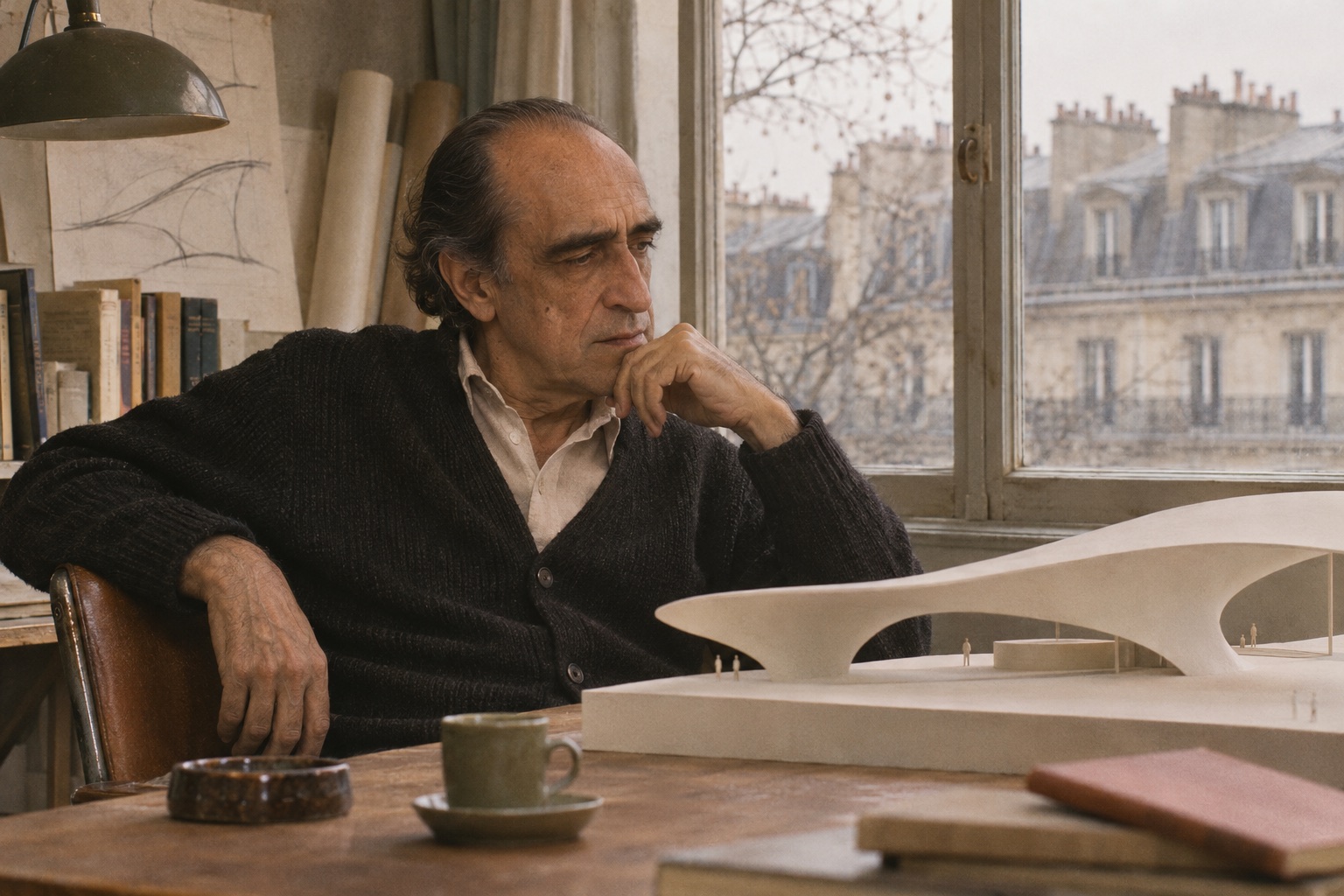
Niemeyer during his Paris years. An imagined office and working moment, not a documented room or meeting.
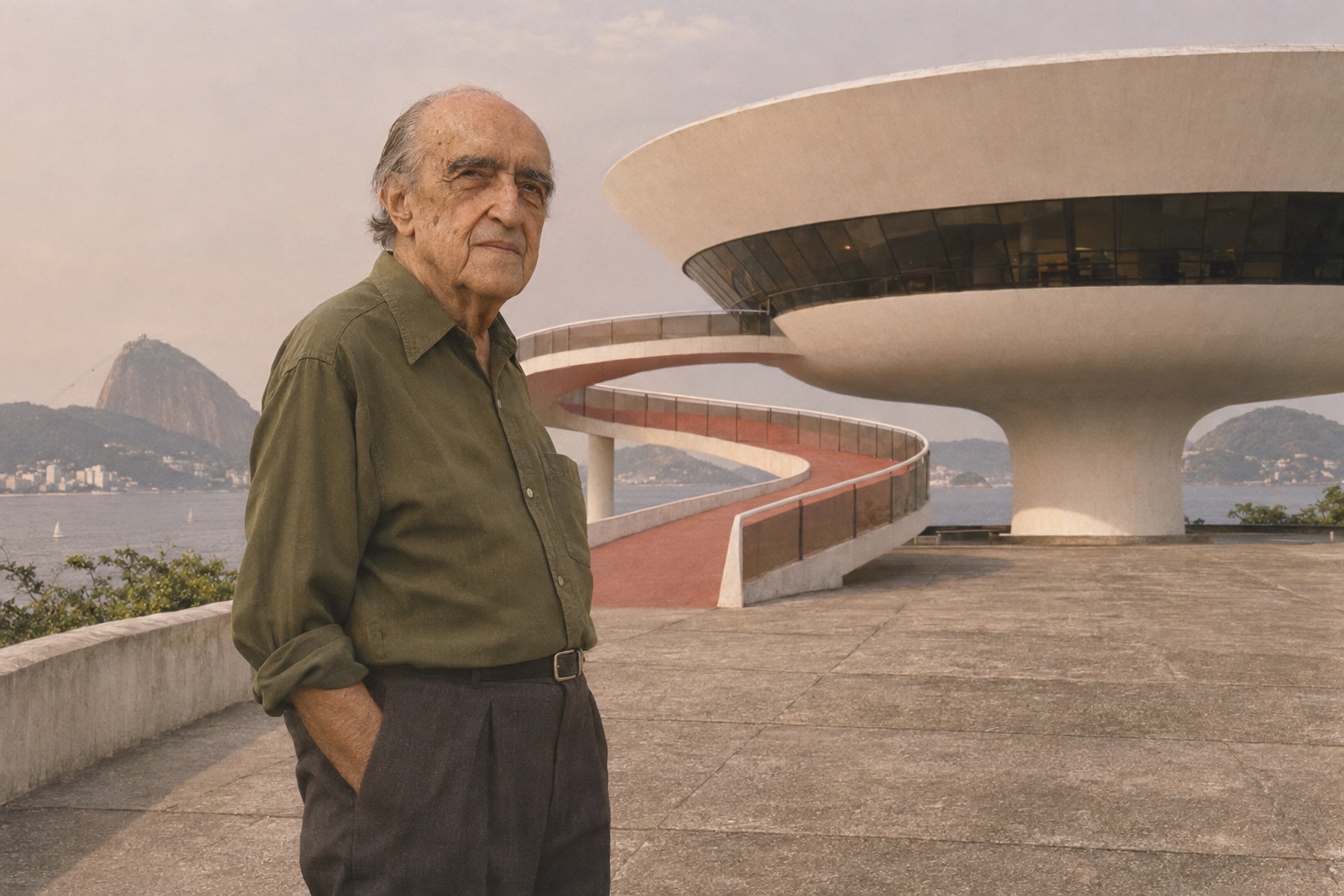
Niemeyer in later life near the Niterói museum. An imagined visit, not a record of the opening ceremony.
Niemeyer in conversation with imagined visitors. No specific meeting, identities or dialogue are represented.
Niemeyer in late life at an imagined Rio drawing table. This is an interpretive portrait, not an archival photograph.
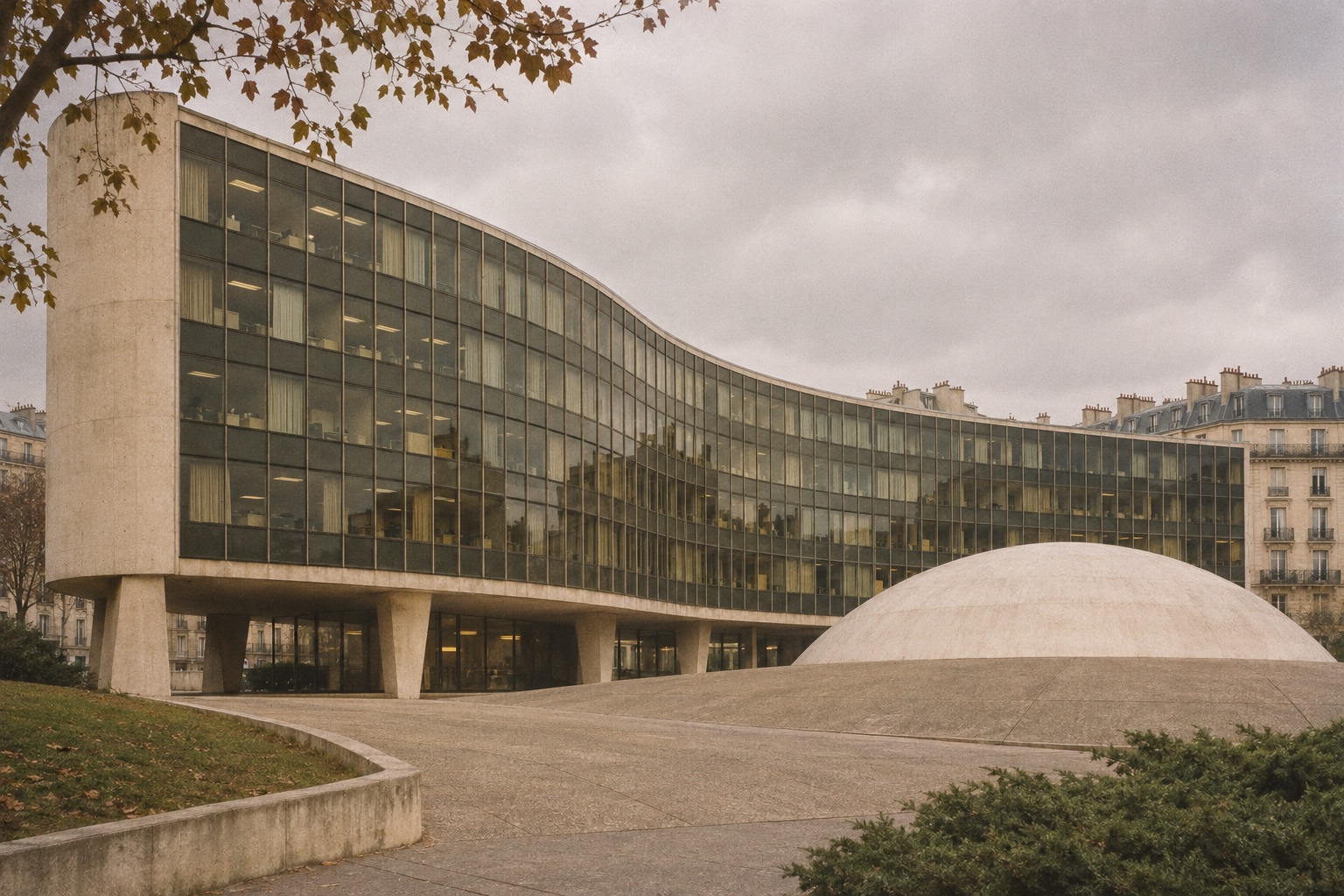
Paris headquarters in its completed, circa-1980 configuration. Geometry, surroundings and light are interpretive.
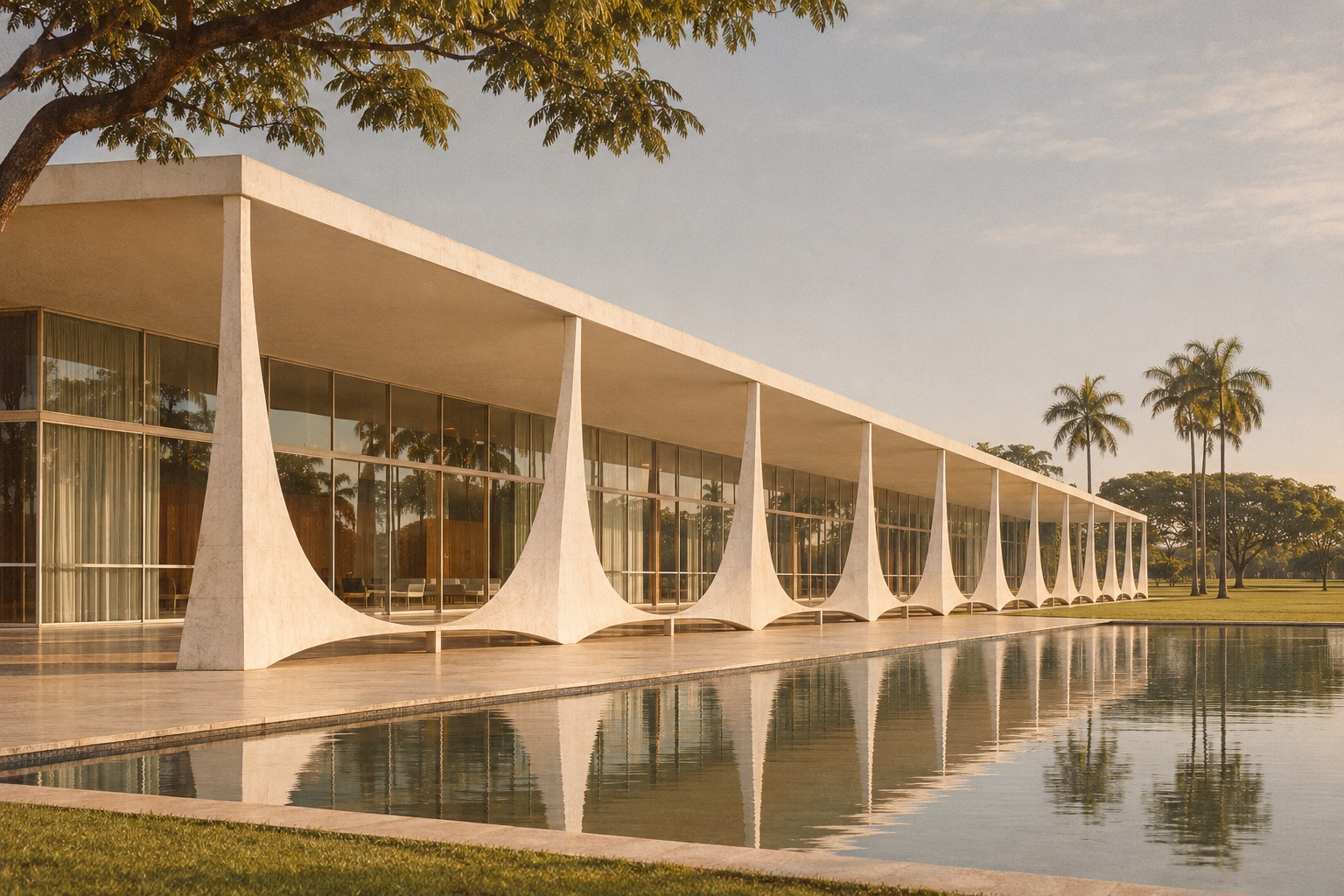
Alvorada: an artistic study of the colonnade and reflecting water. Geometry, gardens and light are approximate.
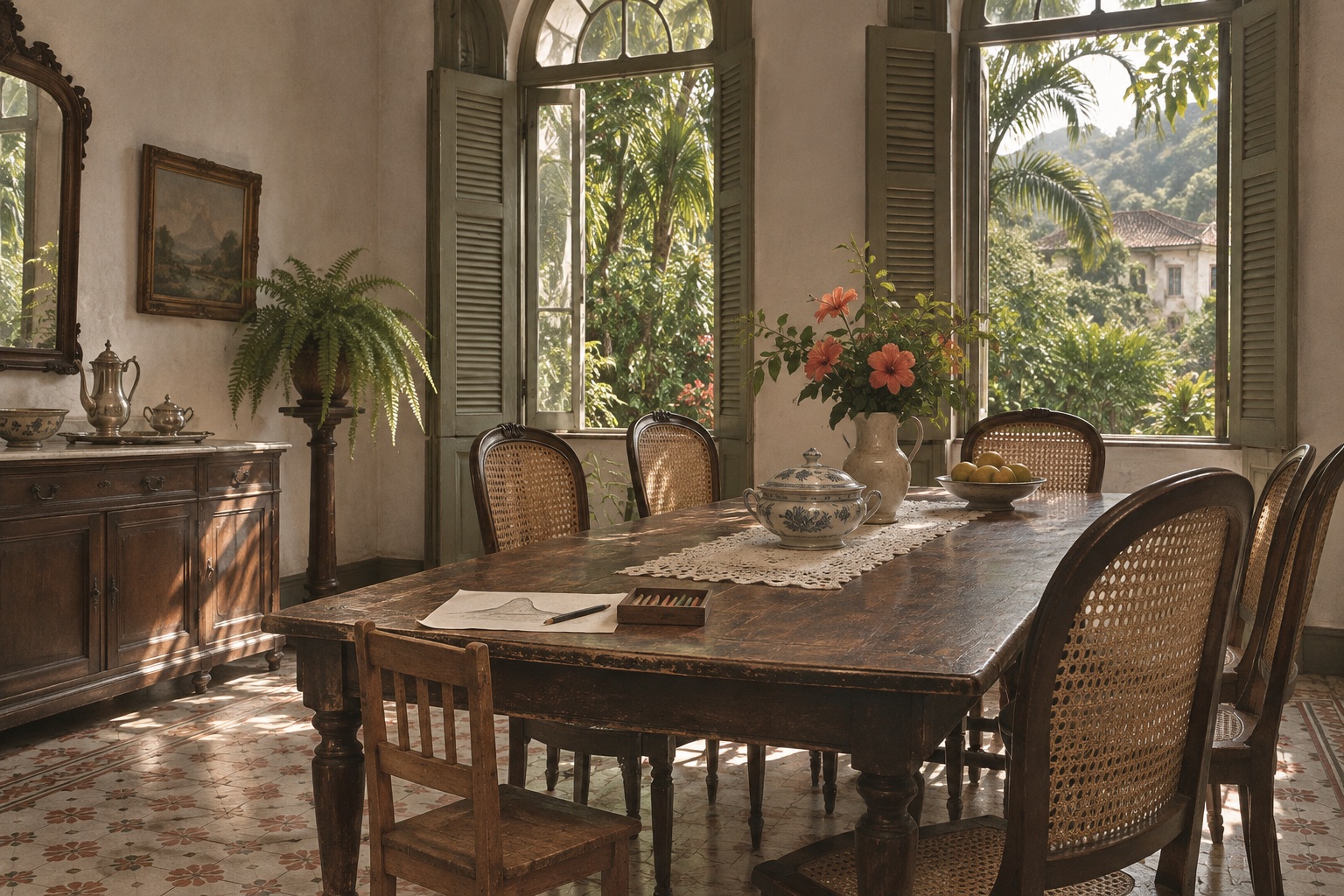
A household before the monuments. Imagined Laranjeiras domestic setting, circa 1915; not the Niemeyer family’s actual home, belongings or a documented scene.
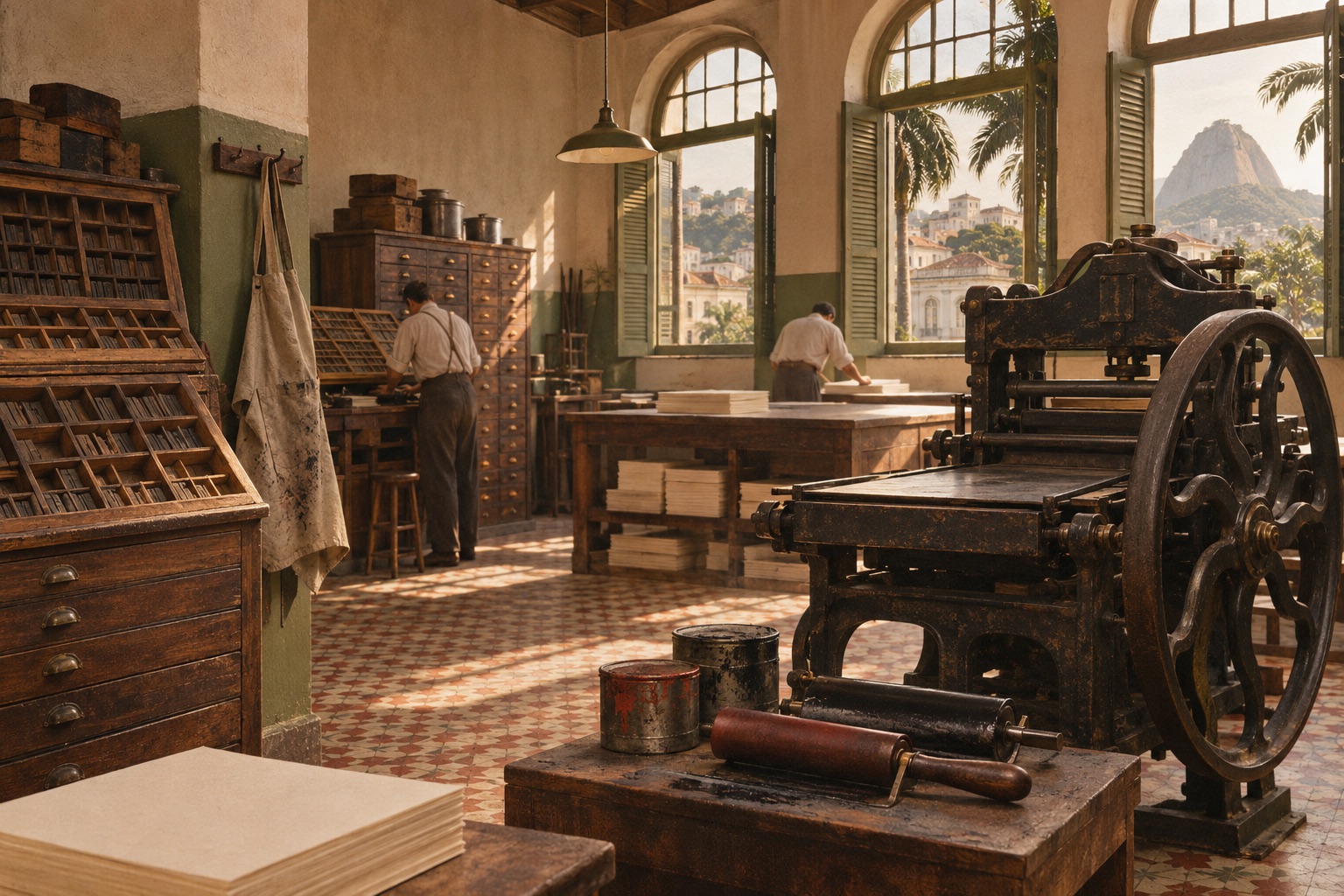
Paper, ink and practical work. Imagined Rio printshop, circa 1929; not a reconstruction of his father’s actual business or its workers.
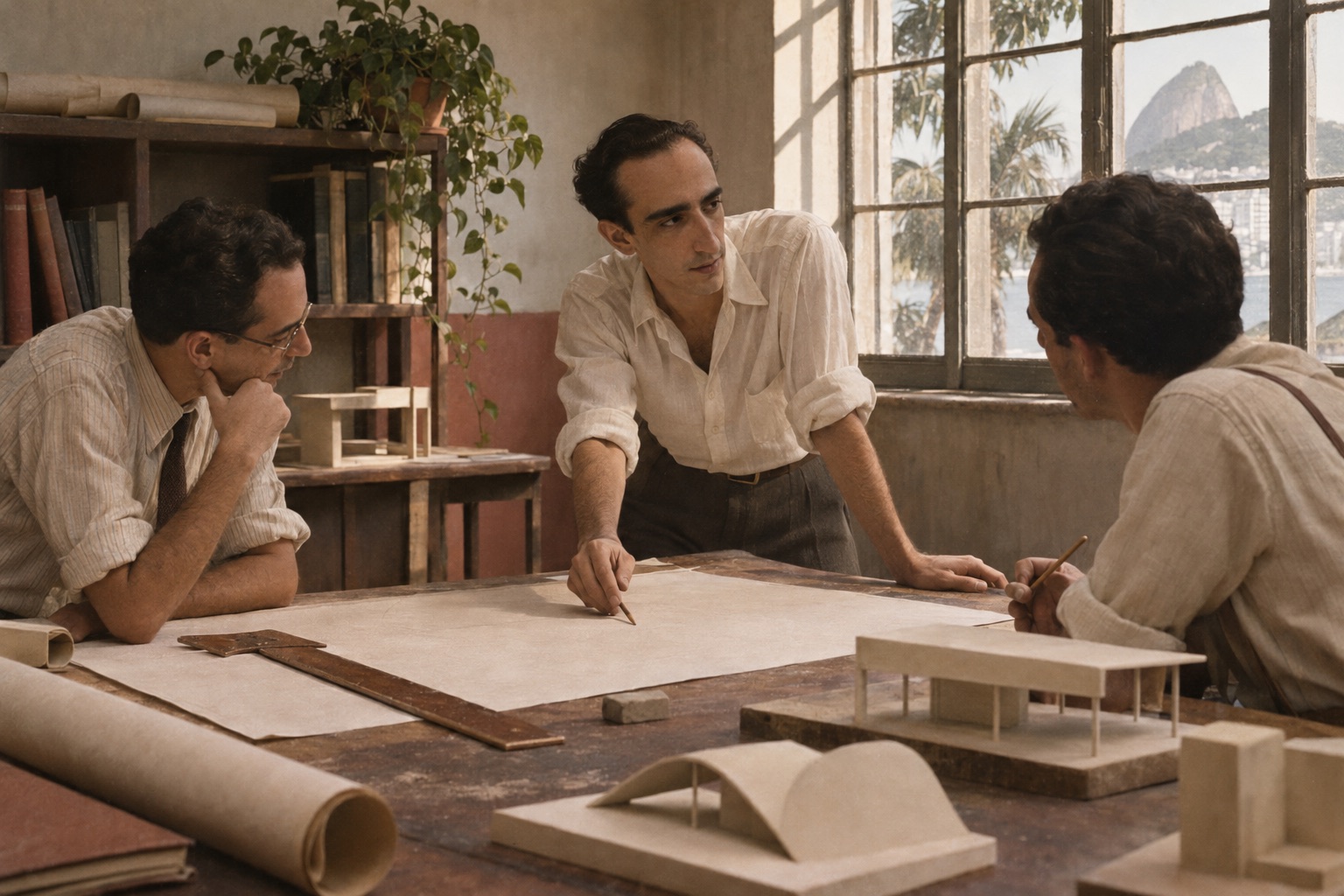
Learning in a shared office. Niemeyer and anonymous colleagues in an imagined mid-1930s setting; no particular meeting, room or original drawing is depicted.
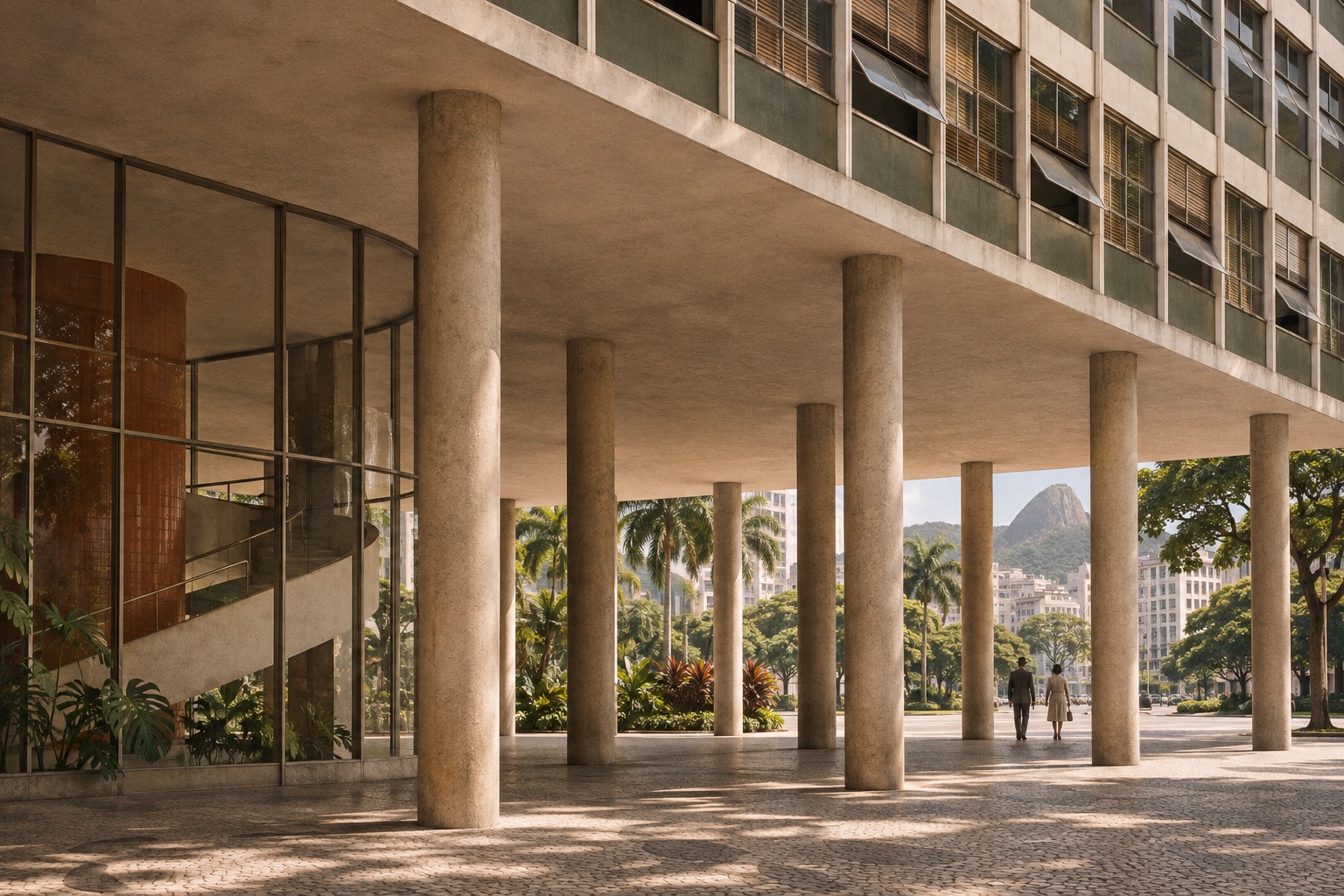
The city passes beneath the ministry. Architectural evocation of Capanema’s pilotis; surroundings, surface condition and geometry are approximate.
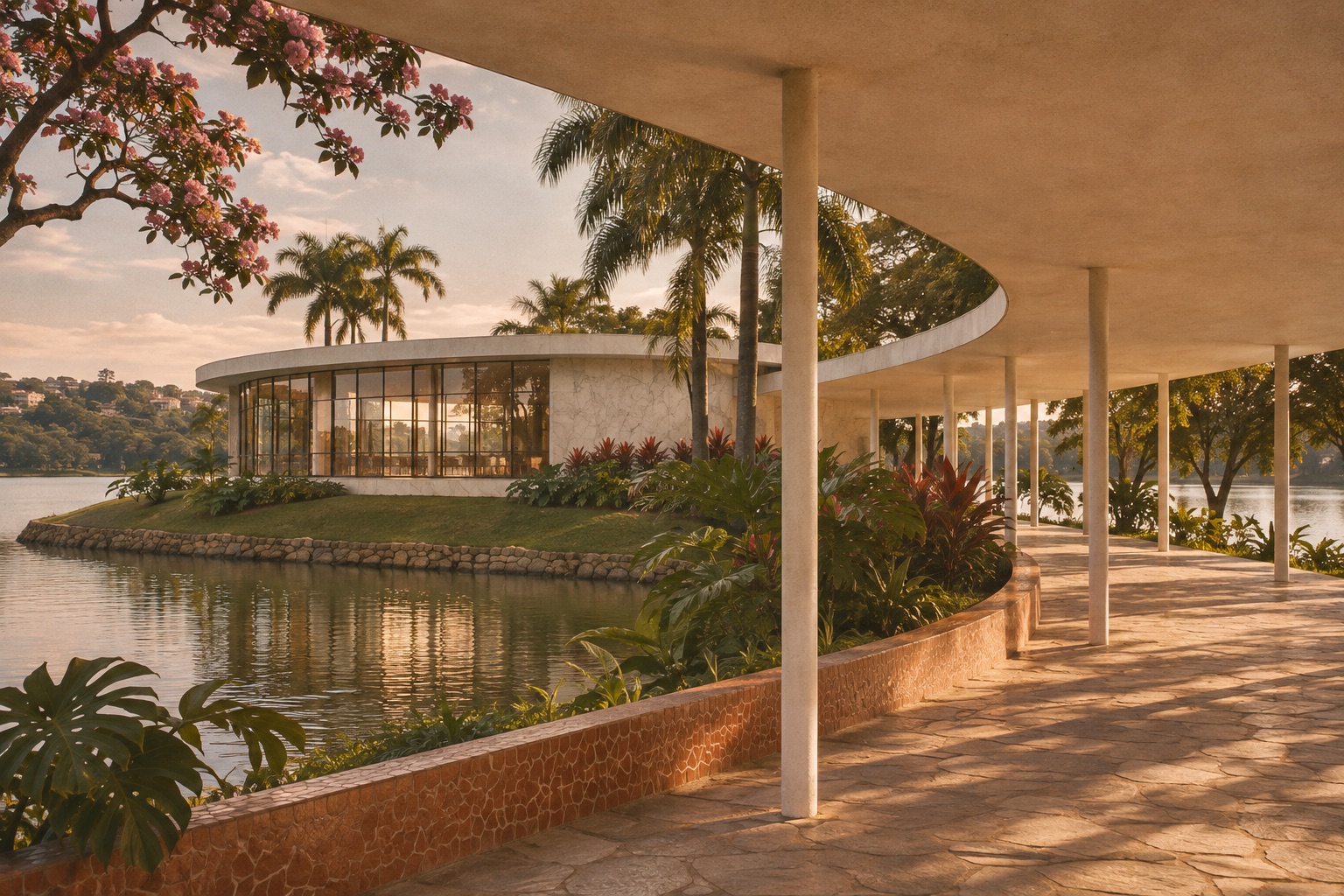
A roof becomes a route. Casa do Baile evocation based on institutional references; garden, light and geometry are interpretive.
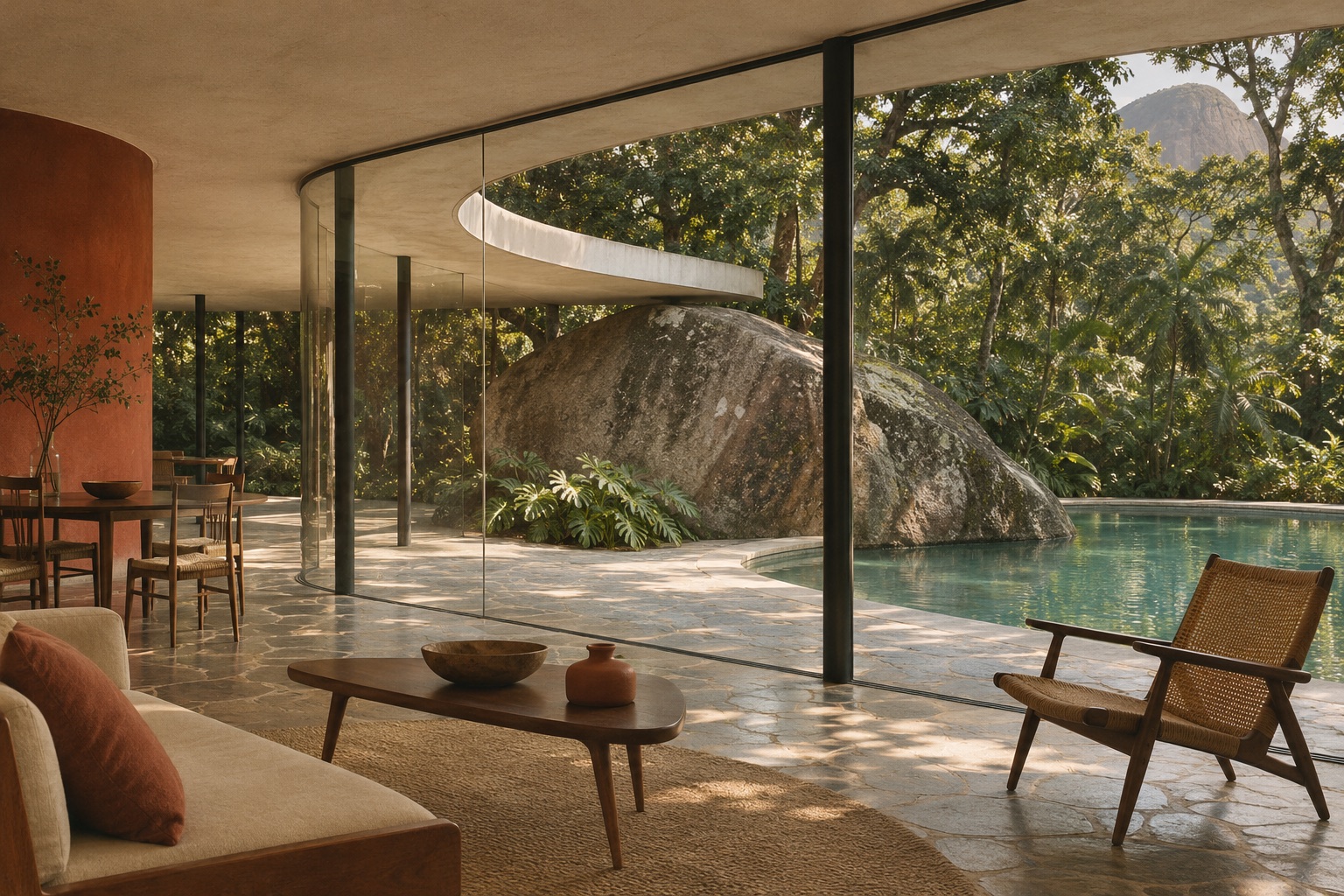
A rock at the edge of a room. Canoas evocation; furnishings, exact glazing, landscape and historical interior state are not reconstructed as evidence.
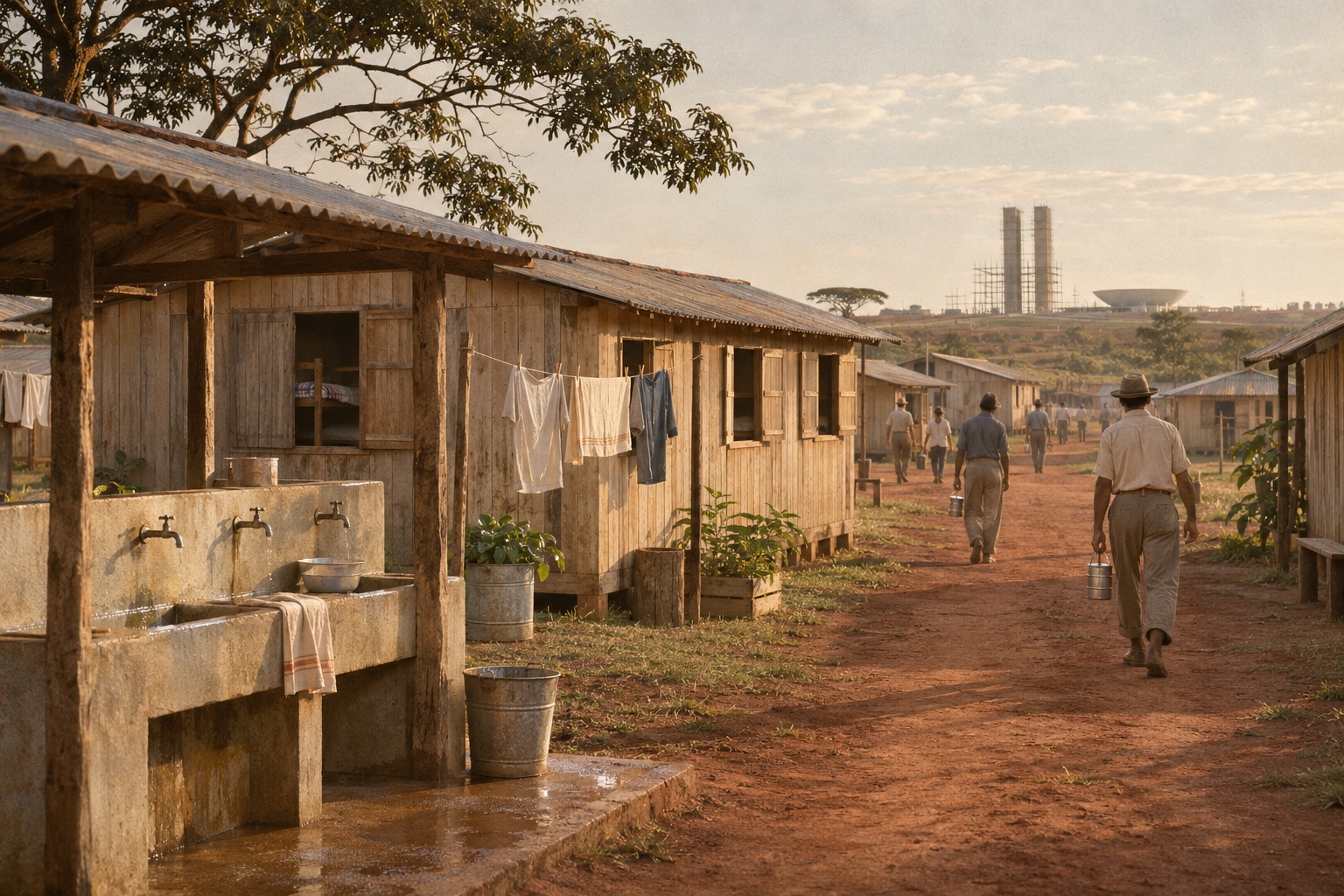
The temporary city that sustained the building campaign. Imagined late-1950s settlement; not a named camp, identifiable worker or documented incident.
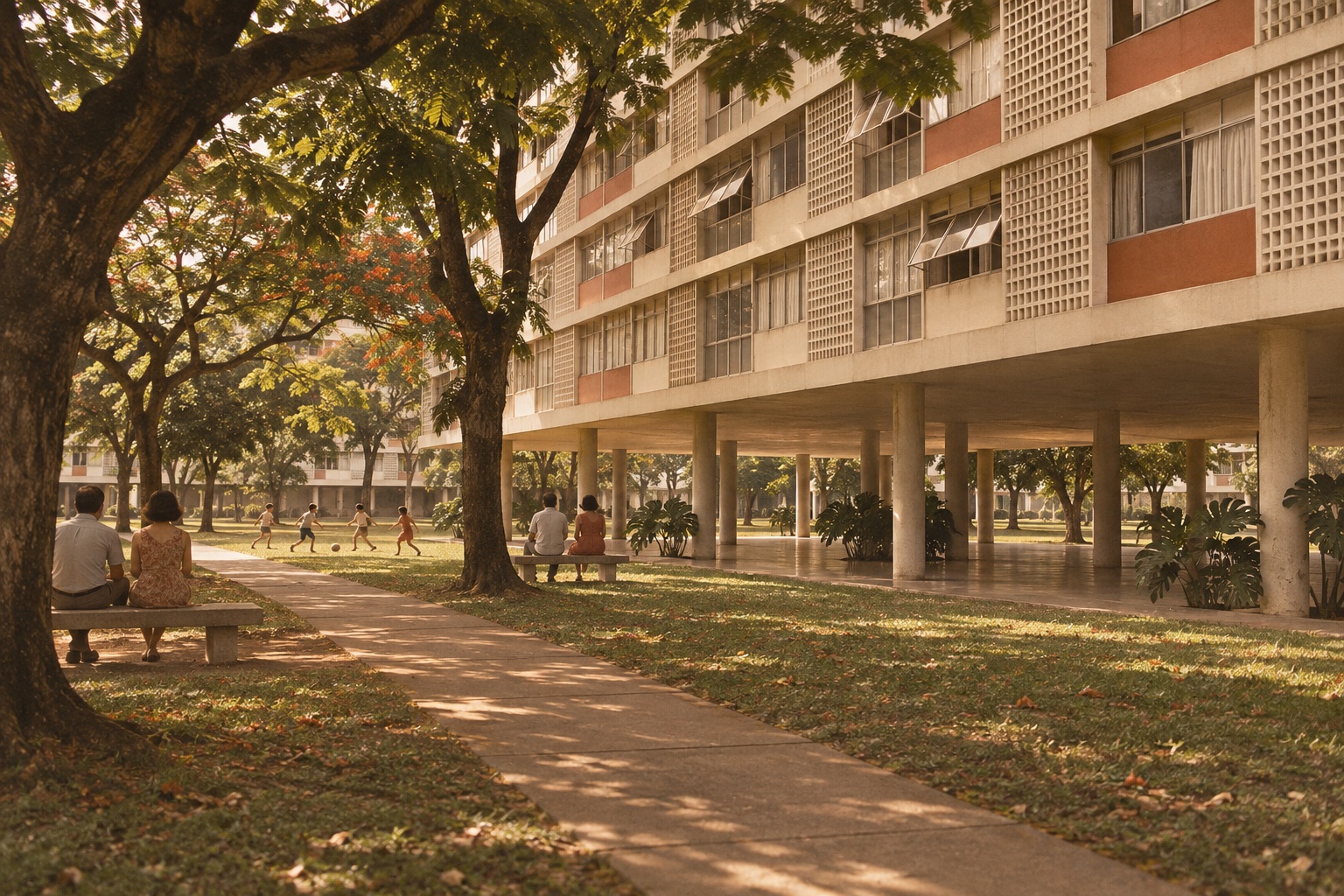
The residential scale beyond the monumental view. Imagined superquadra life, circa 1970; not an exact block or an attribution of Costa’s planning to Niemeyer.
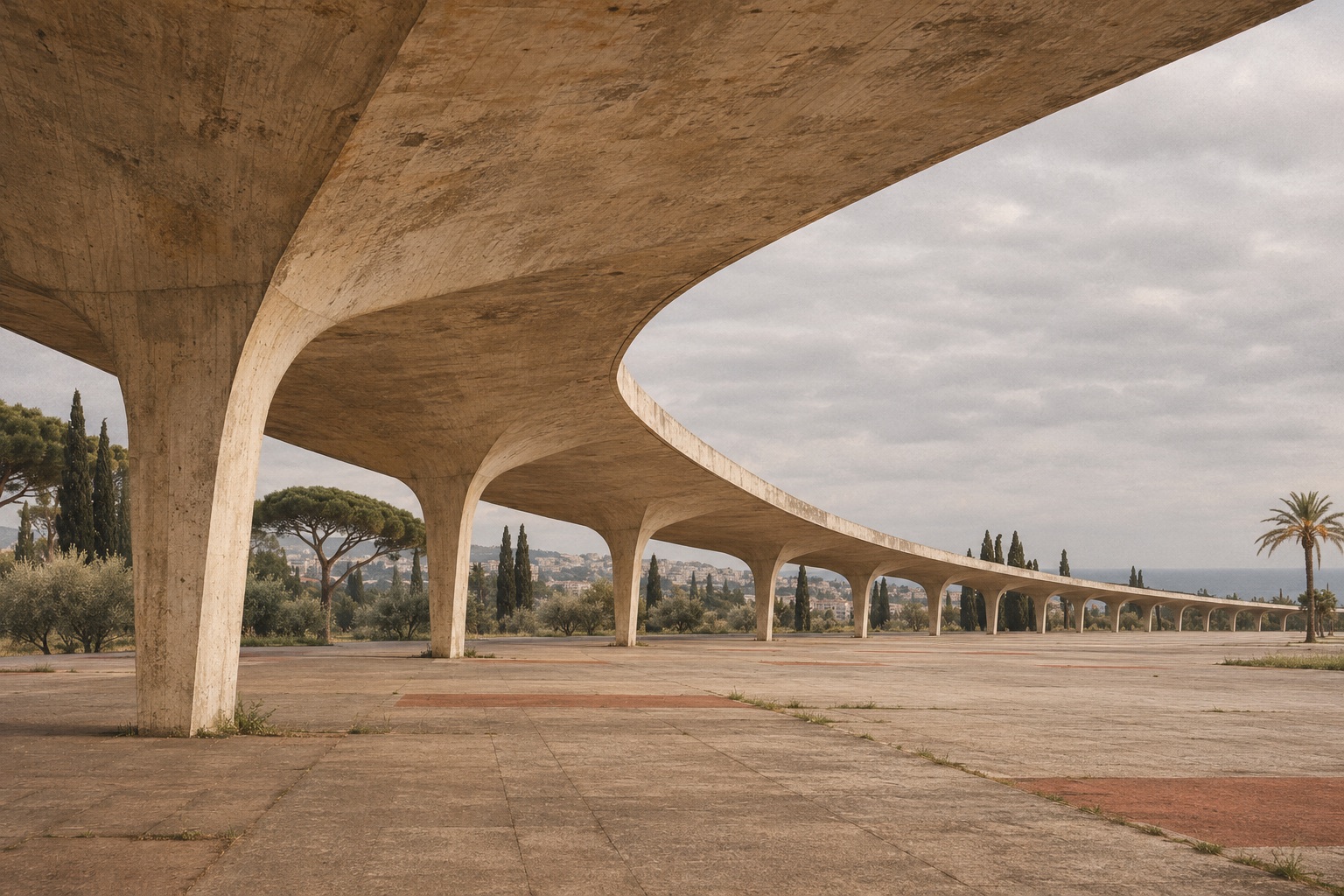
A continuous shelter for an international fair. Tripoli canopy evocation; layout, geometry and visible material condition are approximate, not a current survey.
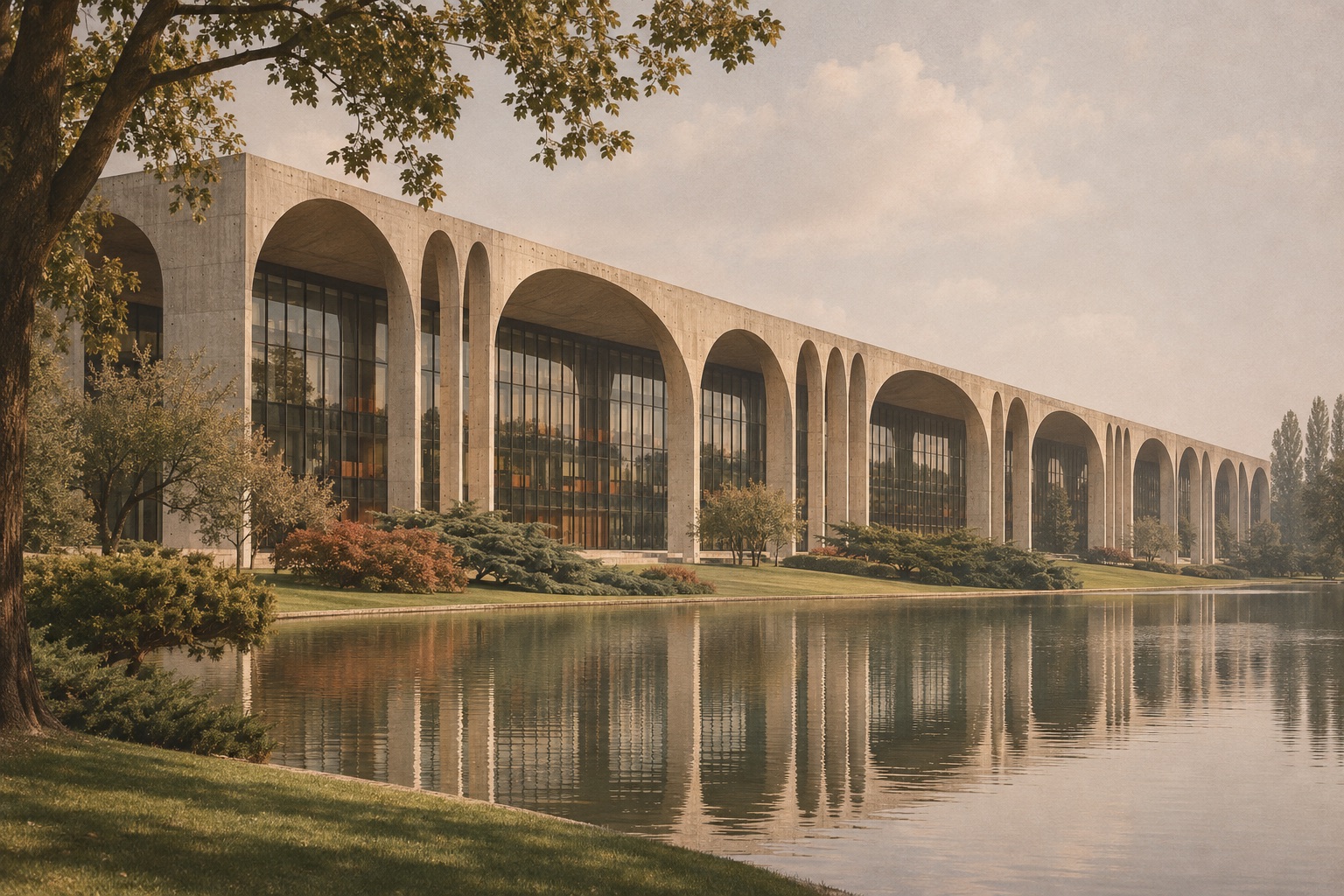
A related architectural vocabulary in another landscape. Mondadori headquarters evocation; proportions, planting and light are interpretive.
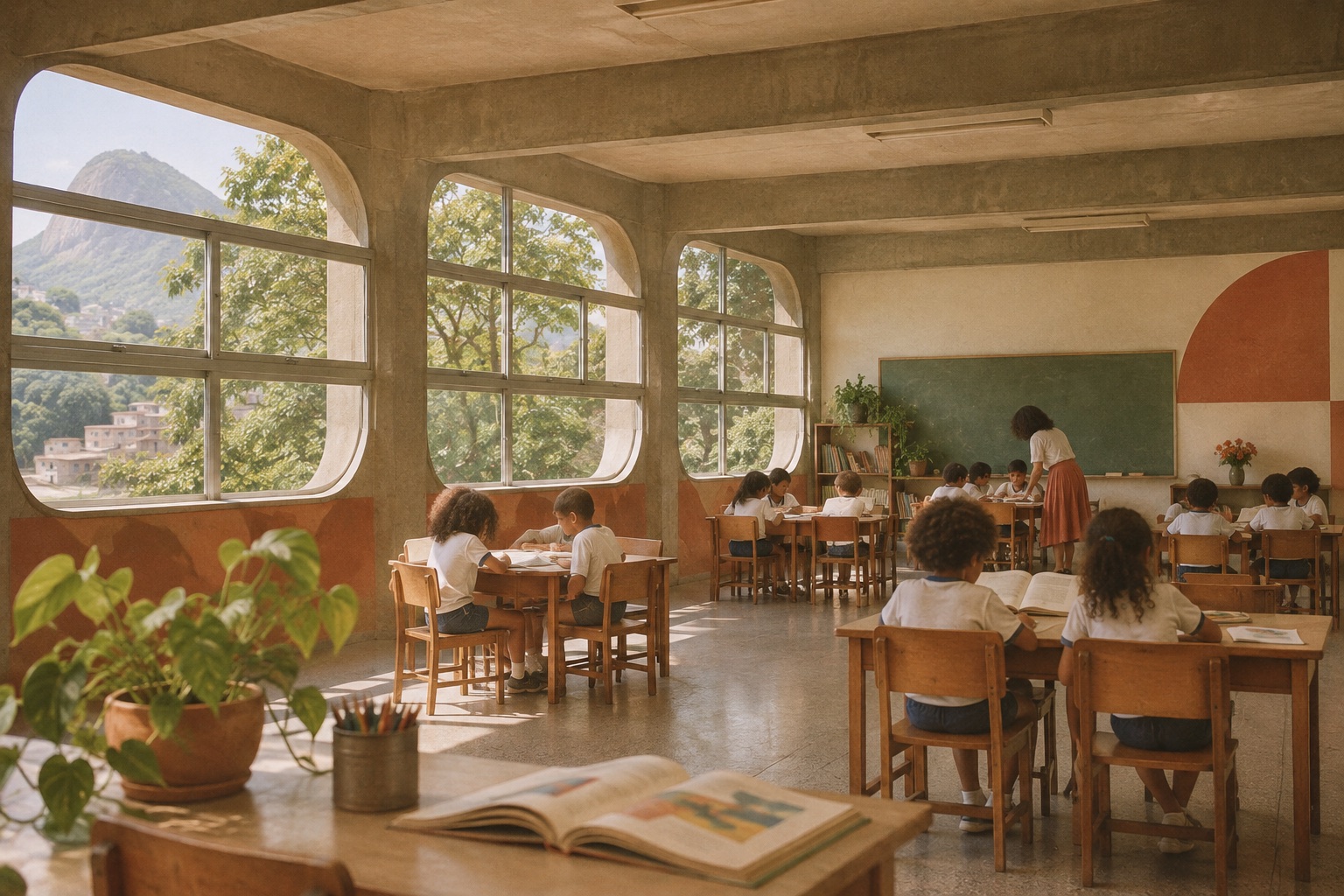
Architecture for a whole school day. Imagined CIEP-era classroom; not a documented school, lesson, precise plan or identifiable class.
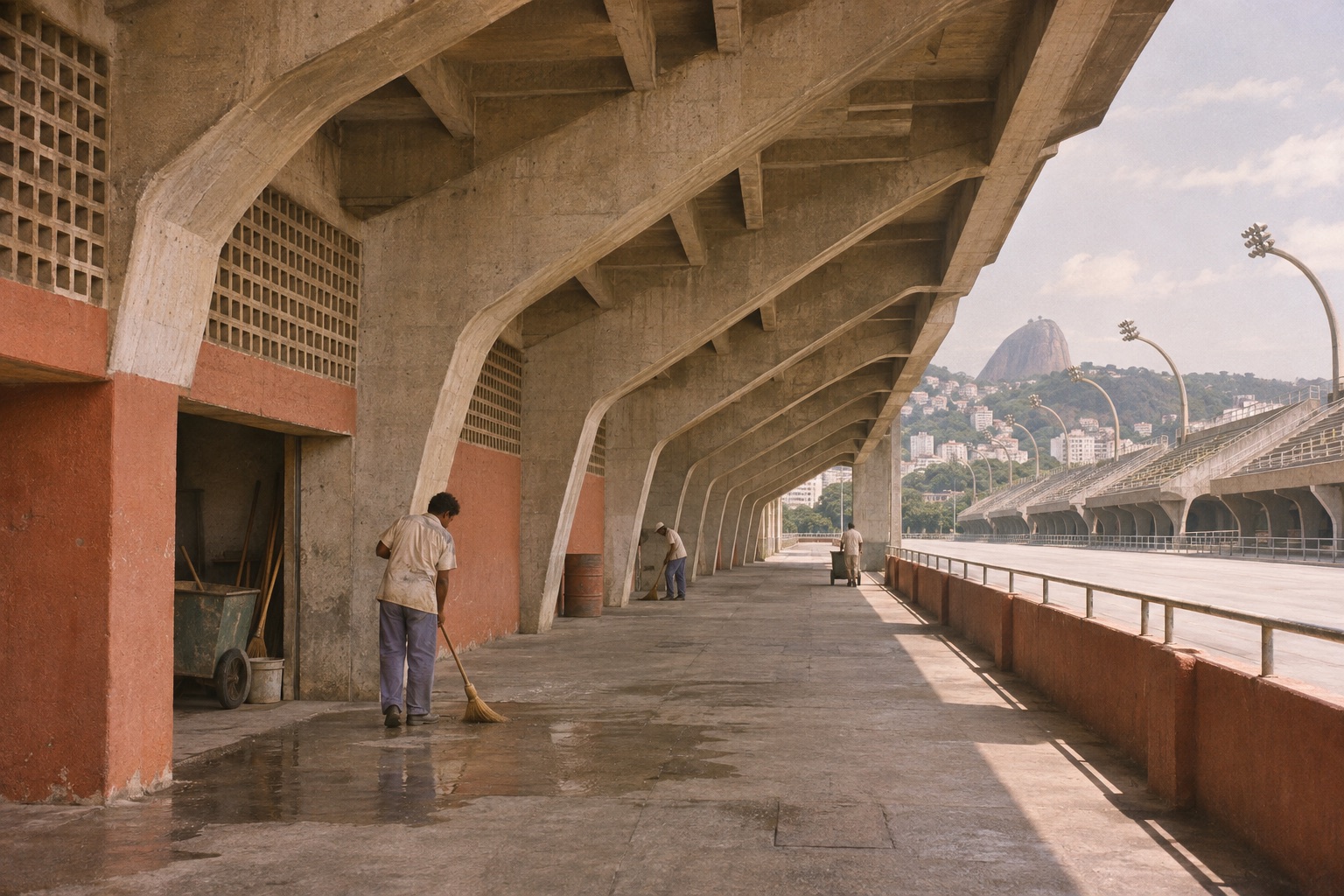
An ordinary day beneath the grandstands. Interpretive Sambódromo passage; exact spatial arrangement, workers and occasion are imagined.
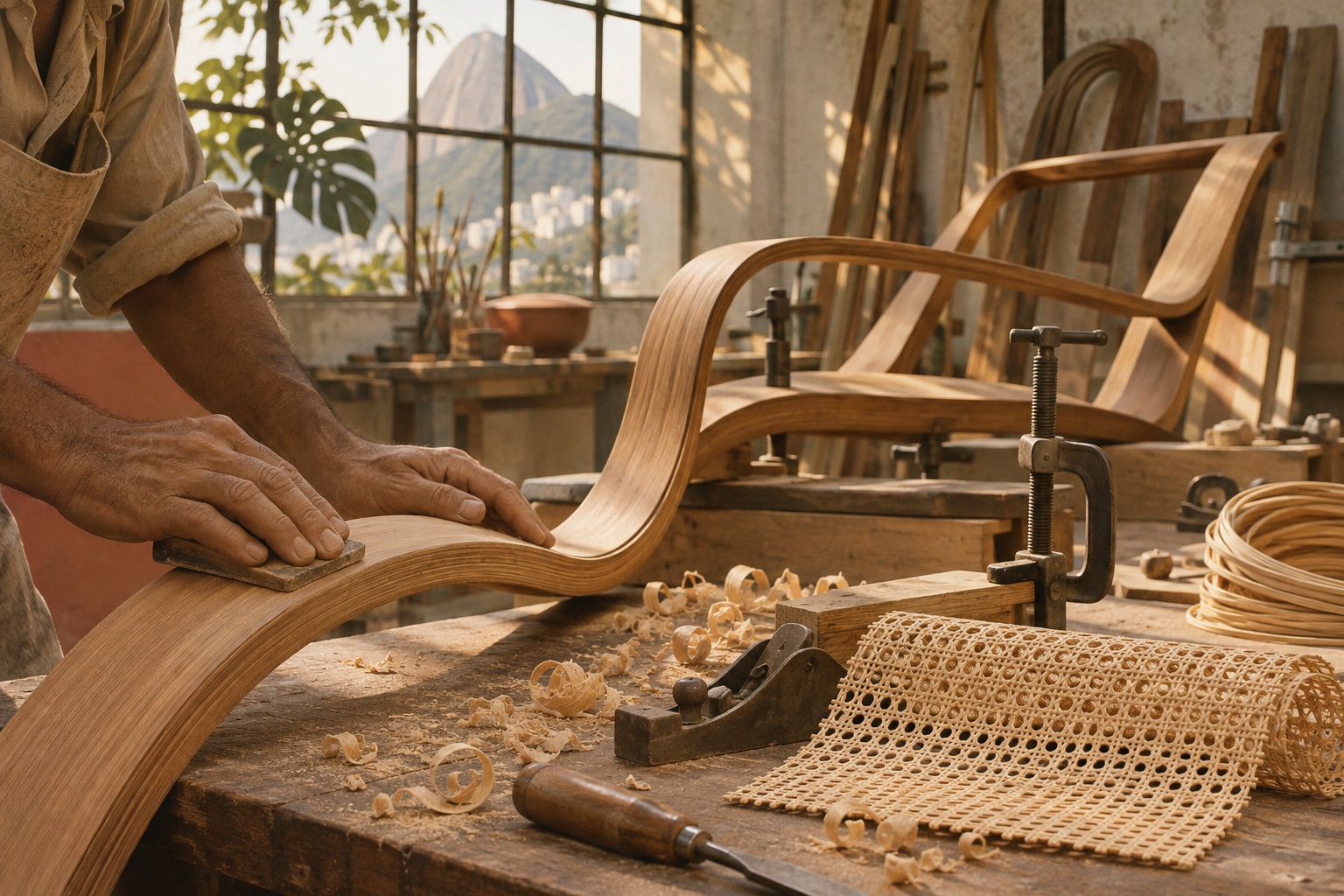
The curve at the scale of the hand. Interpretive furniture workshop; not a documented Oscar or Anna Maria Niemeyer object, workshop or craftsperson.
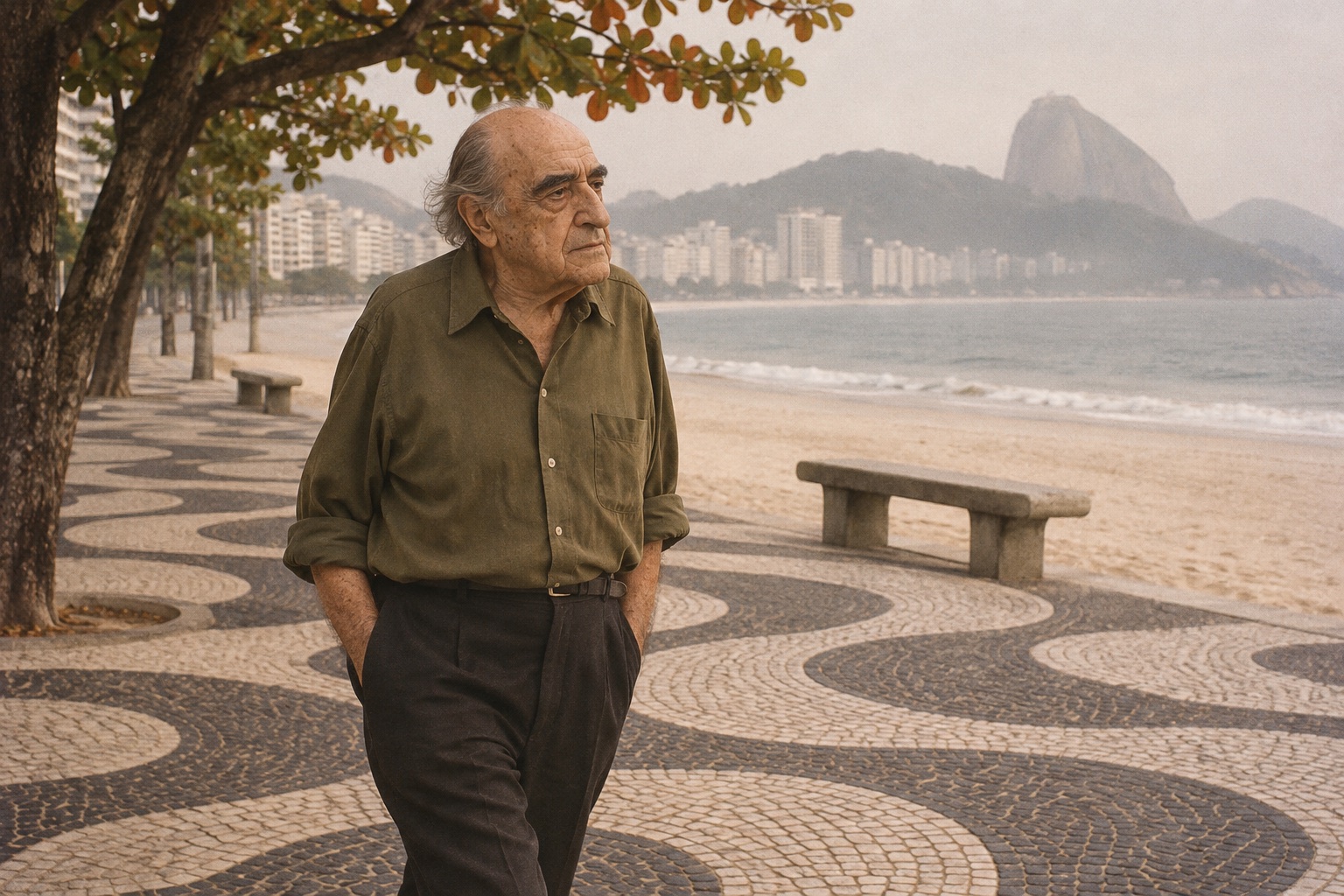
Rio remains in the picture. An imagined later-life portrait near Copacabana; no specific walk, date or daily habit is documented by this image.
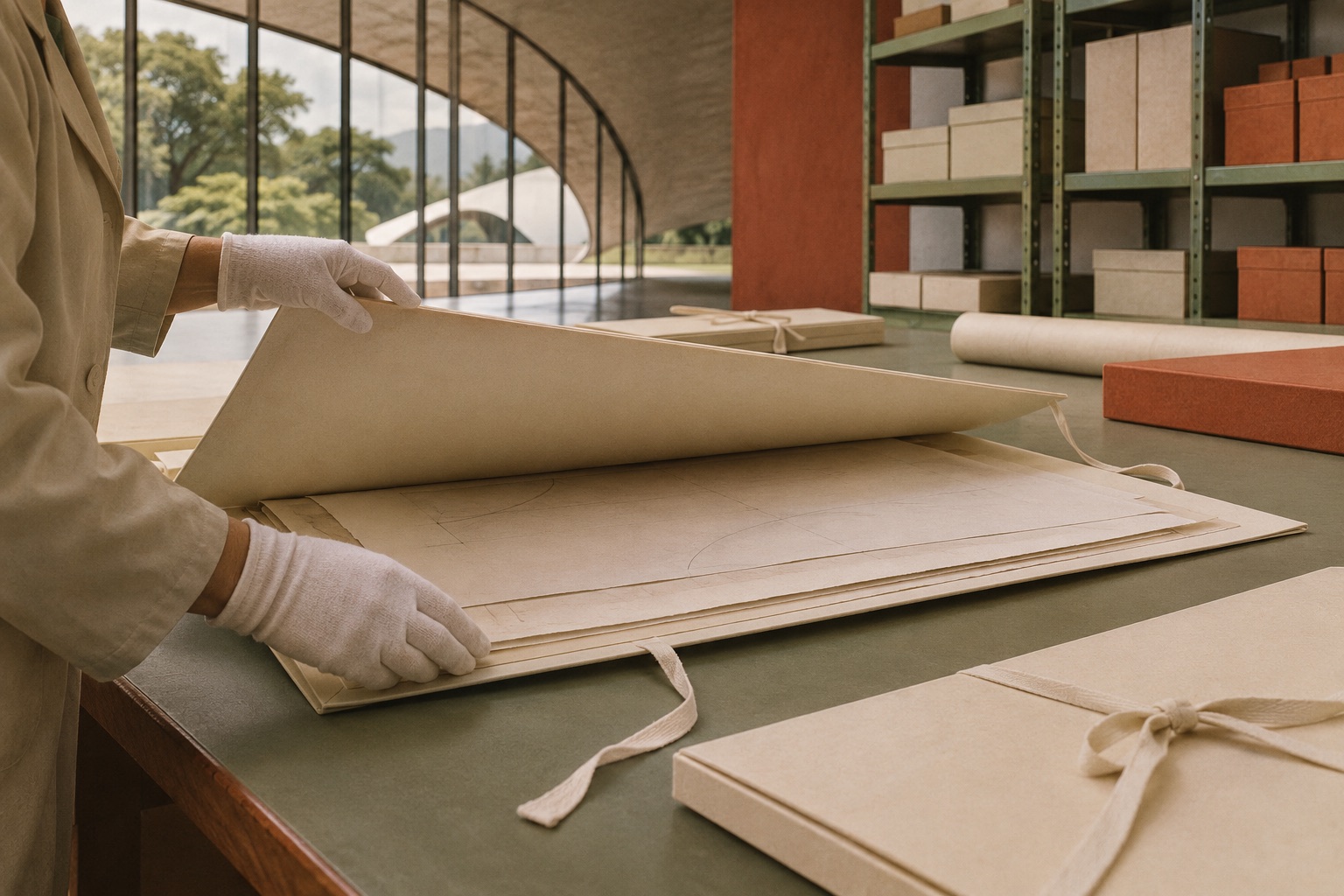
The work of preserving evidence. Imagined archive workspace; the portfolios and sheets are not actual Niemeyer documents or original drawings.
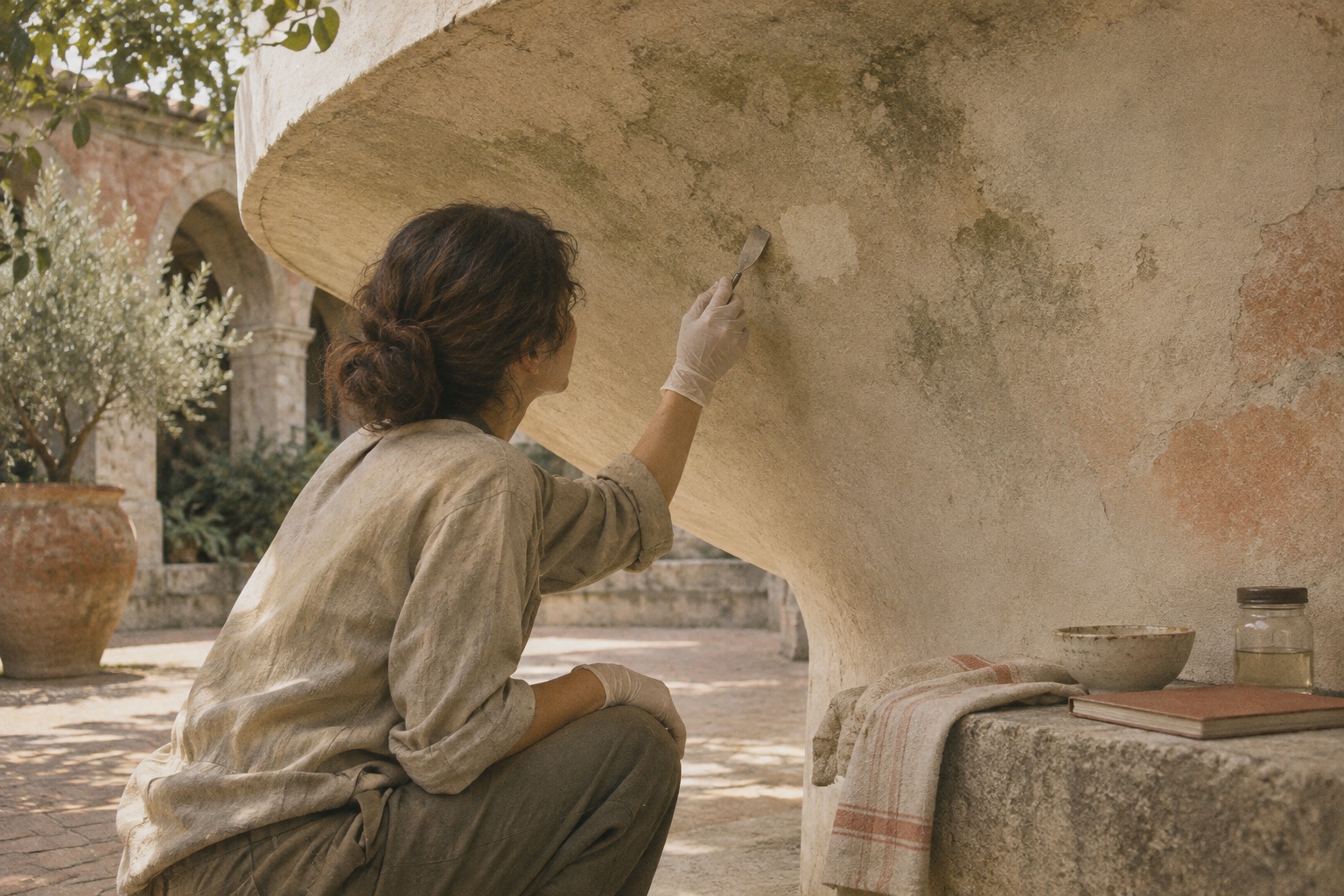
The material life after the opening. Imagined conservation work on a generic curved surface; not a named building, actual repair or technical instruction.
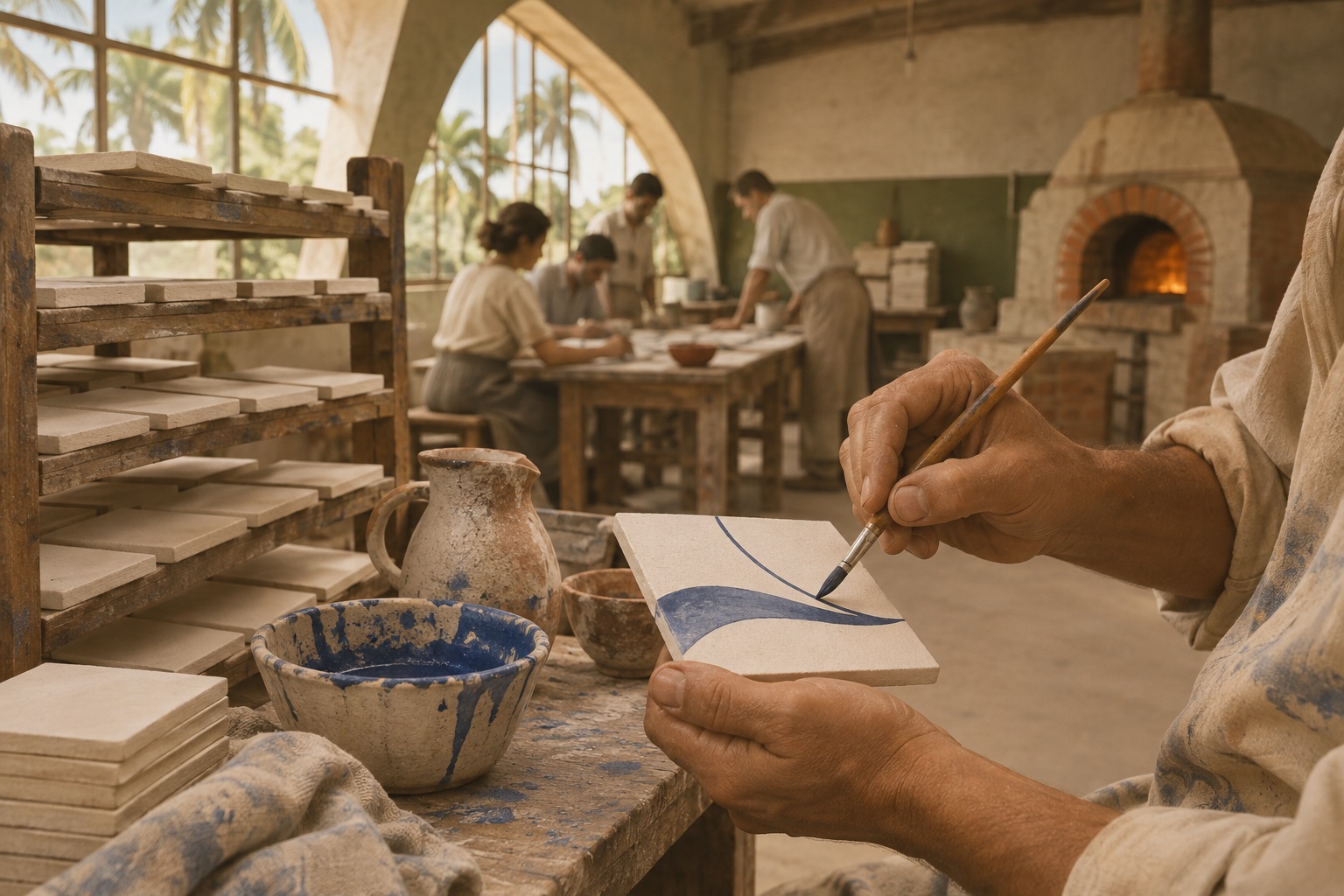
Between a design and a wall: ceramic craft. Imagined tile workshop; no Portinari artwork, Osirarte premises or actual craftsperson is reproduced.
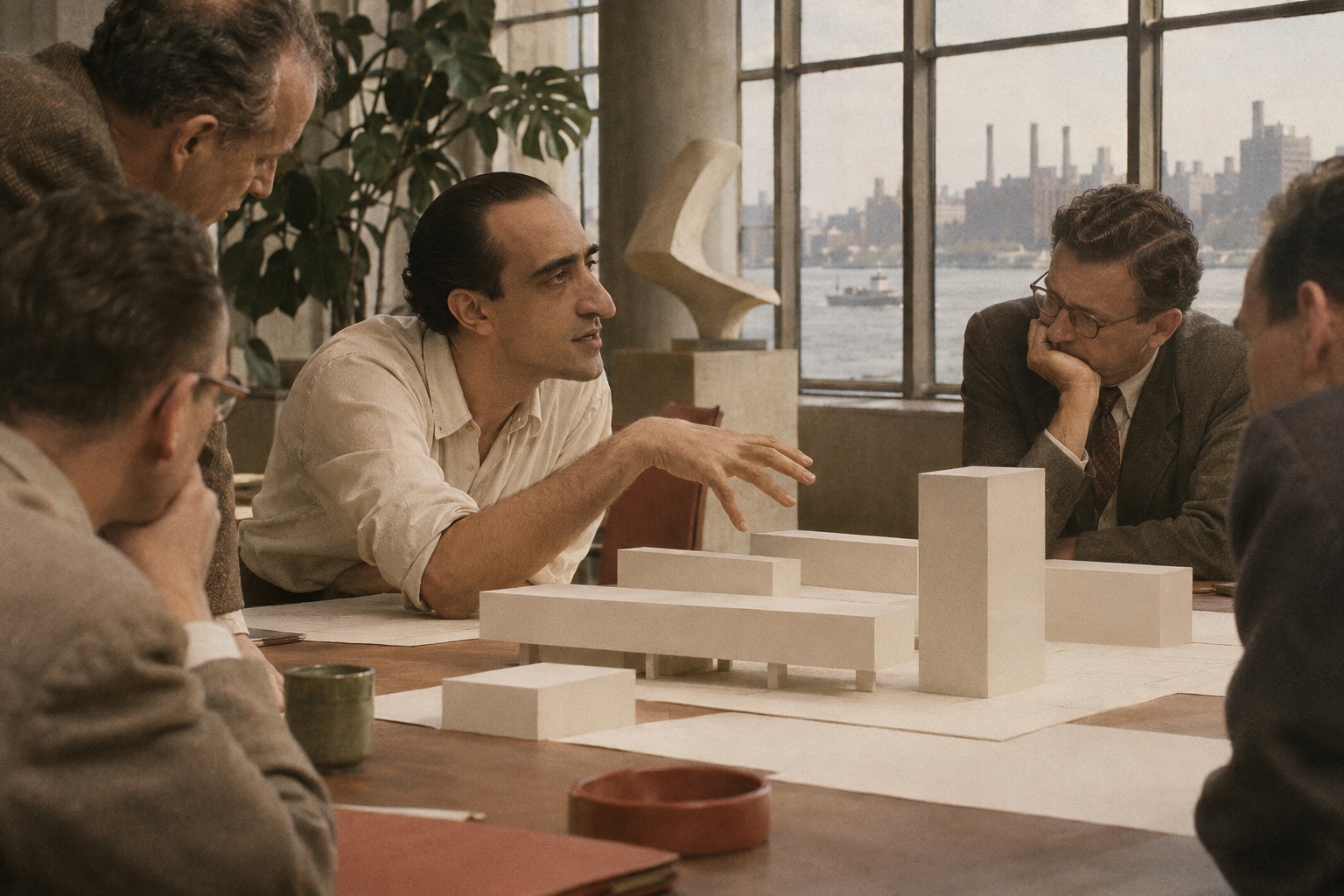
An institution designed through negotiation. Imagined 1947 design-board setting; no exact meeting, original plans or identifiable colleagues are claimed.
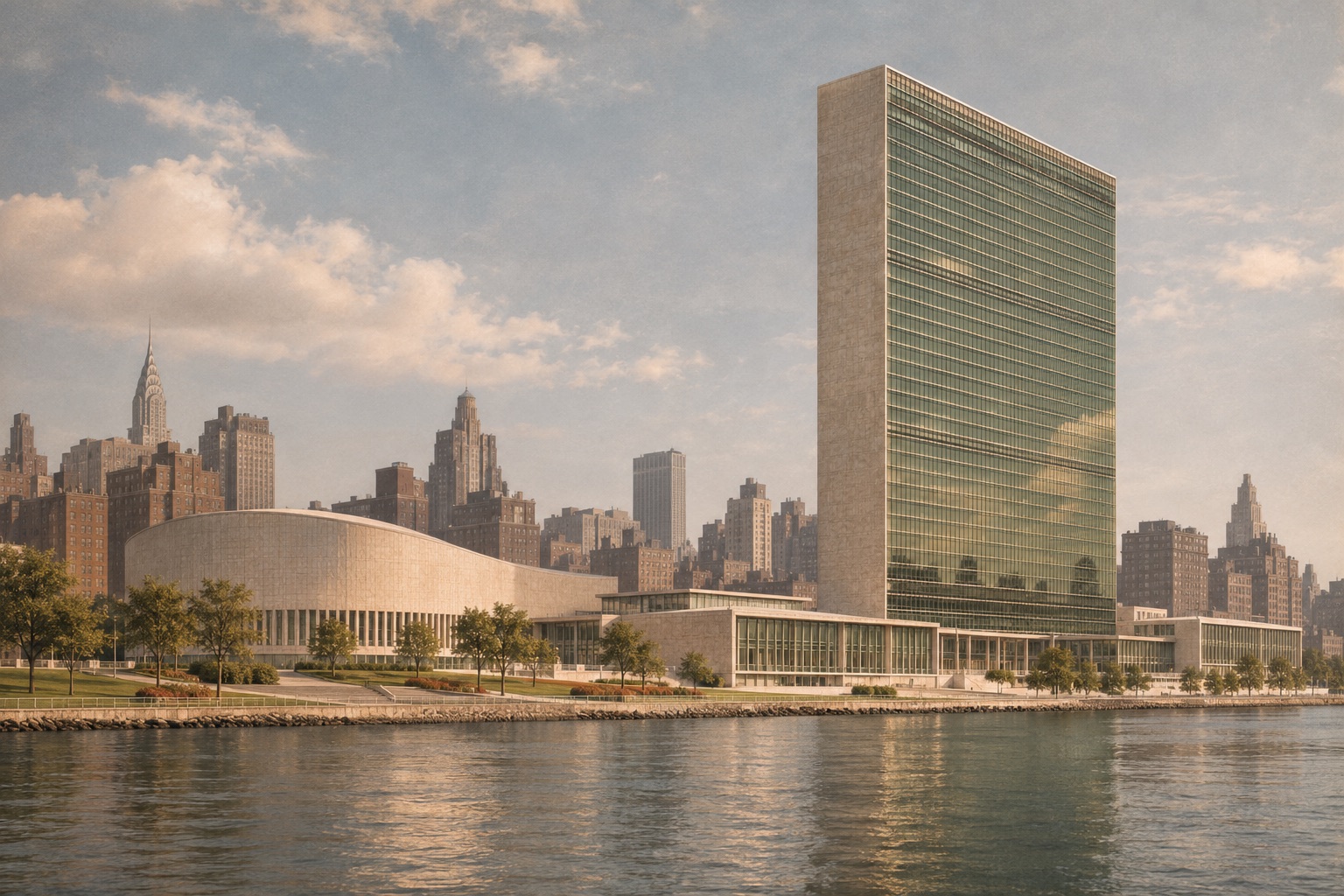
The headquarters as an ensemble, seen from the river. Architectural reconstruction with approximate siting and skyline; not a record of an exact year.
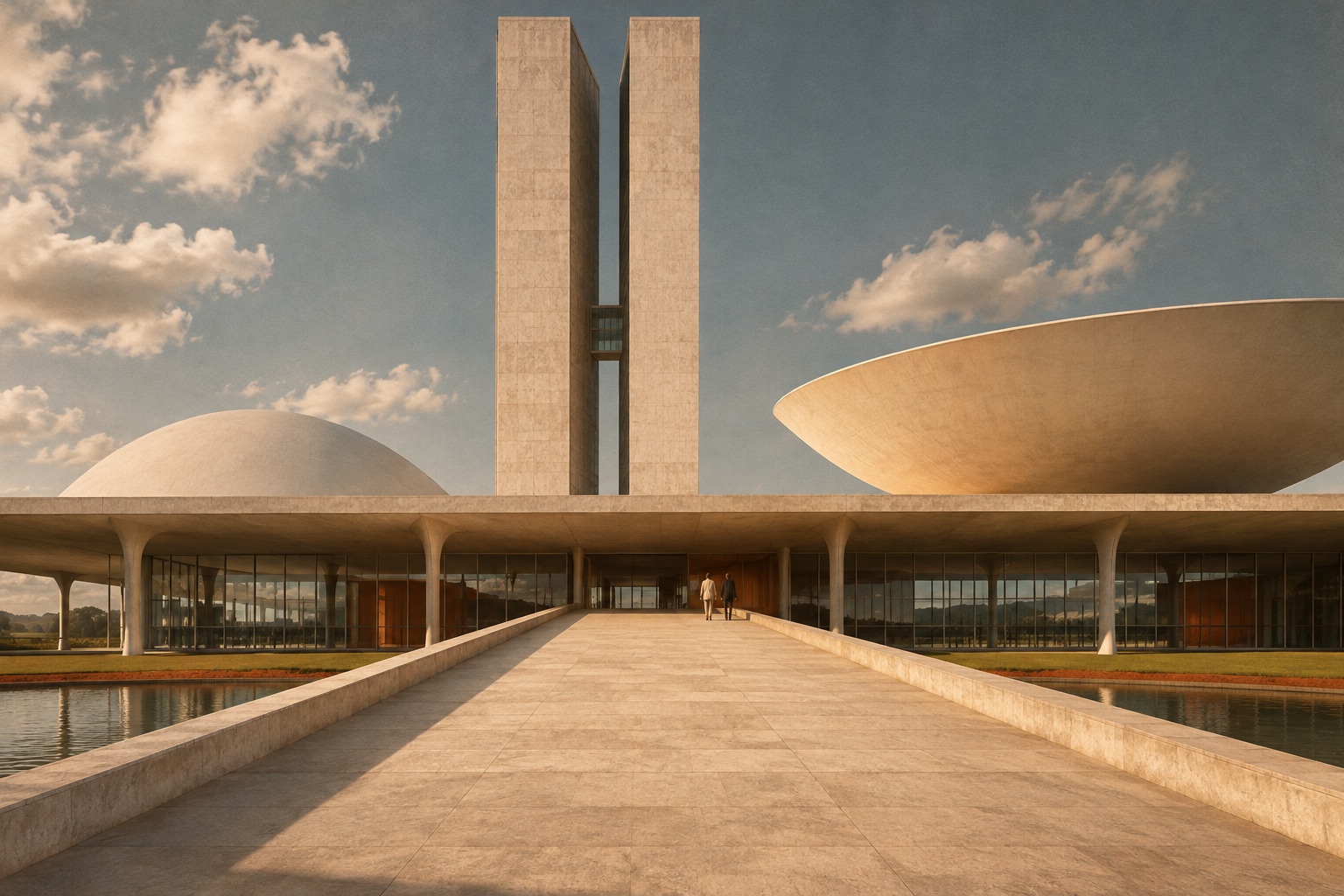
The monument changes as the body approaches. Ramp and podium evocation; geometry, scale and visitors are interpretive.
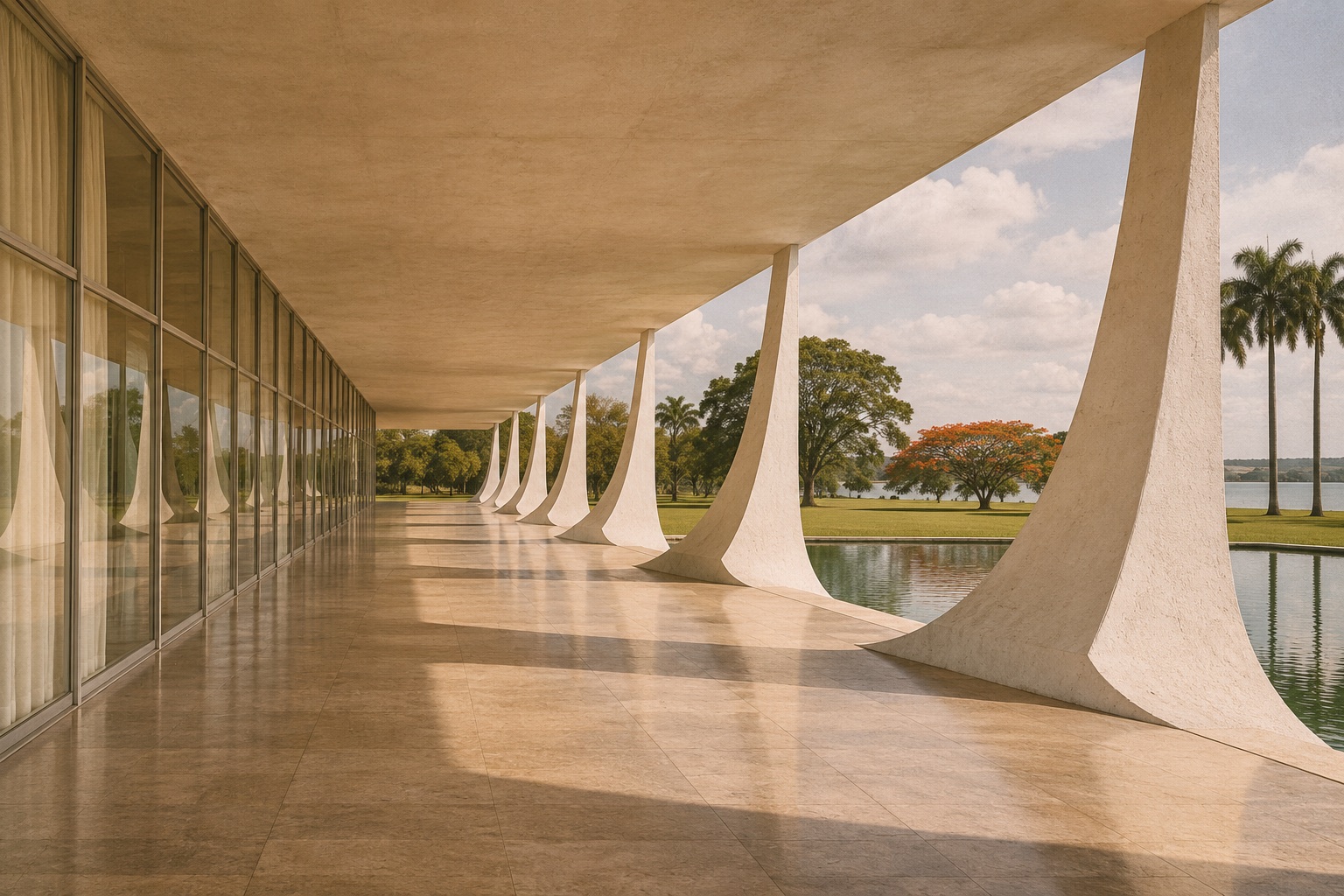
Behind the familiar outline: a sequence of shaded openings. Alvorada veranda study; dimensions, details and historical condition are approximate.
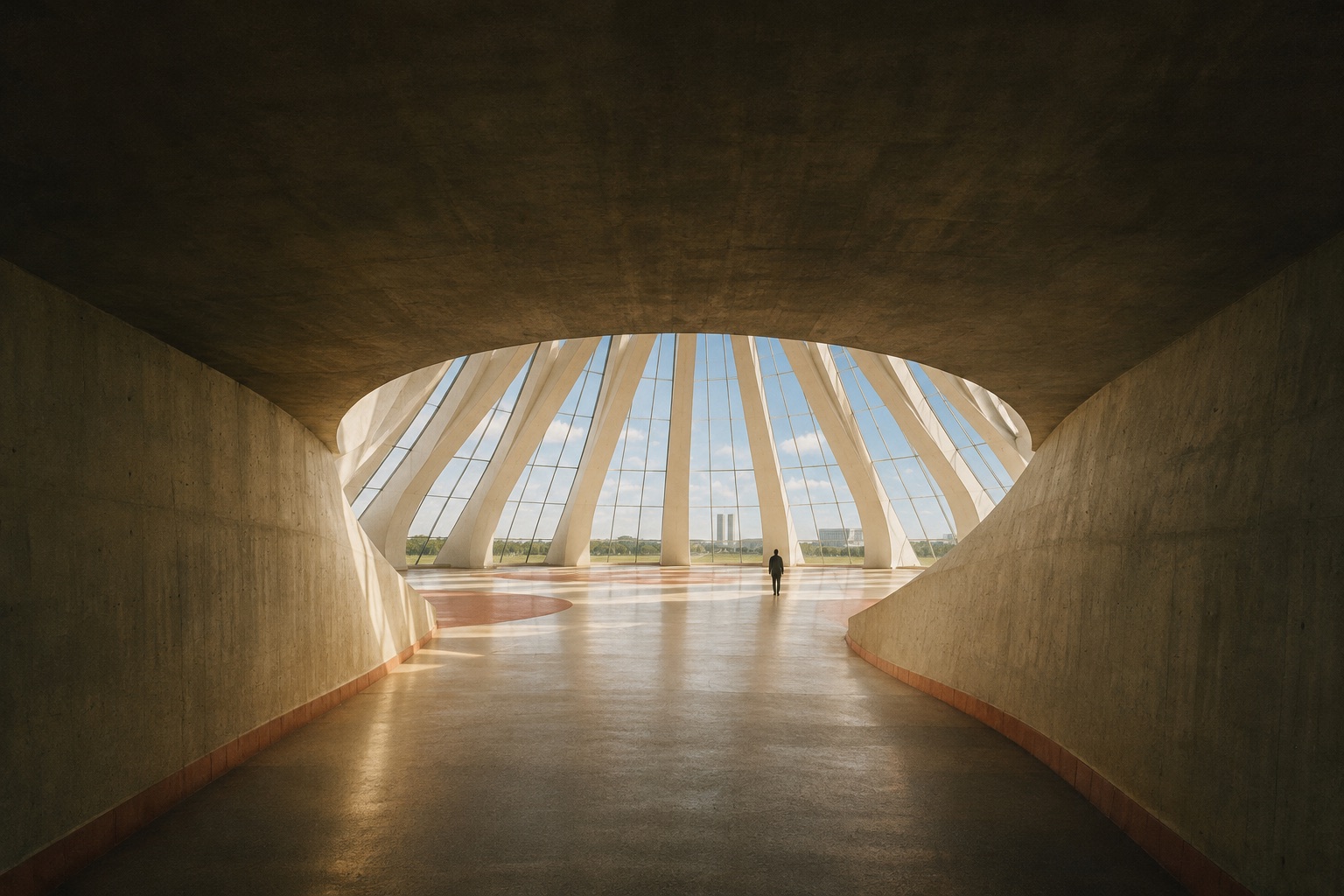
From a compressed threshold toward daylight. Cathedral entry evocation; exact ramp geometry and glazing are approximate, not a measured section.
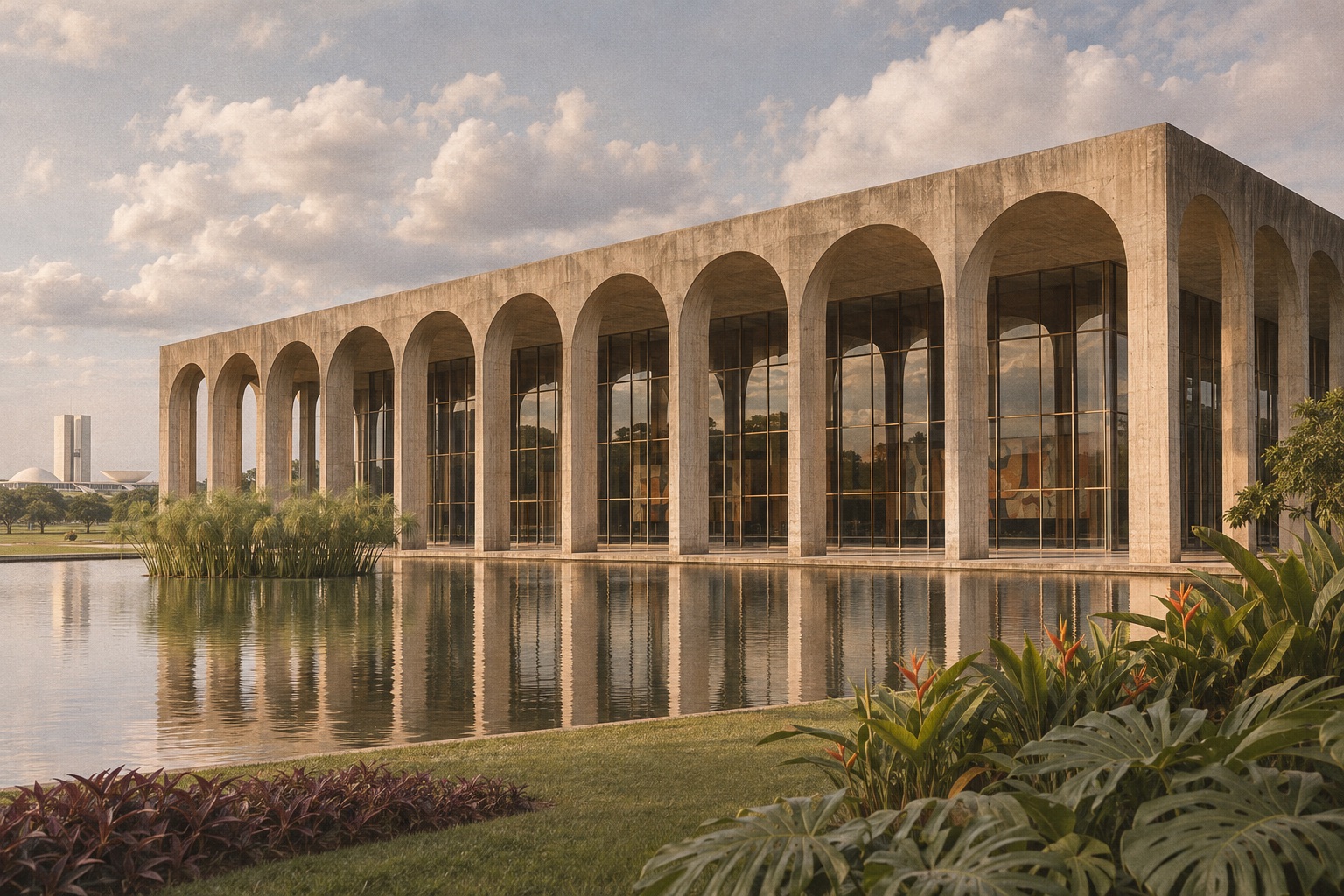
The arcade, its reflection and the space behind it. Itamaraty evocation; planting, geometry and material condition are interpretive.
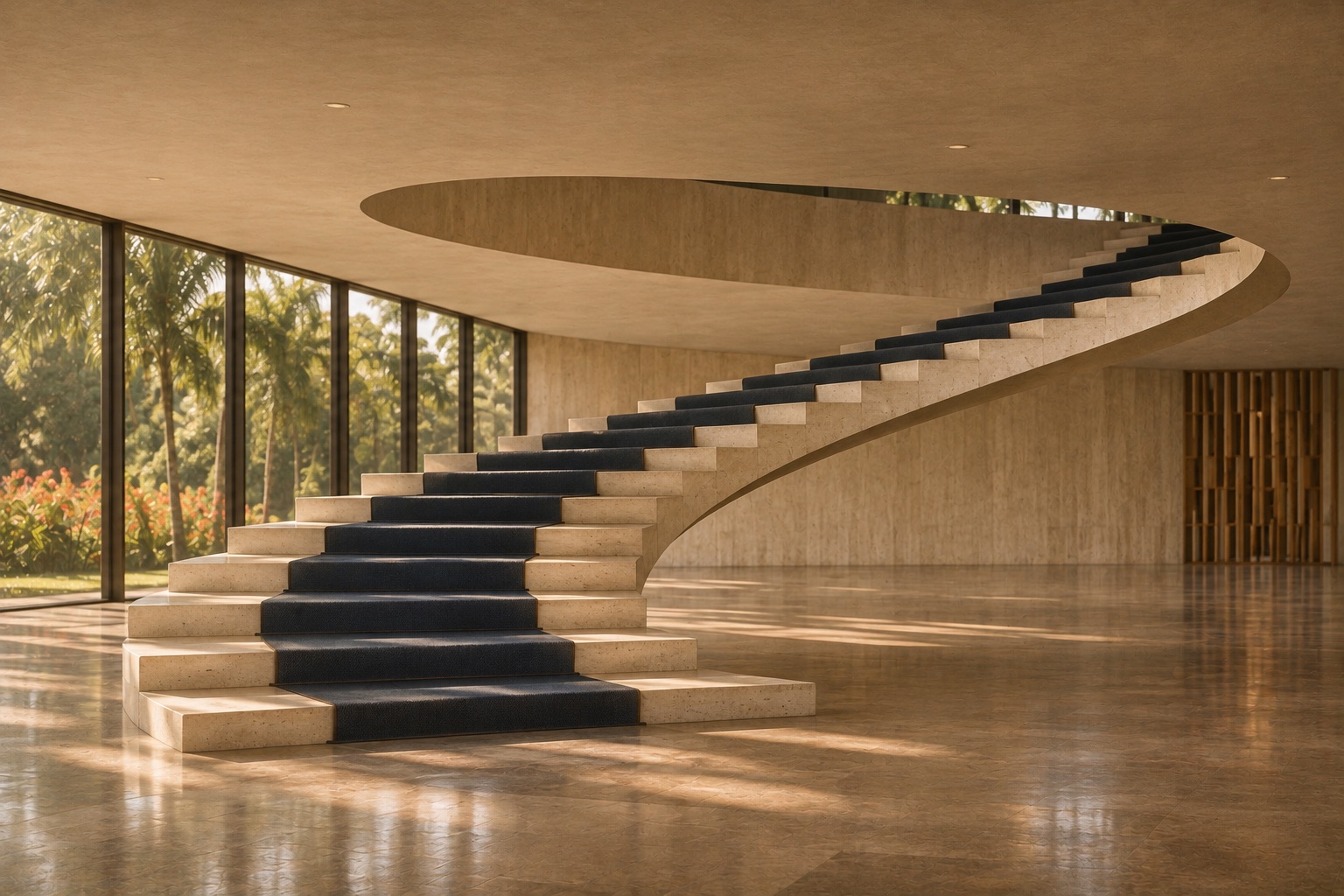
A stair with a collaborative authorship. Interior evocation based on institutional references; not a measured reproduction of the hall or stair.
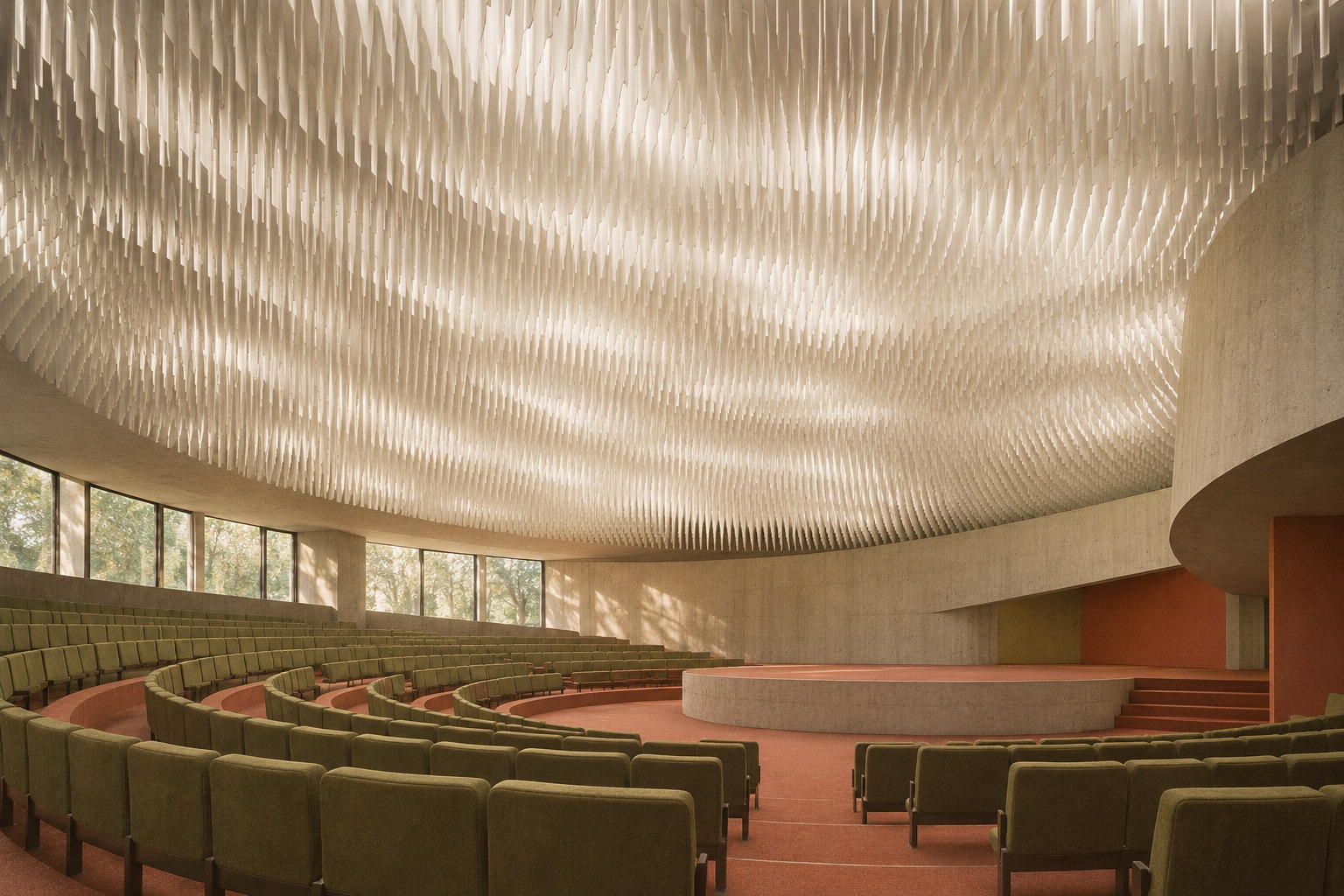
The smooth dome becomes a luminous field. Assembly-hall evocation; the aluminum-fin pattern and seating are approximate.
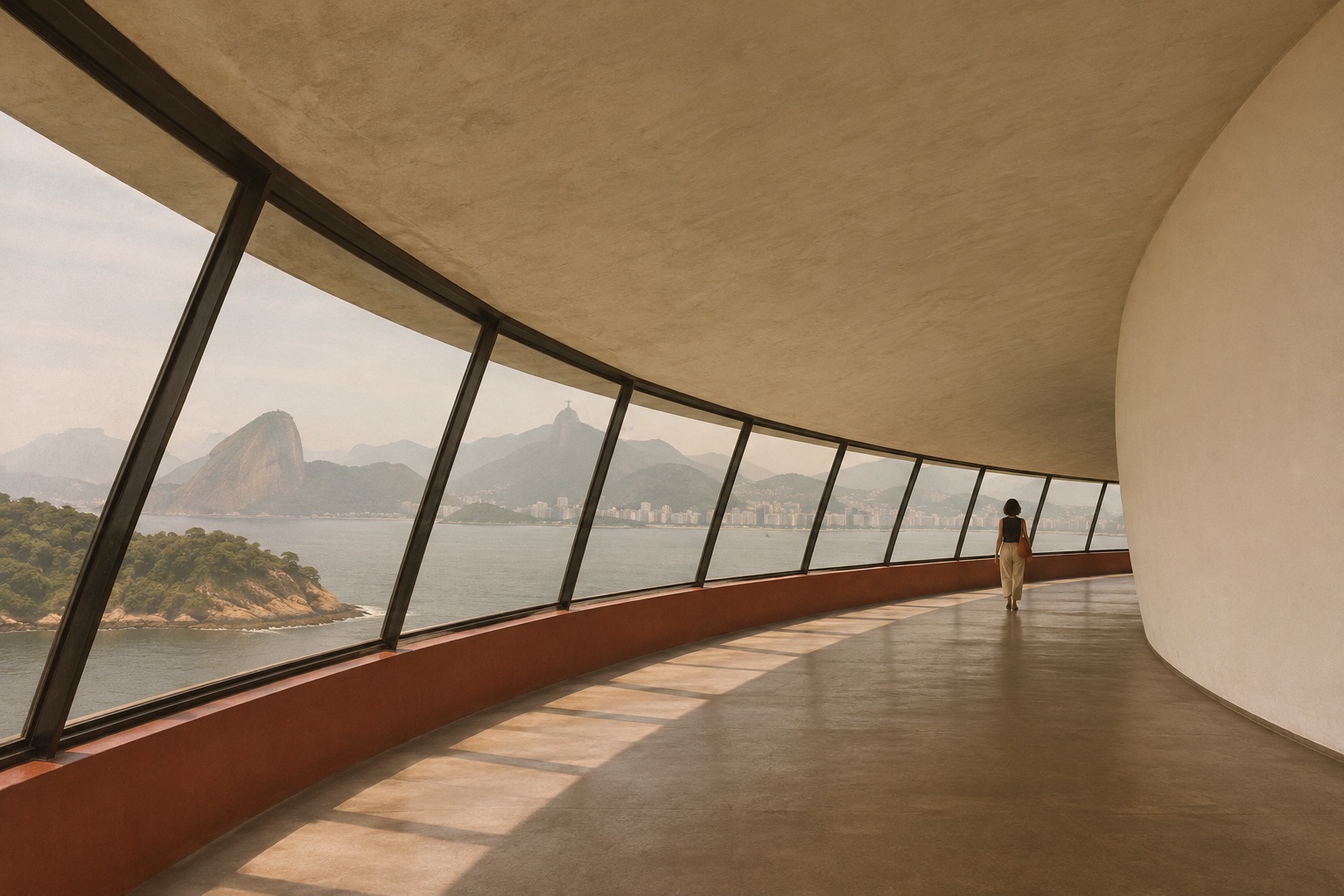
A moving frame for the bay. Panoramic-gallery evocation; glazing, structure and interior details are approximate, with no current exhibition represented.
Sources & further reading
Each passage names its supporting source. This index brings those references together; institutional interpretation and the architect’s recollections are distinguished from independent criticism.
- Fundação Oscar Niemeyer · 1907–1930 ↗
- Fundação Oscar Niemeyer · 1930–1940 ↗
- Fundação Oscar Niemeyer · 1940–1950 ↗
- Fundação Oscar Niemeyer · 1950–1955 ↗
- Fundação Oscar Niemeyer · 1955–1960 ↗
- Fundação Oscar Niemeyer · 1960–1965 ↗
- Fundação Oscar Niemeyer · 1965–1975 ↗
- Fundação Oscar Niemeyer · 1975–1985 ↗
- Fundação Oscar Niemeyer · 1985–1990 ↗
- Fundação Oscar Niemeyer · 1990–1995 ↗
- Fundação Oscar Niemeyer · 1995–2000 ↗
- Fundação Oscar Niemeyer · 2000–2005 ↗
- Rio de Janeiro City Council · Biographical memorial, 2012 ↗
- UNESCO · Architectural archive nomination ↗
- UNESCO · Pampulha Modern Ensemble ↗
- UNESCO · Brasília: significance and conservation ↗
- United Nations · A Workshop for Peace ↗
- Pritzker Architecture Prize · Niemeyer biography and own account ↗
- Ada Louise Huxtable · On Awarding the Prize, 1988 ↗
- Espace Niemeyer · History of the headquarters ↗
- Espace Niemeyer · Institutional press dossier, 2021 ↗
- Cathedral of Brasília · Inauguration and artworks ↗
- Ministry of Foreign Affairs · Palácio Itamaraty ↗
- Karen Akemi Matsuda · Itamaraty project research, University of São Paulo ↗
- Instituto Moreira Salles · Itamaraty catalogue record ↗
- Fundação Oscar Niemeyer · Alvorada: project and architect’s text ↗
- São Paulo Legislative Assembly · Brasília 50 years ↗
- Brazilian Senate · Candangos na construção da capital, 2020 ↗
- Tempos Históricos · Candangos: uma história de trabalho e exclusão ↗
- University of Brasília · Vida Candanga, 2018 ↗
- UNESCO · Oscar Niemeyer Fond, 1938–2005 ↗
- UNESCO · Tribute, 6 December 2012 ↗
- IPHAN · Carlos Eduardo Comas: heritage assessment ↗
- Wallpaper* · Niemeyer interview conducted in 2010; republished 2025 ↗
- Niterói Municipality · Museums and collections ↗
- Oscar Niemeyer interviewed by Silvio Cioffi · Folha, 13 February 1994 ↗
- Ministry of Culture · Palácio Gustavo Capanema ↗
- Museu da República · Gustavo Capanema and the modern ministry ↗
- IPHAN · Architecture and heritage: Capanema, p.70 ↗
- Projeto Portinari · Works for Palácio Gustavo Capanema ↗
- Belo Horizonte · Catalogue of Pampulha historical sources ↗
- Belo Horizonte · Church, artworks and restoration ↗
- Fundação Oscar Niemeyer · Casa das Canoas ↗
- Fundação Oscar Niemeyer · Canoas project and architect’s retrospective accounts ↗
- ICAA / Museum of Fine Arts, Houston · Catalogue summary of Depoimento, 1958 ↗
- EBC / IBGE · The 1959 census and the candangos ↗
- Brazilian Senate · Brasília and the contribution of women, 2022 ↗
- Oscar Niemeyer · Brasília account, FGV CPDOC collection ↗
- Fundação Oscar Niemeyer · University of Constantine, 1969 ↗
- Arab Center for Architecture · University of Constantine ↗
- Mondadori · Headquarters, architecture, landscape and adaptation ↗
- Mondadori · Institutional history, 1975 ↗
- UNESCO · Rachid Karami International Fair, Tripoli ↗
- UNESCO · Tripoli nomination dossier ↗
- Fundação Oscar Niemeyer · CIEP educational program and buildings ↗
- Fundação Oscar Niemeyer · Passarela do Samba: the architect’s program ↗
- Rio Education Department · Avenida dos Desfiles school complex ↗
- Rio Municipality · Niemeyer at the Sambódromo reopening, 2012 ↗
- Senate Museum · Oscar and Anna Maria Niemeyer: collaborators ↗
- University of Brasília · Raquel Silveira Chaves, furniture research ↗
- Chamber of Deputies · Parliamentary record, 7 December 2012 ↗
- Brazilian Senate · Niemeyer, Prestes and Fidel Castro ↗
- Museu Oscar Niemeyer · Institutional history ↗
- Serpentine · Oscar Niemeyer Pavilion, 2003 ↗
- Centro Niemeyer · History of the cultural centre ↗
- Brazilian Senate · Final tributes to Niemeyer in Brasília, 2012 ↗
- Ministry of Foreign Affairs · The Itamaraty Palace ↗
- University of Brasília · Accessibility, authenticity and heritage ↗