Brasília, Brazil · 1957 · project / 30 June 1958 · inauguration
Palácio da Alvorada
The presidential residence turns a repeated column into an unforgettable public image.
1958: a presidential address before the capital opened
The Palácio da Alvorada was inaugurated on 30 June 1958, almost two years before the capital’s opening. The Fundação’s project catalogue places the design under 1957. Project and inauguration dates mark distinct events in a compressed building campaign.12
As a presidential residence, the palace joined private occupation to the representation of the state. It could be a house in daily use and a public emblem without giving the public the same freedom of movement as its inhabitants. That double role is part of its architecture, not an incidental contradiction added by later criticism.
What Niemeyer said he was seeking
In the Fundação’s published project text, Niemeyer explains his preference for a compact, simple composition whose beauty would come through proportions and structure. This is the architect’s own account of his intention. It is more specific than a retrospective claim that everything in his work began with a love of curves.1
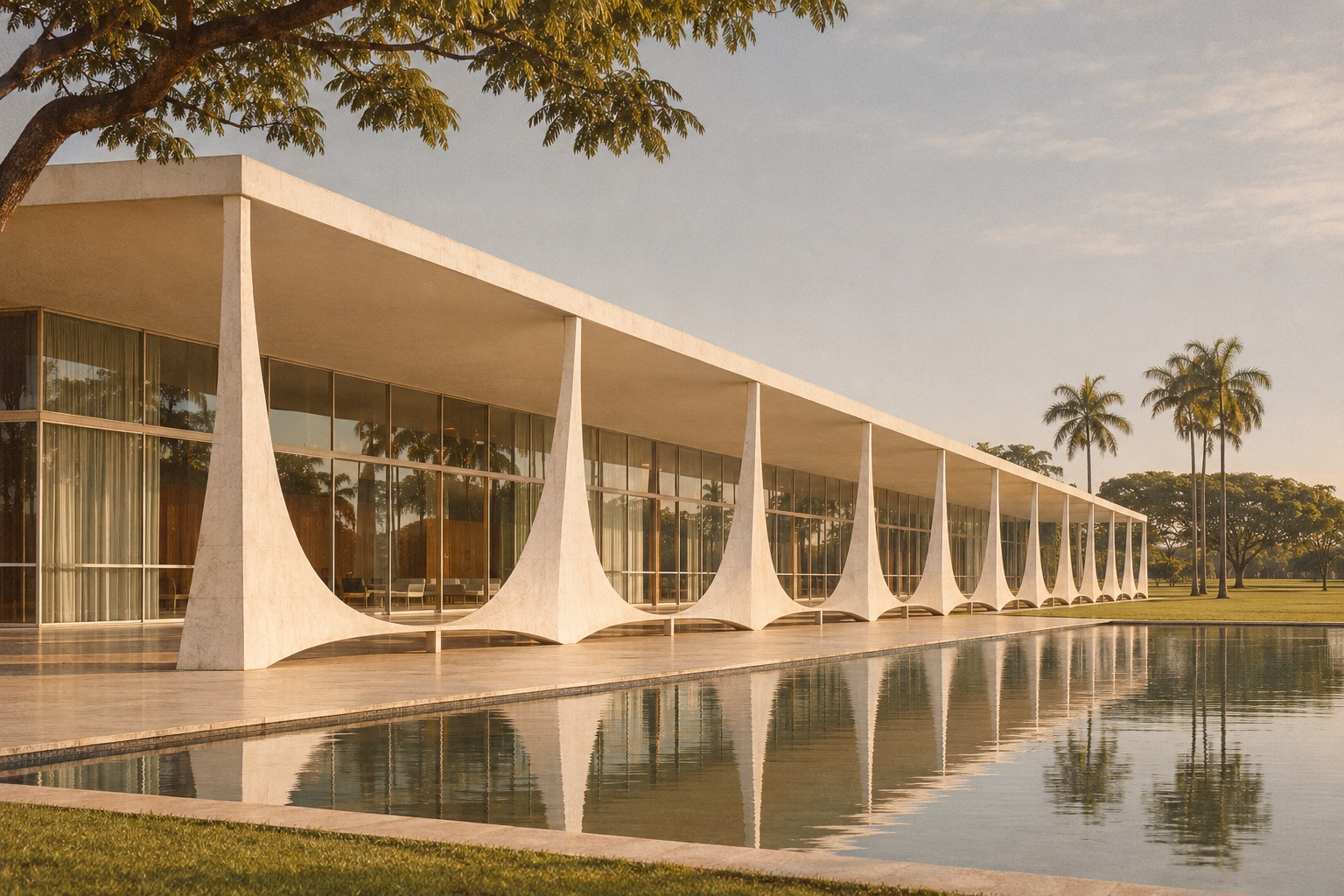
Simplicity here is not the absence of invention. A repeated support can organize a facade so decisively that the rest of the building reads through it. The carefully worked structural image carries the visual identity; the composition does not need a collection of competing forms to establish a presence.
A column that is more than a line in elevation
The curved supports are most familiar as a facade motif. Viewed in depth, they belong to a broader relationship among roof, veranda, glazed enclosure and ground. The eye moves through intervals as well as following the outline of the column itself.1
The impression of touching the earth lightly does not mean the loads are small or that the support is structurally effortless. It is an architectural effect. A broad mass and a narrowed contact can make weight appear more delicately resolved than a solid wall would. The actual load-bearing behavior requires engineering records, not inference from a generated image.
The occupied space behind the emblem
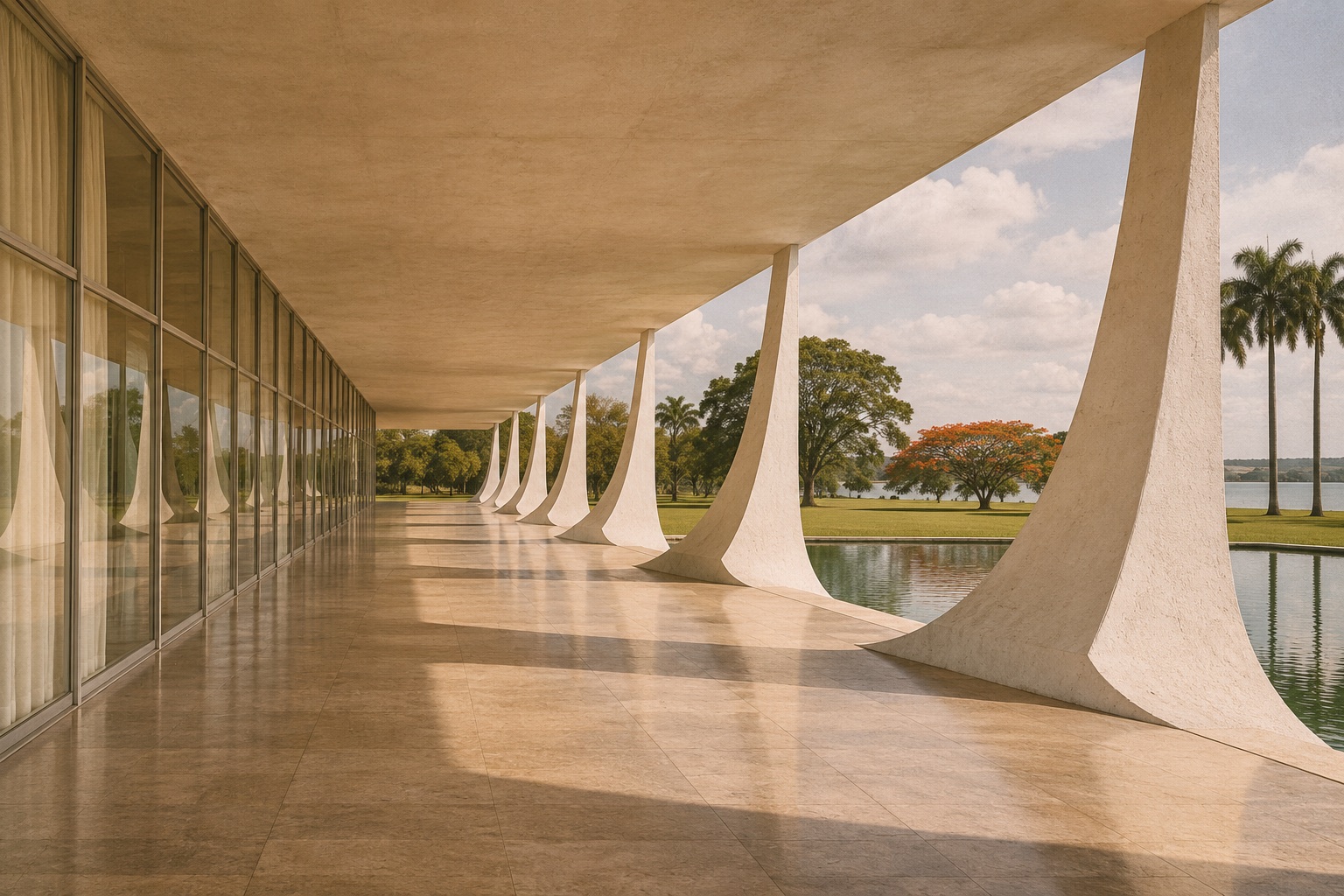
A view along the veranda changes the emphasis. The repeated supports become a succession of openings; the glass stands behind them rather than occupying the same plane. Reflection, shade and the landscape can enter the encounter in different ways. This is how a facade becomes a space to move through.1
The reconstruction is an interpretive study of that depth. It does not establish the exact dimensions or furnish an original interior. Reading the palace through this intermediate zone helps recover an experience that the familiar flat silhouette tends to suppress.
The interior has other authors
Anna Maria Niemeyer’s work included interiors at Alvorada, according to the Senate Museum. Her contribution reminds us that an inhabited palace is not complete when its external form has been decided. Furniture and interior arrangement mediate the encounter between ceremonial space and everyday occupation.3
The scale of a chair differs from that of a presidential colonnade, but both affect a body. Attending to this smaller scale does not diminish the exterior’s power. It makes the palace more comprehensible as a place with rooms and uses, rather than only a sign reproduced in photographs.
The public life of a restricted residence
Alvorada’s recognizability helped give the new capital an architectural identity before the city’s full inauguration. Its role as a residence also means that many people know it through a distant view, a photograph or a reproduced outline rather than through direct occupation.2
That is a useful limit to keep in mind when speaking of architecture’s public generosity. A building can belong to the nation’s visual culture while remaining an institution with controlled access. The palace’s beauty does not remove that distinction. It makes the relationship between public representation and private use more visible.
Sources for this story +
Numbered links beside passages lead directly to the supporting source. Experiential readings are editorial interpretations; generated scenes are labeled artistic reconstructions.