Brasília, Brazil · 31 May 1970 · inauguration / later stained glass
Cathedral of Brasília
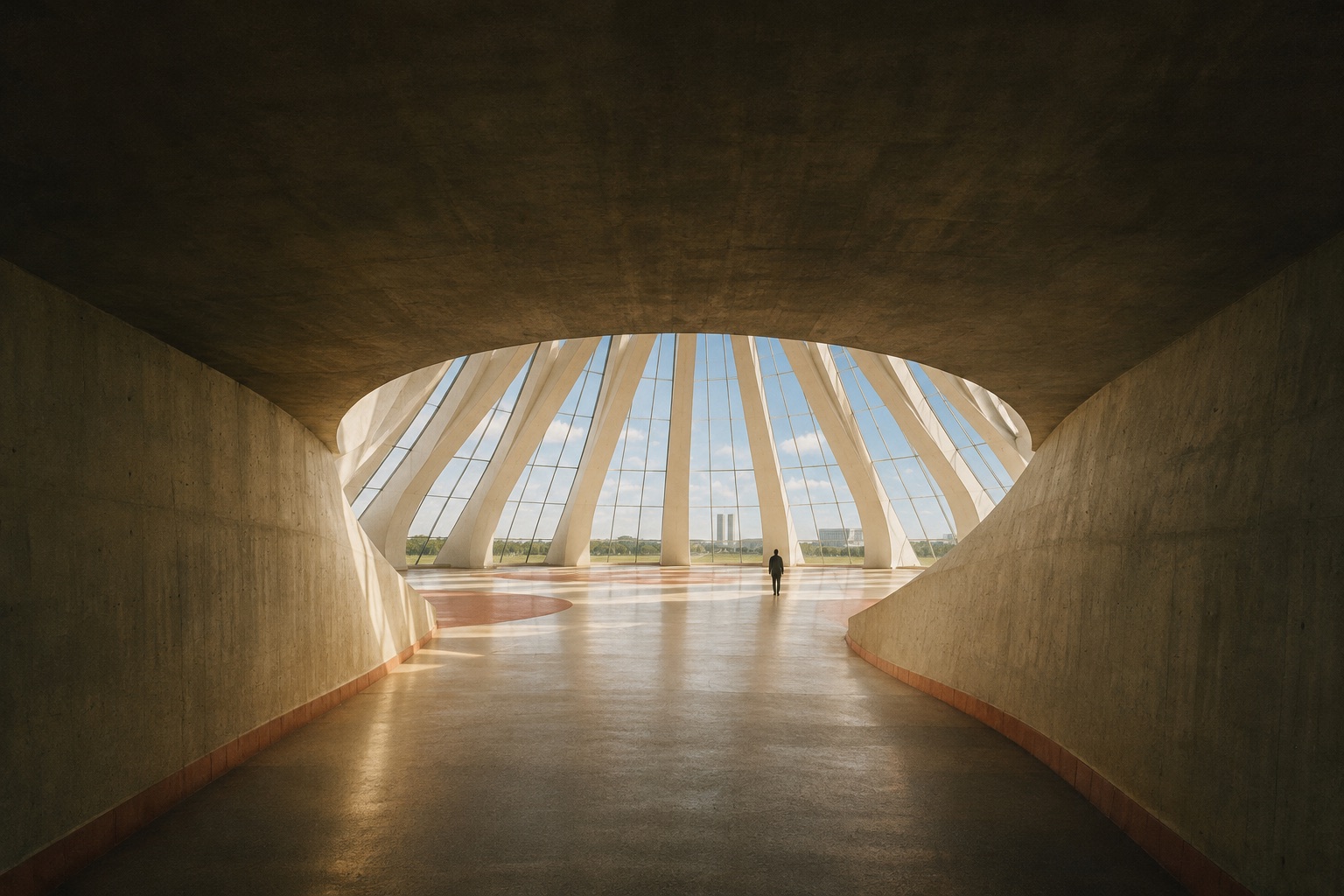
A descent below ground prepares the visitor for a luminous, outward-opening space.
The entrance begins with a descent
The cathedral’s approach is an architectural sequence rather than a single frontal view. A low descending entry prepares the transition into the luminous circular nave. The experience is often discussed through the contrast of shadow and light; that contrast can be examined spatially without claiming to know every visitor’s response.1
The threshold lowers and contains the field of vision before the space opens upward. The new image concentrates on this passage. It is an atmospheric reconstruction, not a measured description of every level or dimension. Its purpose is to draw attention to movement that an isolated exterior photograph cannot show.
Sixteen supports define a volume
Sixteen curving concrete supports establish the circular enclosure and its upward-opening form. The building’s structural image is unusually legible: ribs are not hidden behind a conventional wall or roof, but participate directly in how the interior is seen.21
Their repetition gives order to a space whose surfaces are strongly curved. Following one rib with the eye is different from seeing the whole canopy at once. Structure supplies both a repeated element and the larger geometry. The complete engineering behavior cannot be established from appearance alone, however clear the architectural idea may seem.
A capital in 1960, a cathedral in 1970
The cathedral was inaugurated on 31 May 1970. It should not be folded into a generalized image of everything completed when Brasília opened in 1960. The longer timeline is part of the building’s history and of the city’s continuing formation.1
A new capital’s buildings did not all arrive at the same state on the same day. Political ceremony, construction, artistic completion and everyday use can produce different calendars. Distinguishing them makes the city more real: a developing place with unfinished work, not only a fixed set of monuments.
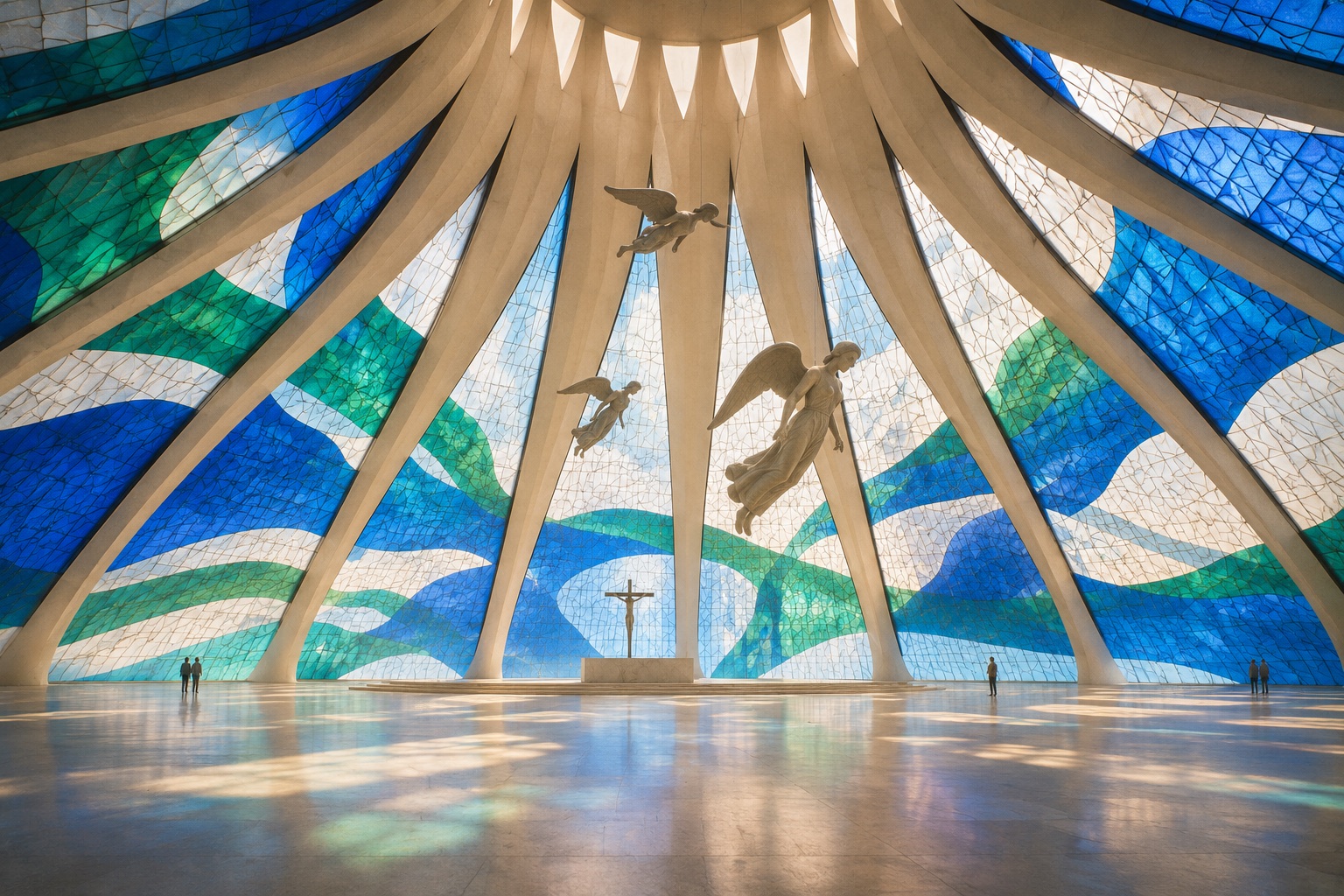
The colored light belongs to a later contribution
Marianne Peretti’s stained glass is central to the later interior. The cathedral’s institutional account dates its design to 1990, years after the inauguration. A reconstruction with its blue and green color fields must therefore not be presented as a photograph of the 1970 opening.1
Light is shared authorship here. The architect’s volume and ribs provide one set of conditions; Peretti’s glass changes the quality of light within them. The relationship is close enough that a visitor may assume the elements were conceived together. Historical attention restores the sequence and gives the artist her own place in the building’s biography.
A place completed through several forms of art
Ceschiatti’s sculptures, Athos Bulcão’s ceramic work and other contributions belong to the cathedral’s encounter with its public. The institution’s account identifies works and additions rather than treating art as an anonymous decoration around the architect’s form.1
Their different materials, locations and scales organize attention within and around the building. A person approaching, descending, looking upward and moving around the nave does not meet a single medium. The architectural synthesis is made through that succession. It is more accurate to understand the unity as an achievement among contributors than as proof of one author doing everything.
The building exceeds its author’s belief
Niemeyer’s atheism did not prevent him from designing places of worship. The cathedral’s religious life belongs to its community and institution, as well as to the history of its architecture. His personal position is part of the biography, not an explanation that can substitute for theirs.31
The building now carries multiple times: its design, its inauguration, later artworks, maintenance and ongoing use. Preserving it means dealing with those layers. The enduring image is powerful; the living place is more complex than an image of a completed moment.
Sources for this story +
Numbered links beside passages lead directly to the supporting source. Experiential readings are editorial interpretations; generated scenes are labeled artistic reconstructions.