Brasília, Brazil · 1960 · inaugurated with the capital
National Congress
Two towers, two chambers, one broad horizontal plane: a national institution made legible at a distance.
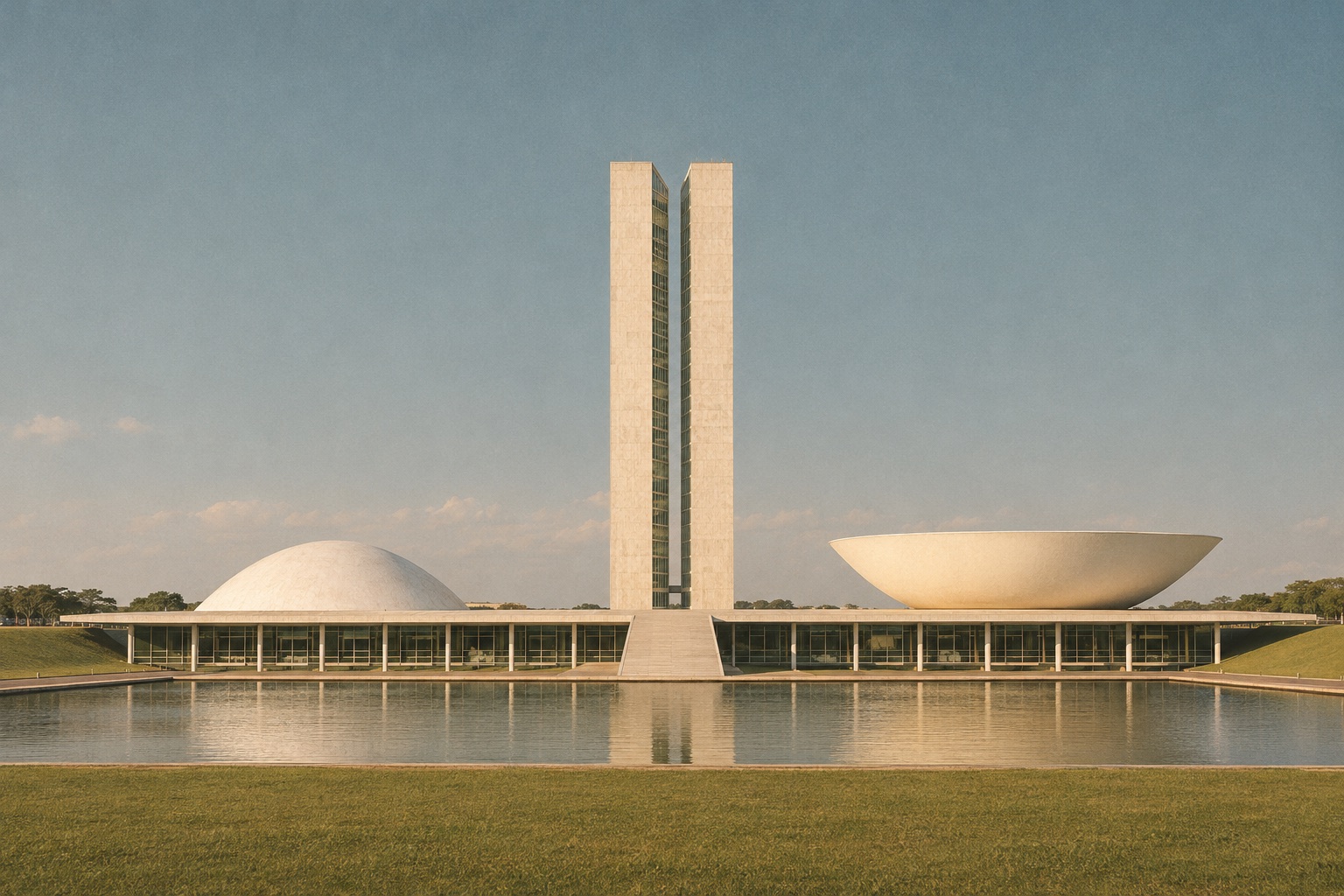
The institution appears on the horizon
Congress is encountered in relation to Costa’s monumental axis. Niemeyer’s ensemble gives that urban approach a concentrated architectural focus: a long podium, two office towers and the contrasting profiles of the legislative chambers. The plan belongs to Costa; these principal forms belong to Niemeyer’s architectural contribution.1
From a distance, the geometry is readable before the detailed workings of the institution are visible. This is a deliberate advantage of the composition, and also its limit. No silhouette can tell us how representatives govern, how staff work or how a citizen gains access. The building’s public image and the institution’s operation have to be considered together.
A dome and an upward-opening bowl
The convex dome marks the Senate; the upward-opening bowl marks the Chamber of Deputies. Their difference gives the ensemble its tension. The office towers supply verticality while the podium holds the composition near the horizon. The architecture draws force from the opposition of these simple figures.1
The forms are often described as symbols, but their most immediate effect is spatial. A closed curved surface and an open upward one catch light differently; the towers interrupt the horizontal field. The composition remains memorable as the sky changes behind it. One does not need a single definitive symbolic explanation to see how the parts work together.
The close approach changes the image
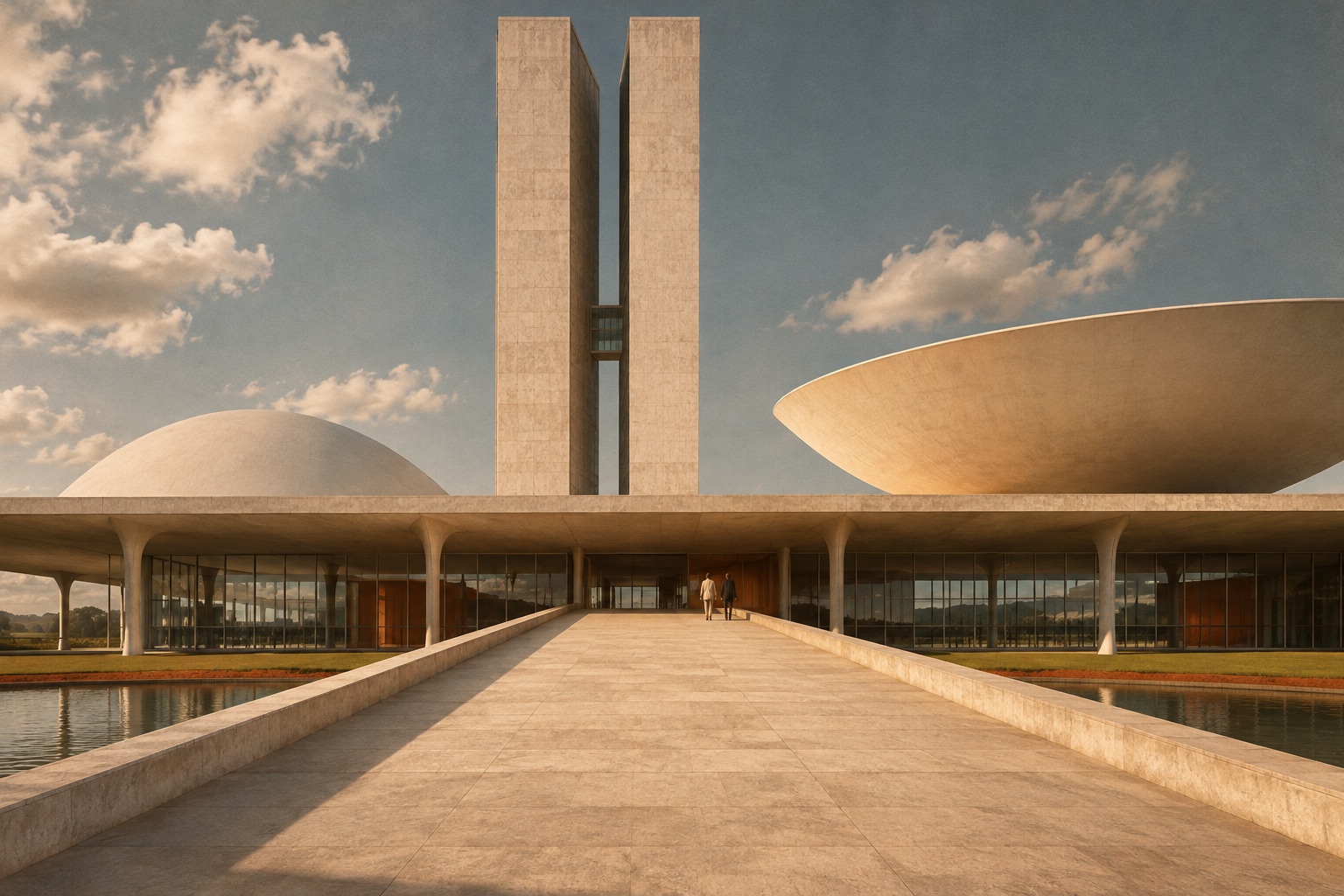
The ceremonial ramp turns the distant composition into an approach. As the body moves toward the podium, the visual balance shifts: the towers rise, the curved chambers separate differently and the horizontal plane becomes an edge with depth. The famous front view compresses a sequence that movement unfolds.1
Our reading follows this change in scale rather than pretending to reproduce a particular visitor’s feelings. The new reconstruction makes the ramp and shadow more present than in the broad panorama. Its geometry remains approximate; it is not a section, measured model or technical account of the building.
Cardozo and the discipline beneath the gesture
In his Brasília account, Niemeyer acknowledged Joaquim Cardozo’s structural work in the Congress building. The forms that appear so concise in an exterior image had to become buildable concrete structures within a demanding schedule.2
A dome, bowl or long plane does not stand because it is visually simple. Geometry, reinforcement, supports and connections have to direct forces toward the ground. The architecture’s apparent ease is a perception achieved through that material discipline. Naming the engineer interrupts the misleading impression that structure arrived afterward merely to support an already complete artistic idea.
The words left behind the finished surface
Maintenance work in 2011 revealed messages left by construction workers inside Congress. The Senate’s reporting records José Silva Guerra’s dated appeal of 22 April 1959 for fairness toward workers’ children and respect for the law. A concealed inscription became evidence of expectations carried into the construction site.3
There is a profound change of scale in moving from the distant national emblem to one worker’s handwriting. Both belong to this building. The inscription asks us to see a collective promise from the position of a person whose labor helped make it visible. It is a reason to include working conditions and social consequences in an architectural account, rather than placing them outside the work.
The monument and the person crossing open ground
The generous visual field around Congress gives the ensemble room to be seen. For a body moving through it, openness also means distance and exposure. A compelling civic image is not automatically a comfortable pedestrian environment. Brasília’s different urban scales and metropolitan inequalities make that distinction important.1
The building can hold formal power without closing the discussion of access, gathering, shade or daily use. Its legacy is strongest when admiration remains capable of asking those practical questions. Congress is a national image, a workplace, a constructed object and a repository of human testimony; none of those identities exhausts the others.
Sources for this story +
Numbered links beside passages lead directly to the supporting source. Experiential readings are editorial interpretations; generated scenes are labeled artistic reconstructions.