CHAPTER 05 / 08 · 1964–1980
Far from home
The military dictatorship interrupted his Brazilian life. Commissions abroad expanded the geography of his work.
1964: the professional ground shifts
The military takeover did not simply send Niemeyer from one country to another on a single date. It changed the conditions in which he could work, publish and teach. Módulo was suspended in 1964. In 1965 he resigned from the University of Brasília with more than two hundred teachers, protesting the repression of the university and the policies imposed on it.1
The contrast with the preceding decade is sharp. He had helped give the state a new architectural image; now a new political order constrained his place within its institutions. His communist allegiance, once compatible with the protection of patrons such as Kubitschek, exposed him to a different balance of power. The freedom to draw had always depended partly on the freedom to practise. The dictatorship made that dependency impossible to overlook.23
A place from which to continue
The Fundação records his establishment in Paris in 1967 and authorization from Charles de Gaulle to practise in France. It dates the opening of the Champs-Élysées office to 1972. Those distinct milestones describe the gradual construction of a new professional base, rather than an effortless transfer of an already functioning practice.3
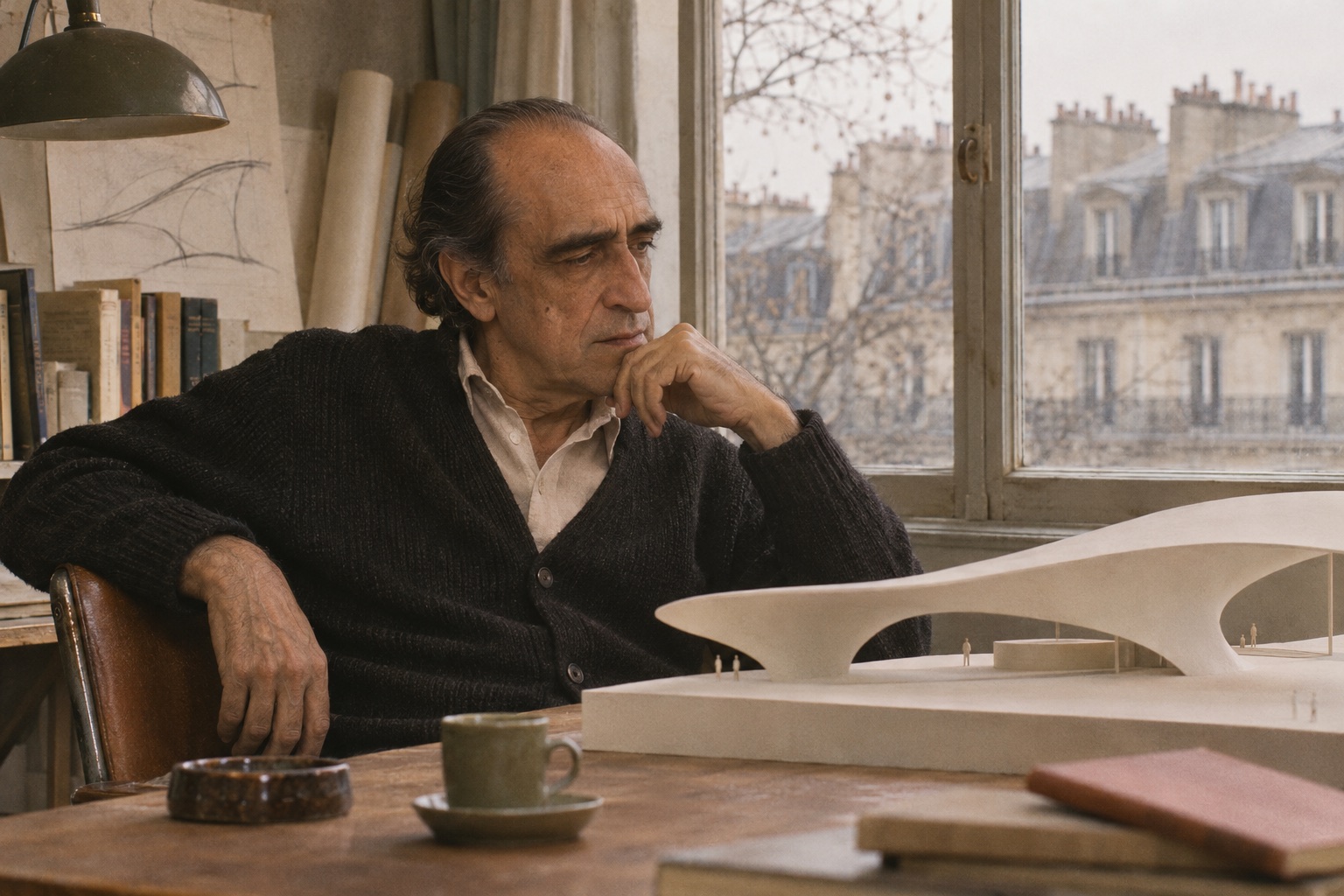
Paris gave the displaced architect a place in which to continue, but not a replacement for Rio. The work depended on a new network of collaborators, administrators, engineers and clients. The portrait in this chapter imagines a working moment, not an actual office interior. The documented story behind it is the continuation of practice across political and national boundaries.
A geography larger than exile
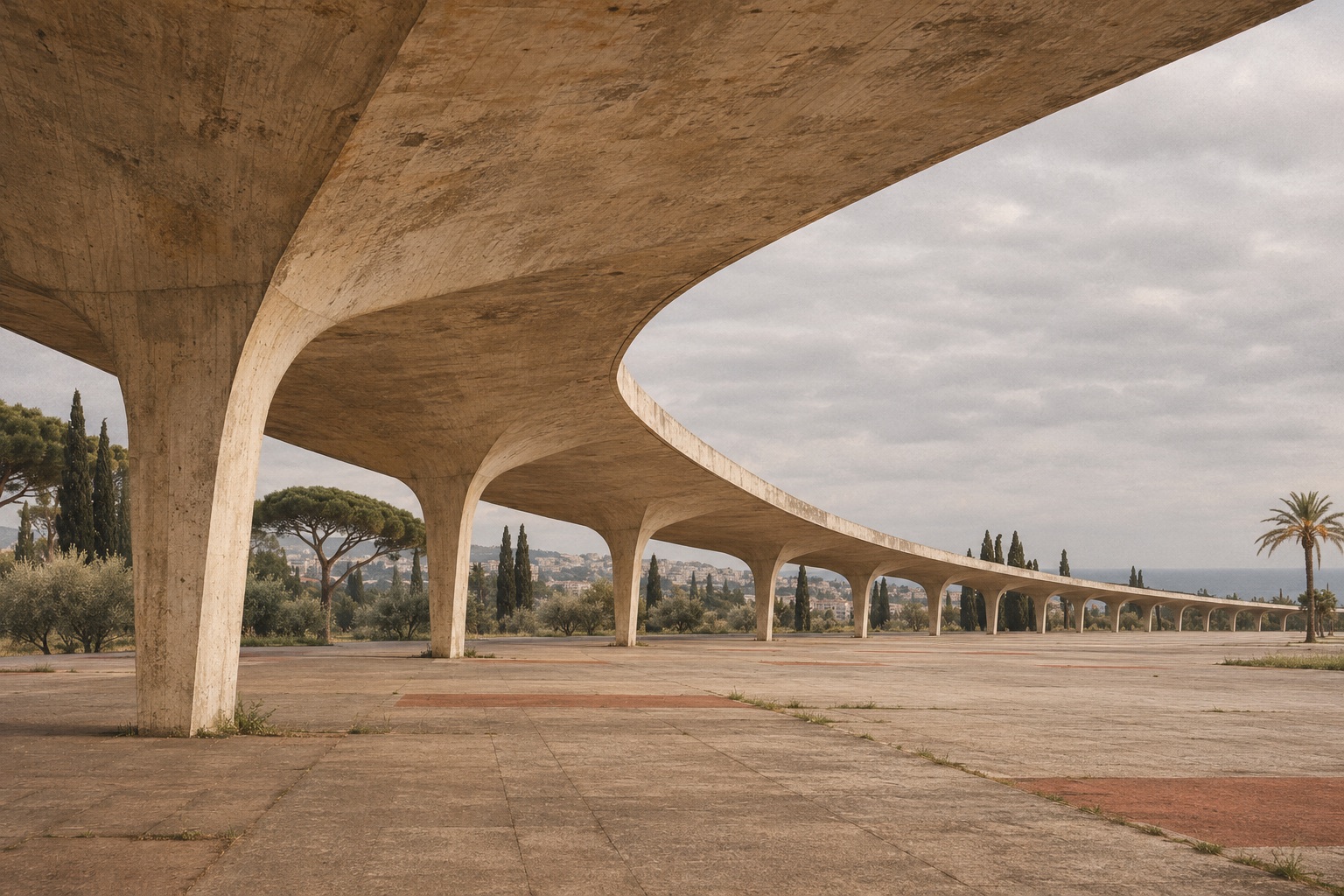
His international work had begun well before the coup. In 1962 he travelled to Lebanon for the Tripoli international fair project. UNESCO dates the design’s development from 1962 to 1967 and construction continuing until 1975. The immense curved exhibition canopy proposed a flexible shelter under which individual national displays could be arranged.14
The fair grew through collaboration with Lebanese engineers and contractors; its nomination dossier identifies local firms among the participants. This was not an architectural object carried intact from a Brazilian drawing board to an empty site abroad. Its realization involved a transfer and transformation of expertise. The project’s later interrupted use and material vulnerability also show that the life of a building can diverge radically from the ambition that initiated it.5
An institution built in solidarity
The French Communist Party headquarters made the relationship between conviction and commission unusually direct. Niemeyer contributed the design as a gift. Jean Deroche, Paul Chemetov and Jean-Maur Lyonnet worked with him; Jean Prouvé collaborated on the facade. The office building and the later dome were realized in separate phases, with the completed ensemble reaching around 1980.67
The building had to accommodate political work while giving the party a public presence in Paris. Its flowing office frontage and low dome did not derive their ideology from a curve alone. Their meaning came from the institution, the act of solidarity, the people working there and the architecture’s subsequent public life. It is a particularly clear case in which a Niemeyer building belongs to a collective enterprise, even as it bears his unmistakable formal language.
A university: concentration rather than dispersal
At the University of Constantine in Algeria, Niemeyer argued for concentrating the program instead of scattering it among many separate buildings. His project explanation emphasizes compactness, flexibility and the capacity to accommodate change. The Fundação dates the project to 1969; the Arab Center for Architecture places the work in a 1969–1972 span.89
The argument concerns the organization of an institution, not simply the shape of an individual facade. A university requires people to reach one another: students, teachers, administrators and shared facilities. Concentration promises connections and common ground, but can also create dependencies on a large organizing structure. Niemeyer’s stated intentions should be read as a design position, not as evidence that all educational and practical problems were thereby solved.
A publisher sees a palace differently
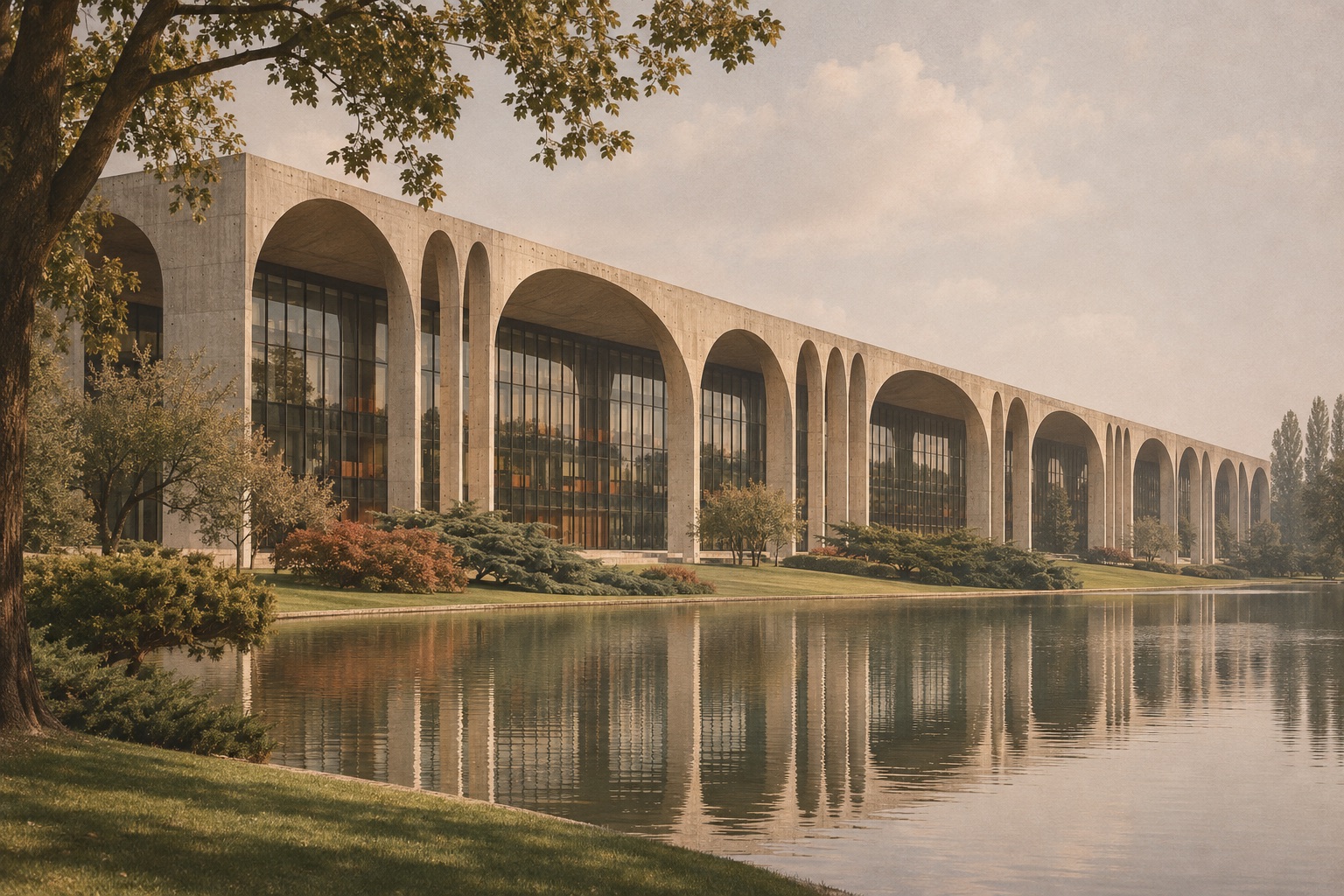
Mondadori’s headquarters at Segrate offered another kind of client. The publishing company needed to accommodate a growing workforce beyond its constrained Milan premises. Its own histories differ between 1967 and 1968 for the initial commission; construction began in 1971 and the headquarters opened in 1975. “The late 1960s” is the most honest shorthand for its beginning.1011
The glass office volume, monumental arcade, lower curving spaces and Pietro Porcinai’s landscape give the site its identity. The relationship to Itamaraty is visible, but the program is different: daily publishing work rather than diplomatic ceremony. A vocabulary could travel without the building becoming the same building. Structure, landscape and the organization’s needs had to be negotiated again.10
The architect and the systems that commission him
These years place a political headquarters, a corporate workplace and post-independence public institutions within one practice. Niemeyer’s communist convictions did not restrict his commissions to party organizations. The contradiction is concrete: an architect seeking a more equal society made important work through governments and businesses operating within unequal societies.32
It would be easy to resolve the tension by declaring either the beliefs or the work meaningless. The more useful approach is to examine what each commission could and could not change. Architecture might open a site, create a powerful shared space or provide an institution with a public image. It could not alone redistribute the power that decided who commissioned, owned and used that institution.
Routes back toward Brazil
Módulo resumed publication in Rio in 1975. In 1978 Niemeyer helped found the Centro Brasil Democrático and became its president. The chronology resists a clean division between an entirely foreign period and a single moment of return. Publishing, political activity, travel and design reconnected his professional life across borders.312
What came next was not simply the resumption of the Brasília years. The new work would include public schools and a permanent setting for Rio’s samba parades, as well as cultural monuments. Questions that his politics had kept alive—who architecture served and what institutions could make available—would acquire a different set of programs. Returning to Brazil did not mean returning to the same historical moment.
Sources for this story +
Numbered links beside passages lead directly to the supporting source. Experiential readings are editorial interpretations; generated scenes are labeled artistic reconstructions.
- Fundação Oscar Niemeyer · 1960–1965 ↗
- Brazilian Senate · Niemeyer, Prestes and Fidel Castro ↗
- Fundação Oscar Niemeyer · 1965–1975 ↗
- UNESCO · Rachid Karami International Fair, Tripoli ↗
- UNESCO · Tripoli nomination dossier ↗
- Espace Niemeyer · History of the headquarters ↗
- Espace Niemeyer · Institutional press dossier, 2021 ↗
- Fundação Oscar Niemeyer · University of Constantine, 1969 ↗
- Arab Center for Architecture · University of Constantine ↗
- Mondadori · Headquarters, architecture, landscape and adaptation ↗
- Mondadori · Institutional history, 1975 ↗
- Fundação Oscar Niemeyer · 1975–1985 ↗