CHAPTER 06 / 08 · 1980–2000
Returning, still restless
The later work moved between the monumental and the everyday, public celebration and public education.
Returning to work in a changing Brazil
Niemeyer’s renewed Brazilian activity developed through the late 1970s and 1980s rather than beginning with one uncontested return date. He remained active in democratic opposition while accepting commissions in Rio, Brasília and São Paulo. An architect now internationally established was entering a different phase of public life at home.12
The familiar silhouettes of museums and memorials can obscure the variety of this period. Public education and the infrastructure of a popular celebration became important fields of work. They raised questions that could not be answered by a memorable facade alone: how a building operates every day, how many people it serves and how an institution remains supported after the opening ceremony.
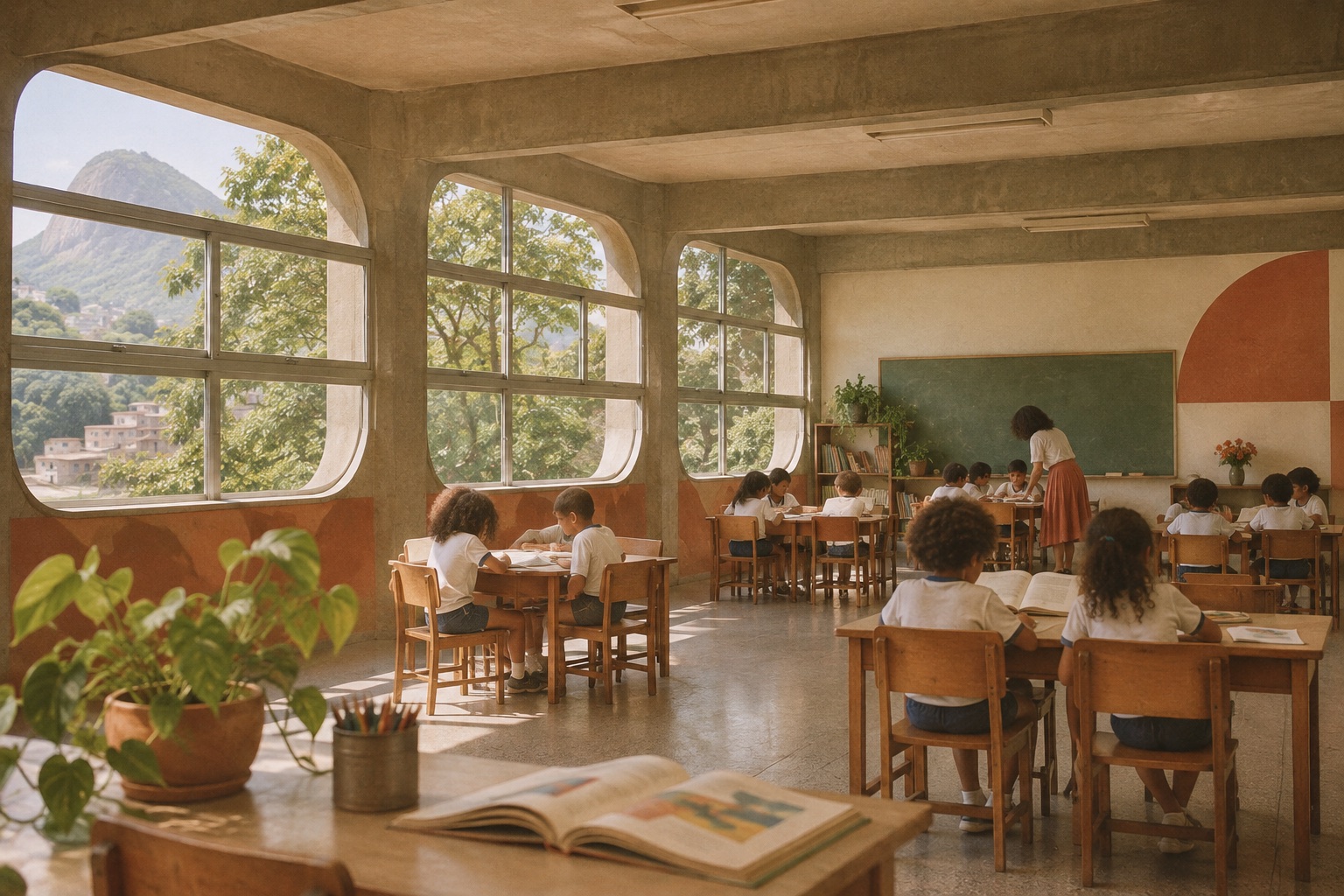
A school day imagined as a whole
The CIEPs—Centros Integrados de Educação Pública—were part of an educational program shaped by Darcy Ribeiro. Niemeyer designed the architecture; the Fundação’s project record also credits João Otávio Brizola’s construction supervision. The first school, CIEP Tancredo Neves, opened on 8 May 1985.3
Their ambition extended beyond a classroom session. Teaching, care, food, health and time for study belonged to a fuller school day. Architecture was a means of giving that program a repeatable physical setting. The standardized approach allowed the discussion to move from one exceptional object to a network of institutions. But a school’s continued value also depends on staffing, maintenance and educational policy. The design establishes conditions; it does not substitute for the life of the institution.
The grandstand as something more than a grandstand
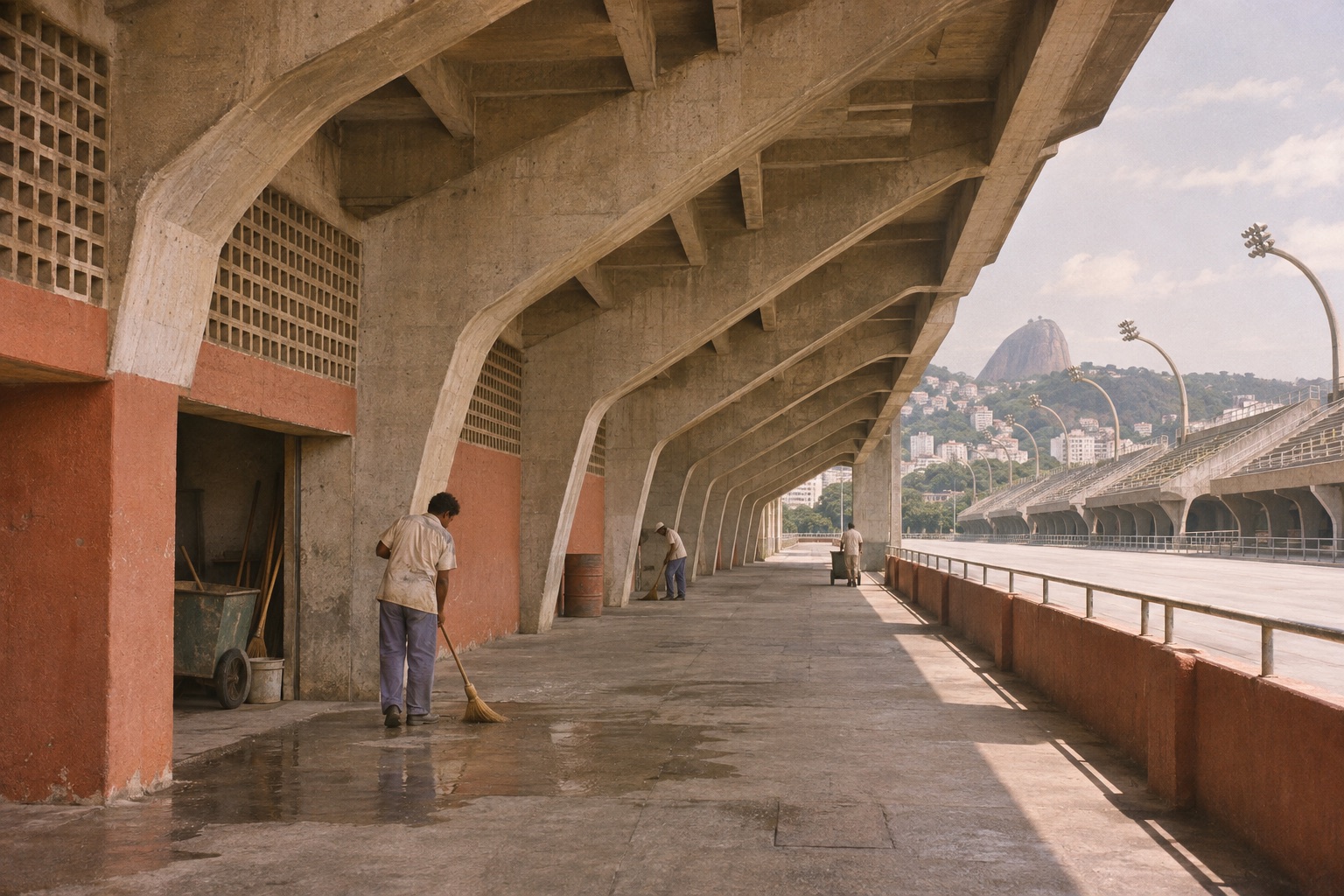
The Sambódromo brought another mass public into the work. The Fundação chronology places the project in 1982, while the project catalogue uses 1983; the venue opened in 1984. These dates describe stages, not necessarily contradictory accounts of one event. Niemeyer’s program included schools, childcare, health and craft facilities alongside the parade infrastructure.14
The educational component was not merely a line in the architect’s explanation. Rio’s education department records the Avenida dos Desfiles school complex opening in August 1984, with teaching spaces in the grandstand blocks. This changes how the site can be understood: the immense spectacle of carnival was paired with a claim on ordinary days.5
Recognition without retirement
Projects for Brasília resumed in the mid-1980s; the Memorial da América Latina followed in São Paulo. In 1988 Niemeyer shared the Pritzker year with Gordon Bunshaft. The award recognized a lifetime of work while a substantial part of that working life was still to come.2
Huxtable’s accompanying essay did not require belief in an unblemished modern movement. She defended the lasting architectural contributions of modernist masters at a time when their urban theories were under criticism. Recognition here was not an instruction to stop examining the work. It was an argument that its quality deserved a more careful reassessment than fashion or rejection could provide.6
1991: a new commission across the water
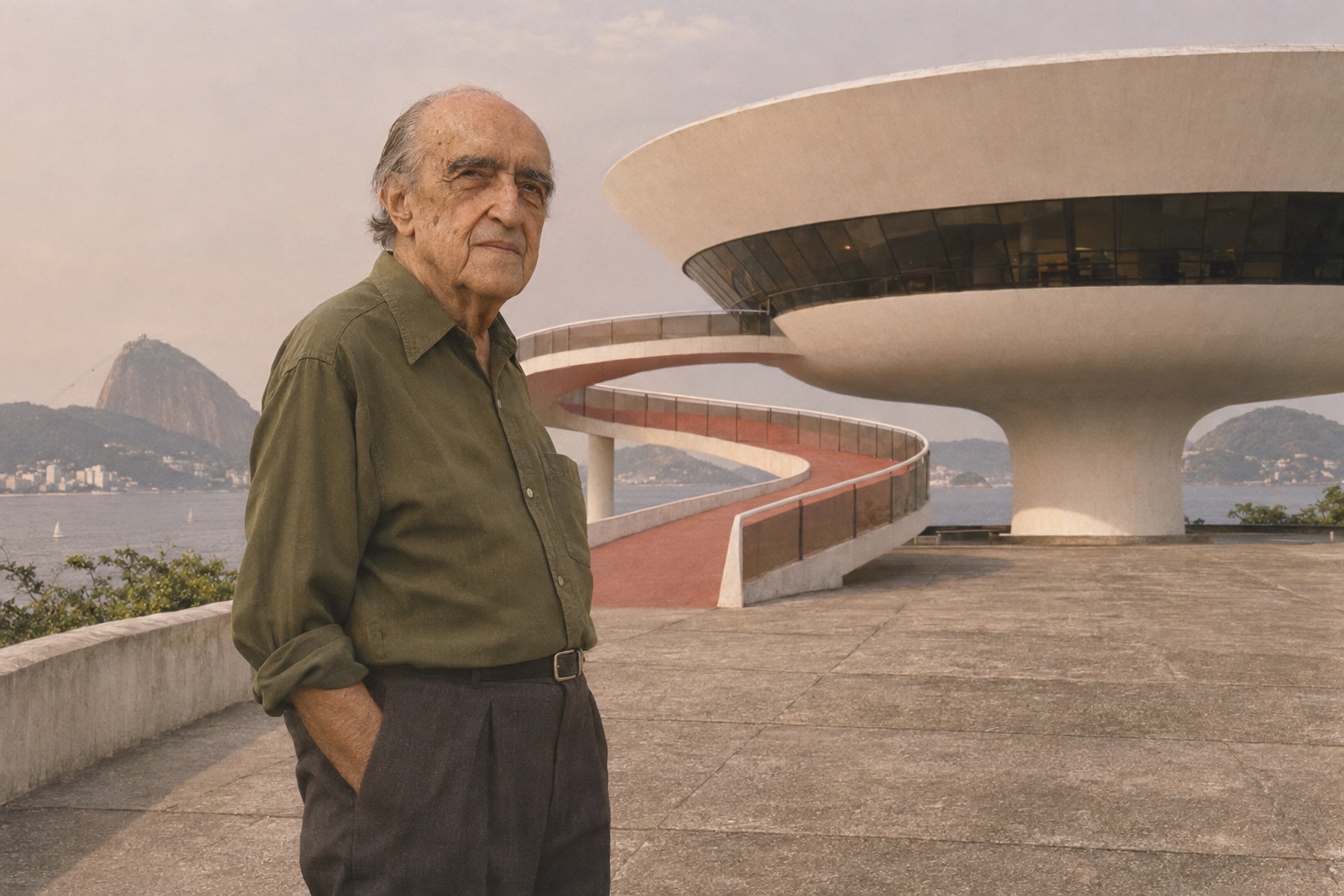
The Niterói Contemporary Art Museum returned the story to the bay. The Fundação dates the design to 1991; the museum opened in 1996. The rising circular form made a small promontory into an architectural destination, while the red ramp transformed arrival into a gradual change of viewpoint.78
The museum also had a public and a collection. Niterói’s institutional account identifies the João Sattamini collection at its heart. Seen only as a sculptural outline, the building can seem to be about its own image. Read as a museum, it must also be understood through the distinction between looking at art and looking out toward landscape. Niemeyer’s own explanation separated the solid-walled exhibition room from the encircling panoramic gallery.98
The support beneath the apparent flight
Bruno Contarini’s engineering helped realize the museum. The central support and the spreading gallery announce a load-bearing idea, but the simplicity of the image should not be mistaken for a complete explanation of the structure. Radial elements, floors, envelope and support had to work as a coordinated system.108
This is the old conversation between line and construction at another age. The image of a hovering object is powerful precisely because the body knows that concrete has weight. Approaching the support and seeing the underside does not destroy the effect; it makes the negotiation between mass and apparent lightness more present. The museum invites both the distant view and the close encounter.
Writing the life that was still unfolding
As curvas do tempo appeared in Brazil in 1998. Niemeyer was now interpreting the trajectory that readers, critics and institutions had already begun to turn into architectural history. A memoir can preserve names and episodes absent from a project catalogue, but it is also a composition: events are selected and relationships given a shape.11
The work of this period makes it difficult to reduce the older architect to a guardian of his own early reputation. Schools, carnival, the museum, publishing and political activity kept different publics within his field of attention. The twentieth century was closing, but his practice was not. He would continue into another century, in which earlier buildings were already being adapted and new commissions were still arriving.
Sources for this story +
Numbered links beside passages lead directly to the supporting source. Experiential readings are editorial interpretations; generated scenes are labeled artistic reconstructions.
- Fundação Oscar Niemeyer · 1975–1985 ↗
- Fundação Oscar Niemeyer · 1985–1990 ↗
- Fundação Oscar Niemeyer · CIEP educational program and buildings ↗
- Fundação Oscar Niemeyer · Passarela do Samba: the architect’s program ↗
- Rio Education Department · Avenida dos Desfiles school complex ↗
- Ada Louise Huxtable · On Awarding the Prize, 1988 ↗
- Fundação Oscar Niemeyer · 1990–1995 ↗
- Pritzker Architecture Prize · Niemeyer biography and own account ↗
- Niterói Municipality · Museums and collections ↗
- Wallpaper* · Niemeyer interview conducted in 2010; republished 2025 ↗
- Fundação Oscar Niemeyer · 1995–2000 ↗