CHAPTER 07 / 08 · A LIFE BEYOND BUILDINGS
Life was always larger
Behind the monumental silhouette was a man attached to Rio, to conversation, and to an enduring belief that society should change.

Annita: a life running beside the public career
Oscar and Annita Baldo married in 1928, before he began architectural school. The public chronology then moves rapidly through degrees, offices and commissions. Their shared life moved on another calendar, largely outside the documents that make architectural fame visible. Annita died in 2004 after a marriage lasting more than seven decades.12
The disparity in documentation is a reason for care, not a license to invent. We cannot turn a generated dining room into evidence about how they spoke to one another or distribute private motives between them. We can acknowledge that the long public career was also a family life, with relationships that were neither commissions nor prizes. Following that thread brings another measure of time into a biography so often organized by buildings.
Anna Maria: a collaborator with work of her own
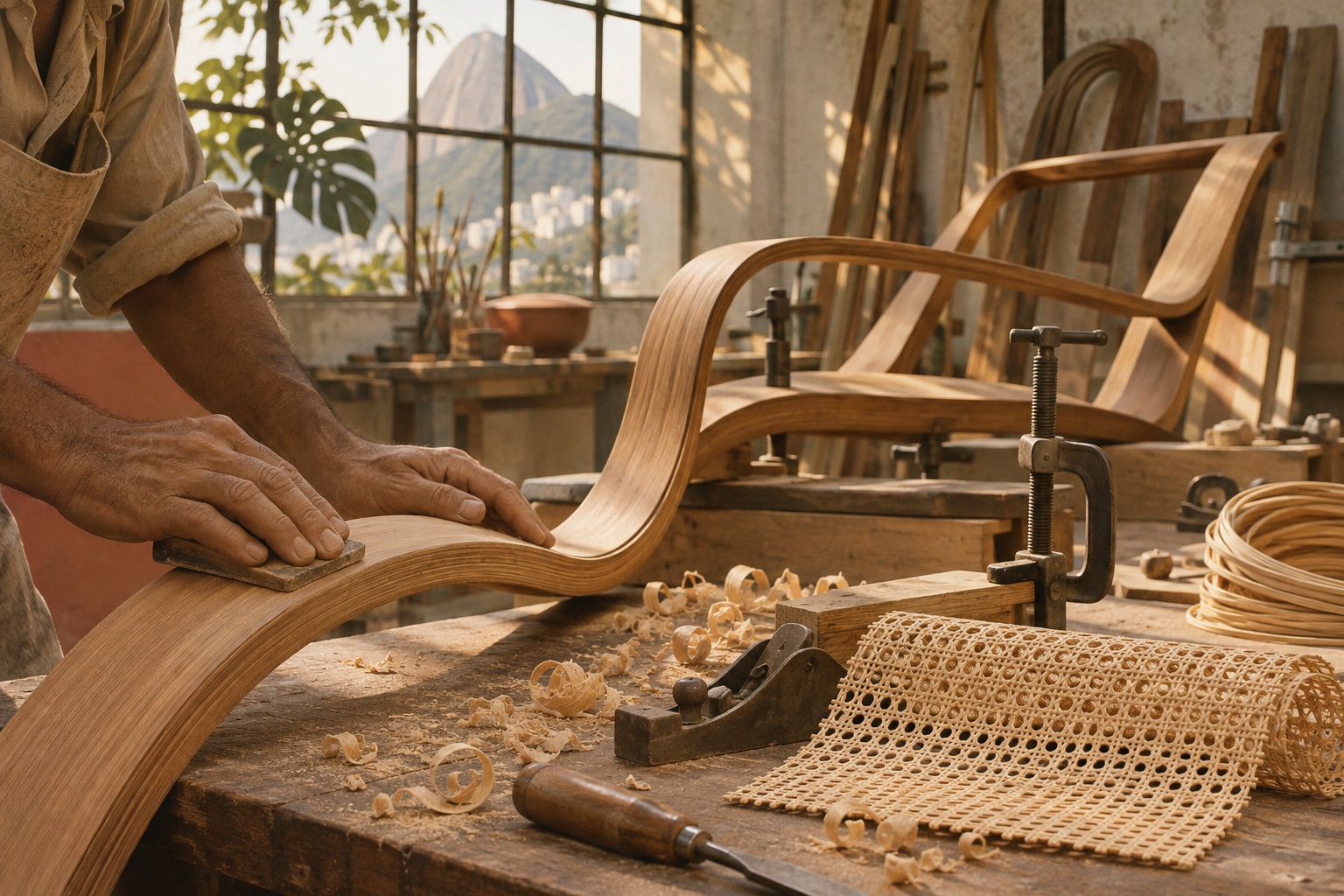
Their daughter Anna Maria was a designer, curator and gallerist, not simply a relative accompanying a famous architect. The Senate Museum credits her participation in interiors for Congress, the Supreme Court, Planalto and Alvorada, as well as furniture designed jointly with her father. These are specific forms of authorship within buildings too often summarized under one name.3
An interior determines how the large architectural idea meets a body: where a person sits, how a reception room is arranged, how materials feel at close range. Furniture brings the curve down from a distant roof to something touched and occupied. Research at the University of Brasília identifies the Alta chair as a joint Oscar and Anna Maria design from 1971. Their collaboration belongs to the history of the work at that intimate scale.4
Rio as a continuing address
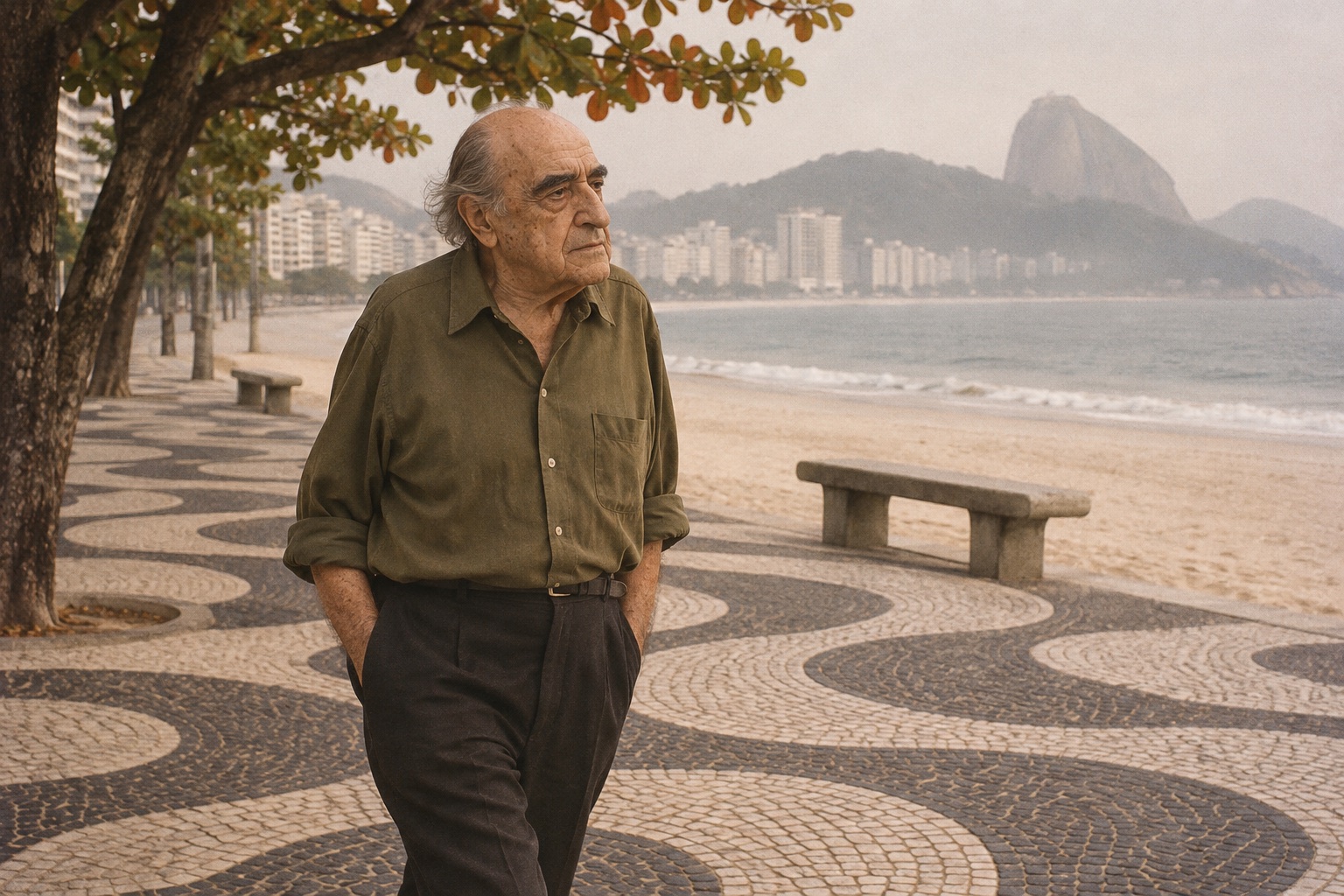
Even when his work ranged across several continents, Rio remained central to his biography and public identity. In a 1994 interview he spoke from the Copacabana office where he also received friends. The relationship to the city was not confined to the symbolic language of mountains and waves; it included the place in which he worked and met people.5
The landscape in his architectural explanations is therefore accompanied by a more ordinary geography: a window, an office, a conversation, a route through the city. The waterfront portrait here is an imagined scene placing him in that environment. It is not a claim about a documented daily walk. The distinction lets the image give the city presence without manufacturing a new biographical anecdote.
Drawing, writing, receiving friends
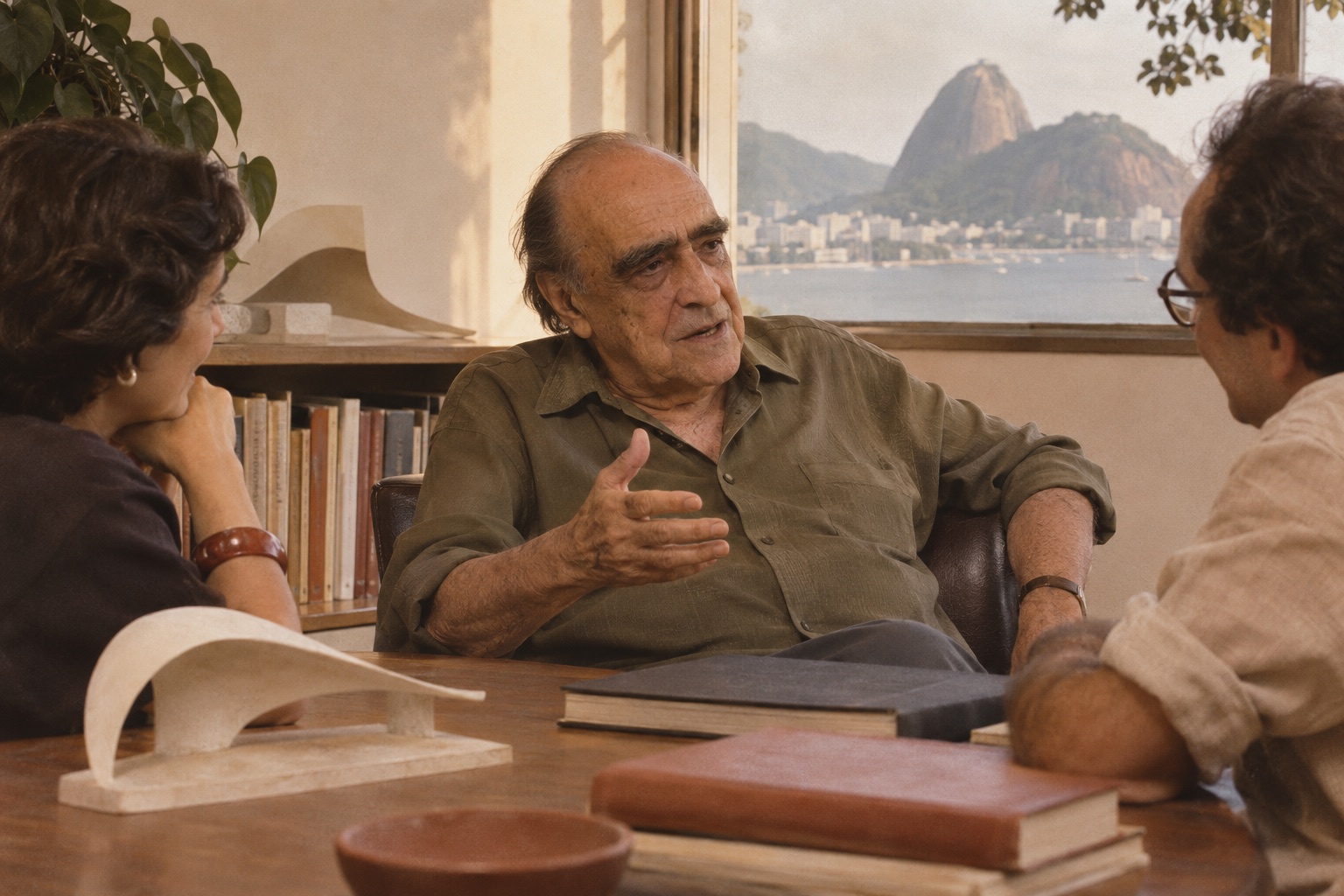
In an interview conducted in 2010, Niemeyer described an office day divided between appointments, drawing, lunch, writing and friends’ visits later in the afternoon. The account presents neither an endlessly inspired recluse nor a man whose professional life had already stopped. It describes work sustained by a pattern of ordinary activities.6
Drawing was not the only medium. Módulo and later writings gave him ways to explain architecture and intervene in public debate. A project’s visual clarity did not remove the need to argue for it. Written explanations, meetings and correspondence joined sketches within a practice that relied on persuasion as well as invention. The conversation image evokes this social world; its visitors and particular occasion are invented.78
Communism as affiliation, not a vague mood
He joined the Brazilian Communist Party in 1945. Senate reporting records his friendship with Luís Carlos Prestes and Fidel Castro, and his assistance to party activity in Rio. These were concrete personal and institutional allegiances. Describing him only as a generous humanitarian would smooth away political positions that he himself made explicit.910
Those allegiances also invite criticism. Solidarity with leaders and states cannot be made equivalent to an abstract wish for equality. The judgment of his politics and the judgment of his buildings overlap without becoming identical. A visitor can be moved by a cathedral or a palace while questioning the political relationships of its author. A serious tribute makes that room available instead of treating admiration as an obligation to agree.
An atheist designing a church
His atheism coexisted with a school education under Catholic clergy and with the design of some of Brazil’s most recognizable religious buildings. Religious use did not require the architect to possess the faith of the congregation. It did require him and his collaborators to make places that could be inhabited within that tradition.11112
At Pampulha, the long interval before the church’s first Mass makes the distinction between architectural recognition and institutional acceptance especially clear. At Brasília, the cathedral’s later artworks changed the interior across time. Neither is simply the expression of one man’s belief or unbelief. Buildings pass into communities and ceremonies that exceed the author’s personal convictions.13
A gift is also a piece of the record
The French Communist Party records the gift of his design for its headquarters. The Fundação records the Eldorado Memória monument, designed in 1996 and donated to the landless workers’ movement. These are documented acts of solidarity, more useful to the biography than a collection of unverified stories about private generosity.148
They do not resolve every contradiction in his career. The same architect worked for corporate clients and powerful governments. But they show that political commitment sometimes entered practice as a decision about giving, rather than only as a statement attached afterward to an architectural image. In following a life, such decisions deserve to sit beside the more familiar list of completed buildings.
Family time in an extraordinarily long life
After Annita’s death, Niemeyer married Vera Lúcia Cabreira in 2006. Anna Maria died in June 2012, months before her father. Public records establish these transitions without giving us access to the family’s private experience of them.211
Longevity can turn a person into a symbol before the life is over: the last witness, the tireless master, the man who would not stop drawing. Those descriptions capture part of the public phenomenon and leave other things out. Family relationships, collaboration, loss, friendship and stubborn political loyalty ran through the same years. To see the man alongside the monuments is to allow those different kinds of life to remain in the frame.
Sources for this story +
Numbered links beside passages lead directly to the supporting source. Experiential readings are editorial interpretations; generated scenes are labeled artistic reconstructions.
- Fundação Oscar Niemeyer · 1907–1930 ↗
- Chamber of Deputies · Parliamentary record, 7 December 2012 ↗
- Senate Museum · Oscar and Anna Maria Niemeyer: collaborators ↗
- University of Brasília · Raquel Silveira Chaves, furniture research ↗
- Oscar Niemeyer interviewed by Silvio Cioffi · Folha, 13 February 1994 ↗
- Wallpaper* · Niemeyer interview conducted in 2010; republished 2025 ↗
- Fundação Oscar Niemeyer · 1955–1960 ↗
- Fundação Oscar Niemeyer · 1995–2000 ↗
- Fundação Oscar Niemeyer · 1940–1950 ↗
- Brazilian Senate · Niemeyer, Prestes and Fidel Castro ↗
- Rio de Janeiro City Council · Biographical memorial, 2012 ↗
- Cathedral of Brasília · Inauguration and artworks ↗
- Belo Horizonte · Church, artworks and restoration ↗
- Espace Niemeyer · History of the headquarters ↗