CHAPTER 03 / 08 · 1940–1955
The freedom of the curve
At Pampulha, structure, painting and landscape began to speak together. International recognition followed, along with a deeper political commitment.
1940: Kubitschek opens a field of work
Juscelino Kubitschek’s commission at Pampulha in 1940 changed Niemeyer’s opportunities. Then mayor of Belo Horizonte, Kubitschek wanted a new leisure setting around an artificial lake. A casino, ballroom, yacht club and church would form an ensemble rather than one isolated object. The commission allowed architectural invention to operate across several programs and through the spaces between them.12
The patron and the architect would later become inseparable from the public story of Brasília, but their relationship began here at a different scale. Pampulha was a laboratory with a political sponsor. Its freedom depended on an invitation, resources and a willingness to build unfamiliar forms. The result was not a departure from construction into sculpture; it was an experiment in how construction could carry a more expansive artistic ambition.
A landscape made, not merely found
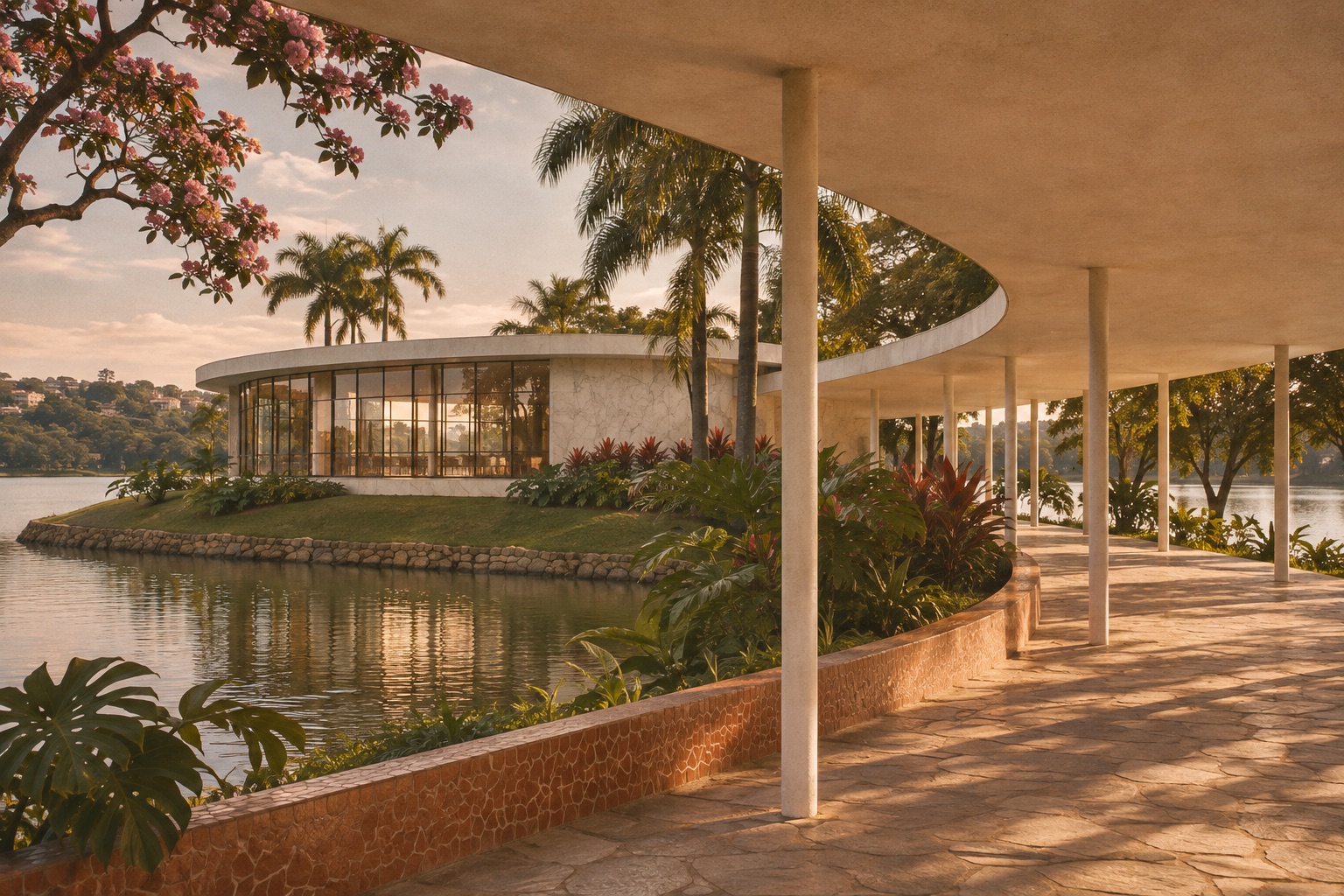
The lake was artificial, the gardens designed, and the surrounding development part of a new urban project. The familiar description of a building in harmony with Brazilian nature is therefore only part of the story. At Pampulha, architecture and landscape together produced a new environment for recreation.1
Casa do Baile makes this especially legible. Its small circular pavilion and winding canopy turn a short walk into a sequence of enclosure, exposure and reflection. A thin horizontal roof can be read almost as a line floating over the garden; approaching it reveals supports, edges and shade. The curve has become a route through a place. It is not necessary to assign it a single symbolic meaning to understand its effect.
A line meets its engineer
Joaquim Cardozo was central to the ensemble’s structural realization. The lyrical outline associated with Niemeyer required engineering judgment: spans, thicknesses, supports and reinforcement had to become buildable relationships. Cardozo’s contribution belongs inside the architectural story, not in a technical appendix added after the creative act.1
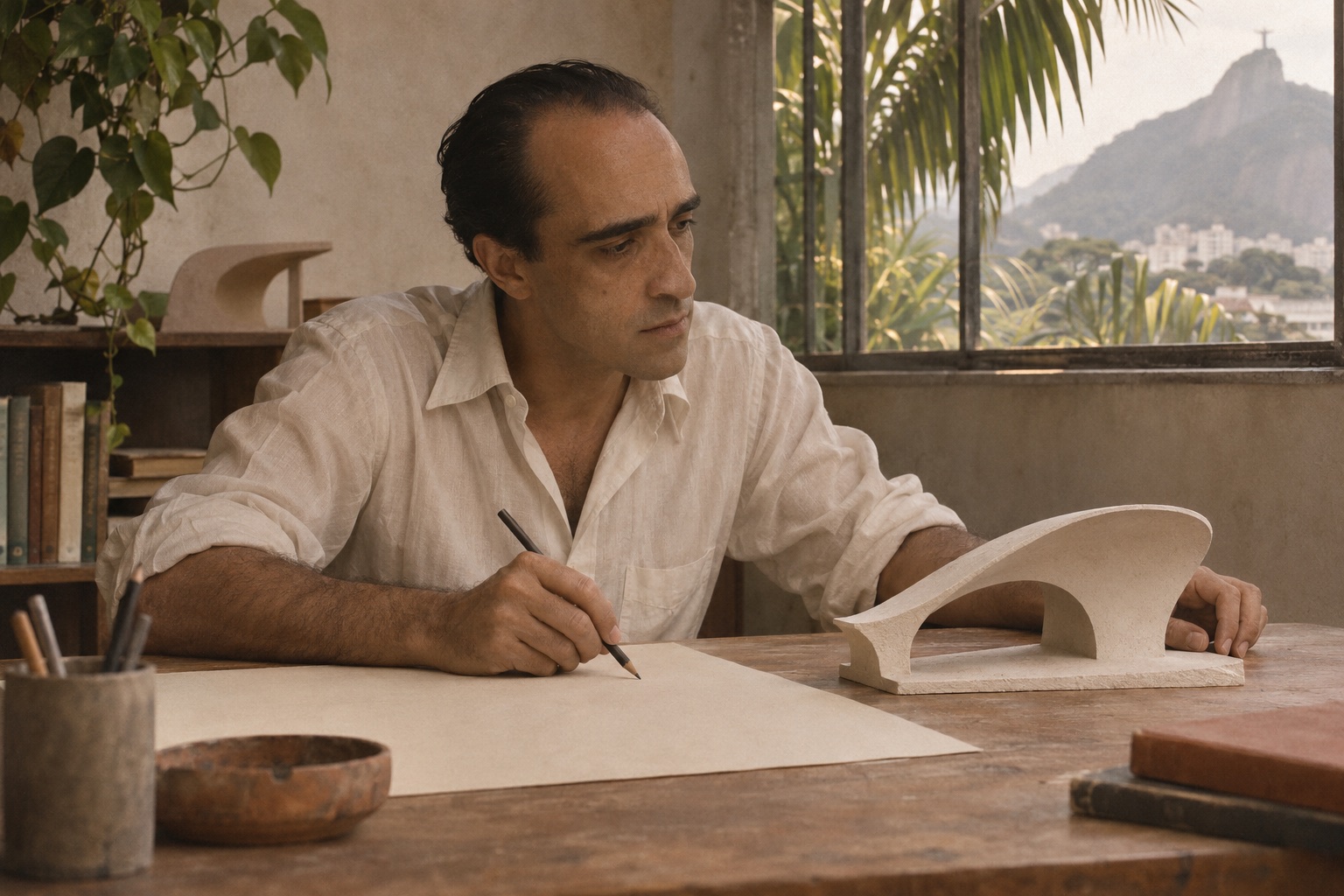
The work also depended on less visible forms of knowledge. Timber had to be shaped into formwork, steel placed, concrete poured and surfaces finished. A smooth shell seen from the garden conceals this sequence of labor. Its apparent ease is an achievement of coordination. The image of Oscar at a drawing table is a reconstruction; the collective nature of the work it evokes is documented.
The opening did not finish the work
The municipal source catalogue records an inauguration in May 1943 while the ensemble remained unfinished. Artworks at the church continued in 1944–1945. Portinari’s designs and their ceramic execution were different stages of production; Paulo Rossi Osir’s Osirarte workshop carried out the tile work.3
This longer sequence matters. A single year beneath an architectural photograph can make a building appear to arrive all at once. In reality, design, structure, painted surfaces, sculpture and religious use followed different calendars. The church’s first Mass took place in April 1959, long after its form had begun circulating as an emblem of Brazilian modern architecture.4
1945: a political commitment takes a name
Niemeyer joined the Brazilian Communist Party in 1945. The commitment would last through changes of government, international travel and the loss of professional security after the military takeover. It was not simply a color added to his public persona in old age.5
Yet neither a curving roof nor a party membership can demonstrate that a particular institution was socially equal. Pampulha was a leisure and development project, not a resolution of Brazil’s inequalities. Keeping those facts together makes his position more intelligible: a committed communist could pursue beauty through commissions from influential patrons while locating wider social change in politics beyond architecture. The contradiction would grow larger as his commissions grew.
1947: a second New York encounter
Niemeyer returned to New York as a member of the international architectural team designing the United Nations headquarters. This was another step beyond the role of Costa’s younger collaborator. He now participated in a negotiation among architects representing different countries, with Wallace Harrison directing the process.65
The eventual ensemble combined ideas from Niemeyer and Le Corbusier. Questions about the position of the General Assembly, the office tower and open ground were questions about the institution’s public face. The experience expanded his international authority before the Brasília commission. The capital did not create his reputation from nothing; it gave an already recognized architect an unprecedented field of work.
Early 1950s: making a place for himself
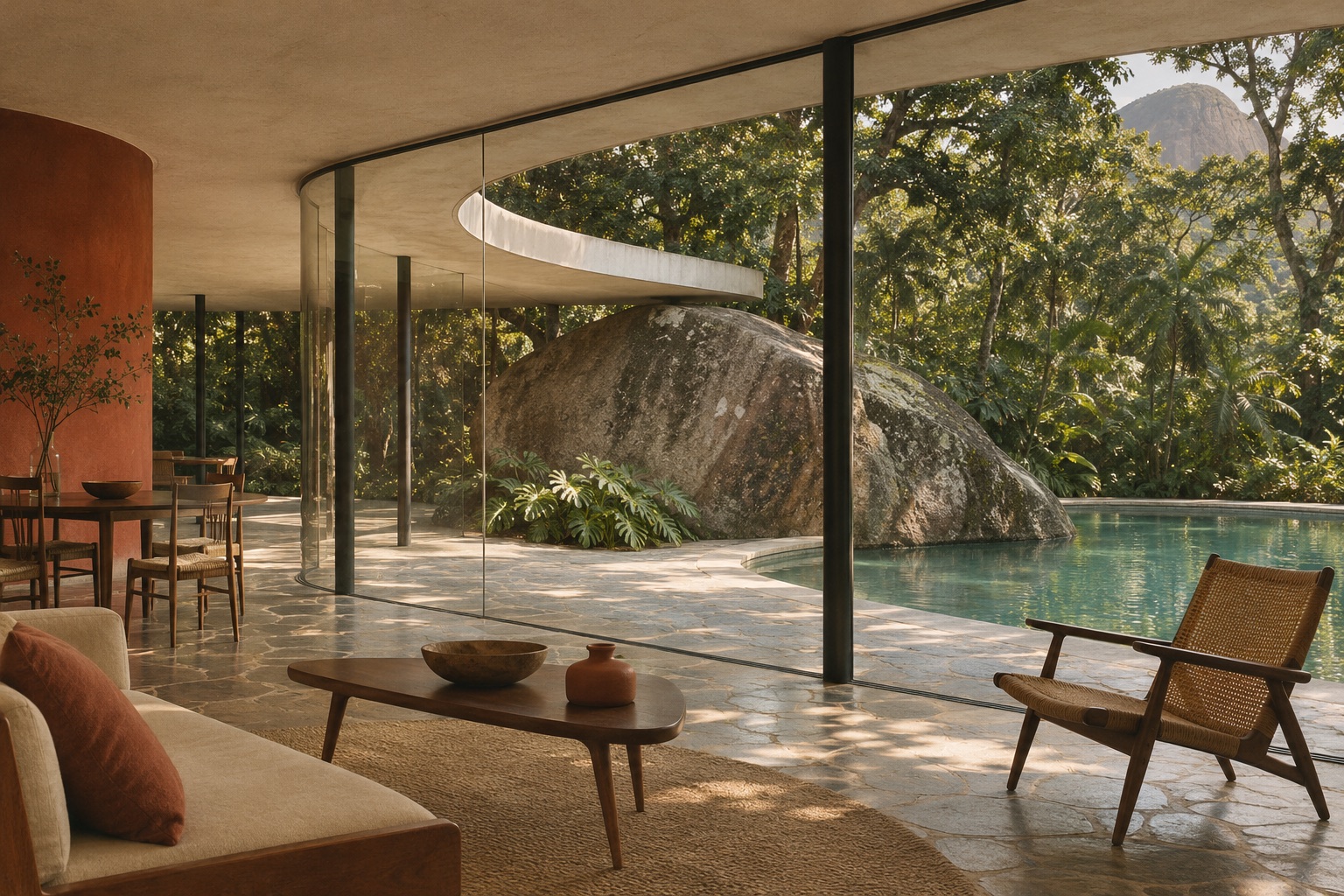
At Casa das Canoas in Rio, the scale turned intimate. In Niemeyer’s retrospective explanation, the house accommodated the sloping site with living areas above and bedrooms lower down. A large rock, a curving roof, glass and vegetation shaped the relationship between shelter and landscape. This was a particular house for a particular site, not a prototype for every household.7
The exact dating is less simple than many captions suggest: the Fundação’s visitor page uses 1951, while its chronology and project catalogue use 1952. “The early 1950s” captures the episode without silently choosing between those institutional labels. What matters spatially is the negotiation with what was already there. At Canoas, landscape did not remain a distant view; rock and vegetation pressed close to the inhabited room.89
The confidence to reconsider
Stamo Papadaki’s study of his work appeared in the United States in 1950. In 1954 Niemeyer made his first European journey in connection with Berlin’s Hansa reconstruction program. Recognition brought more invitations, but his practice was not a settled formula.9
The ICAA catalogue summary of his 1958 essay Depoimento describes a striking self-criticism: too many commissions and too much improvisation, followed by a wish for fewer projects, simpler geometric unity and stronger structural expression. We have consulted that catalogue account, not the restricted full scan. It supplies a valuable hinge in the story. Brasília’s clarity of domes, planes and repeated supports was not merely the old curve enlarged; it emerged during a period of reassessment.10
Sources for this story +
Numbered links beside passages lead directly to the supporting source. Experiential readings are editorial interpretations; generated scenes are labeled artistic reconstructions.
- UNESCO · Pampulha Modern Ensemble ↗
- Fundação Oscar Niemeyer · 1930–1940 ↗
- Belo Horizonte · Catalogue of Pampulha historical sources ↗
- Belo Horizonte · Church, artworks and restoration ↗
- Fundação Oscar Niemeyer · 1940–1950 ↗
- United Nations · A Workshop for Peace ↗
- Fundação Oscar Niemeyer · Canoas project and architect’s retrospective accounts ↗
- Fundação Oscar Niemeyer · Casa das Canoas ↗
- Fundação Oscar Niemeyer · 1950–1955 ↗
- ICAA / Museum of Fine Arts, Houston · Catalogue summary of Depoimento, 1958 ↗