CHAPTER 04 / 08 · 1956–1964
A capital, a promise
Brasília made a nation’s future visible. It also exposed the distance between an architectural ideal and the lives needed to build and inhabit it.
1956: an invitation with organizational power
Kubitschek, now president, invited Niemeyer into the creation of a new capital in 1956. His appointment was more than a commission for a set of buildings: he became director of Novacap’s Department of Urbanism and Architecture, helped organize the urban-plan competition and served on its judging commission. He was part of the machinery that made the project possible.1
Lúcio Costa’s winning Plano Piloto gave the city its urban structure. Niemeyer designed many of the principal public buildings. The distinction is essential, but it should not make their relationship seem distant or mechanical. Urban axes, open ground and architectural silhouettes were made to work in relation to one another. Their convergence produced a powerful image of a national future.2
The plateau was not an empty beginning
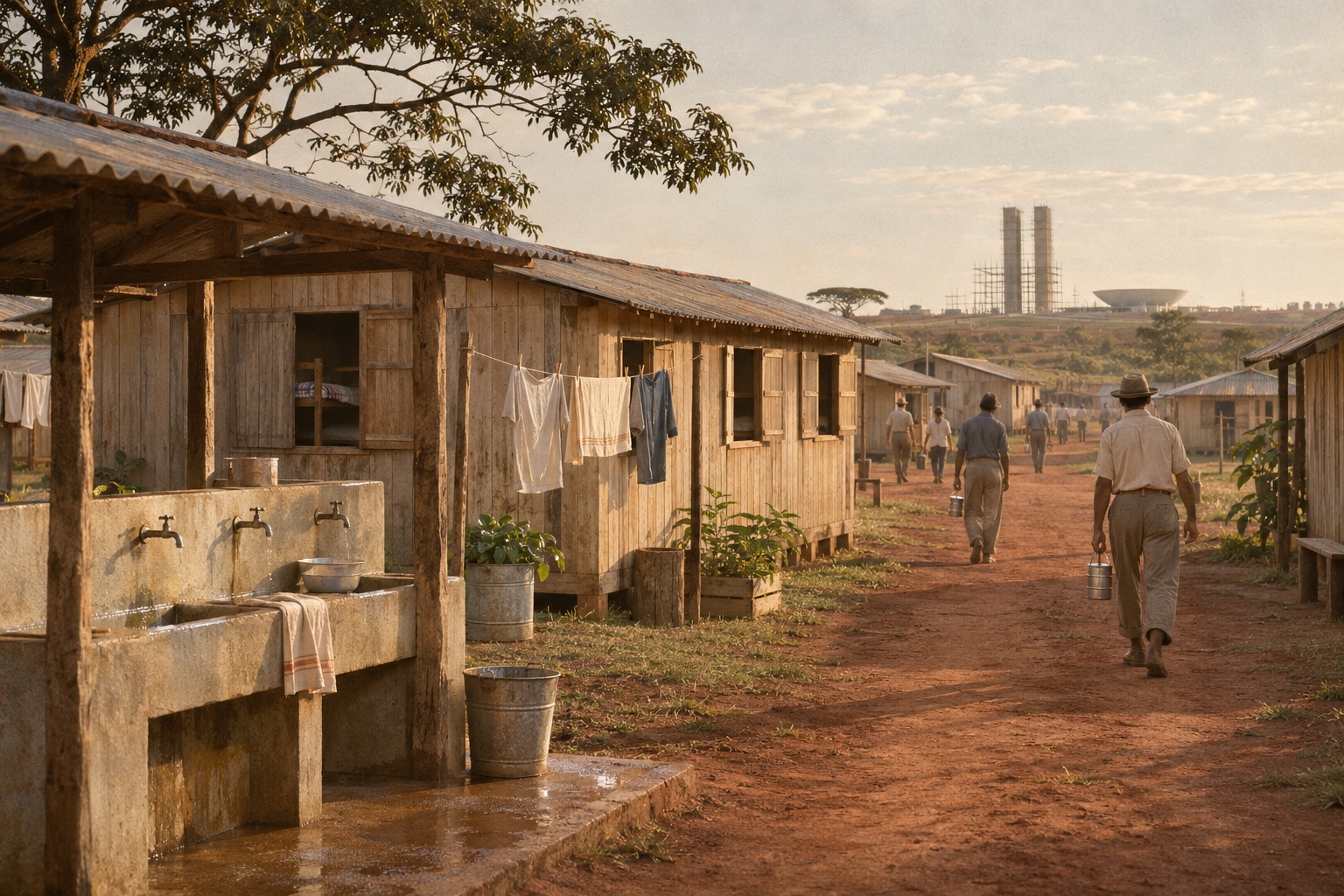
The language of a capital created “from nothing” can make the region’s existing life disappear. The 1959 census, discussed by EBC using IBGE records, also complicates a familiar image of the workforce: major places of origin included Goiás, Minas Gerais and Bahia. The candangos were not one uniform group arriving from a single region.3
Nor were the people making the new city only the men most visible in construction photographs. Cooking, washing, care, administration and trade were part of the settlement’s daily operation. Later Senate recognition explicitly includes women’s contributions. A capital required buildings, but its building campaign required a social world capable of keeping people fed, housed and working.4
A schedule carried by bodies
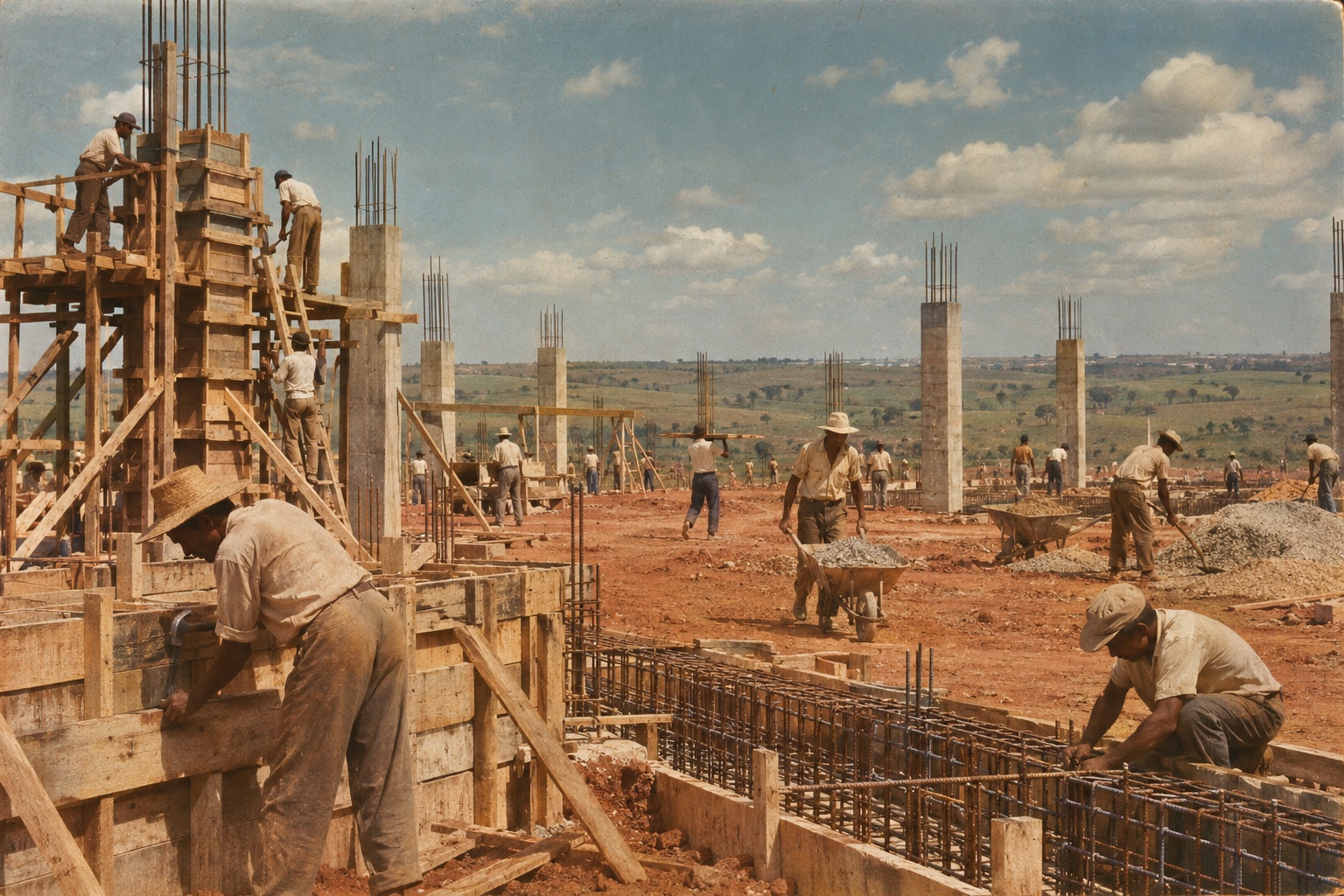
The inauguration on 21 April 1960 gave the work a public deadline. In the official achievement, speed became evidence of national capacity. In labor history, that same speed appears through prolonged hours, precarious accommodation, inadequate protection and accidents. These are not two different construction campaigns. They are two accounts of the same achievement, seen from different positions.56
The difference is especially sharp when looking at a concrete shell. Its clean finished surface suppresses the temporary structures and risky operations that made it possible. A carpenter’s formwork disappears; the roof remains. Naming Cardozo’s engineering and the workers’ labor together interrupts the misleading sequence in which an architect draws a line and a monument simply follows.
A residence arrives before the capital
The Palácio da Alvorada opened on 30 June 1958, before the capital’s inauguration. In Niemeyer’s own project explanation, simplicity, proportions and structural form were central to its composition. The repeated curved supports made the presidential residence recognizable even at a distance.78
The building’s apparent lightness depended on carefully organized depth: supports, veranda and glazing were not one flat facade. What looked almost like an emblem from afar could become a corridor of changing views close up. Niemeyer’s description of imagining himself moving between supports in his Brasília work helps explain this attention to approach and perspective. The silhouette was important, but it was not his only way of thinking.9
Two chambers against one horizon
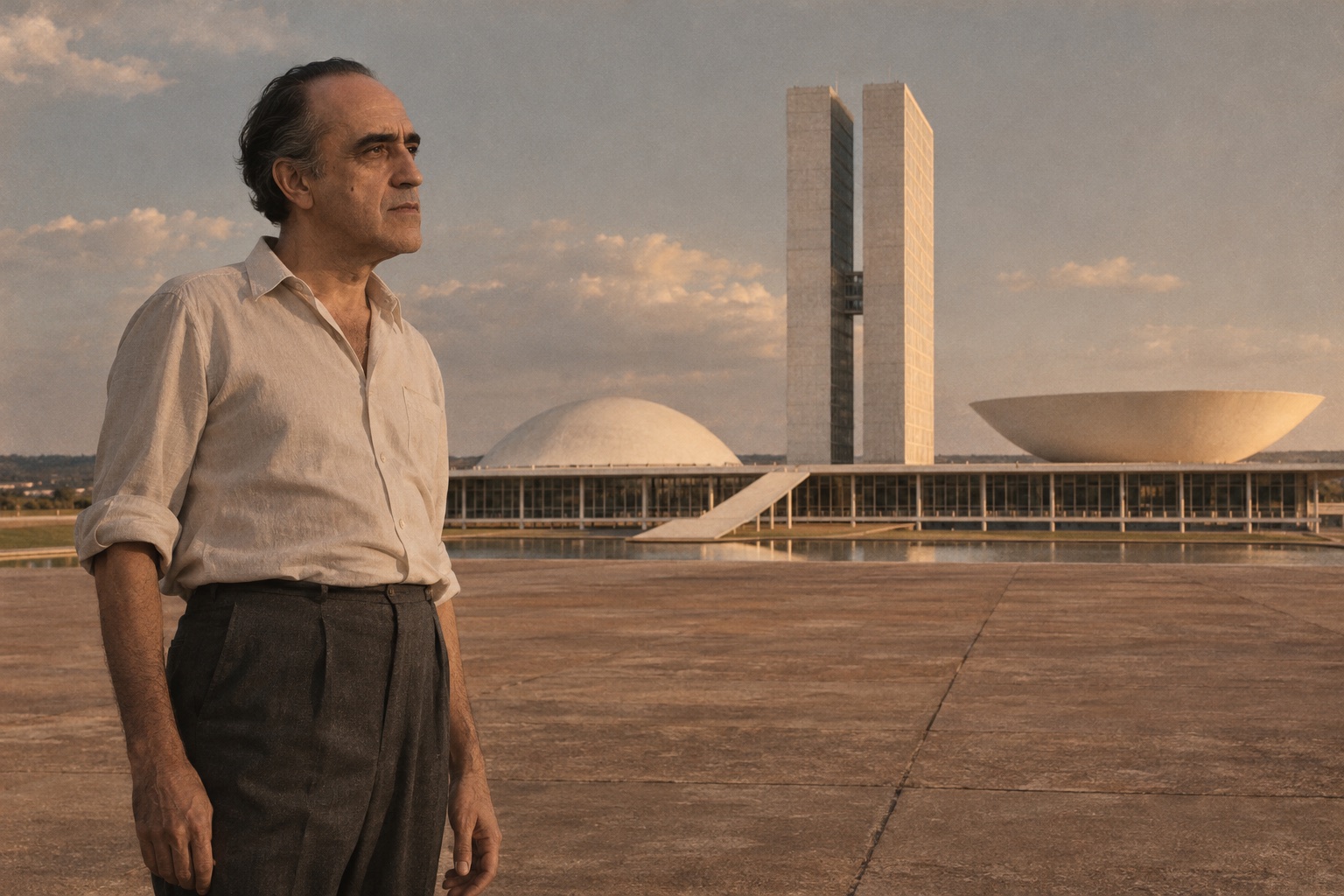
At Congress, the horizontal podium, twin office towers, convex Senate dome and upward-opening Chamber of Deputies bowl create a concise group of contrasting forms. They are not a complete diagram of government, but they make an institution legible across an immense space. Costa’s monumental axis gives the approach its urban setting; Niemeyer’s ensemble gives the distant view its architectural focus.2
The apparent clarity is inseparable from its setting. Move closer and the towers, ramp, podium and curved volumes change their relationship. A photograph can compress them into one emblem; a person walking across the site experiences distances and exposure. The image’s authority and the body’s effort belong to the same place.
A message left inside the monument
In 2011, maintenance work at Congress revealed messages left by construction workers. One, dated 22 April 1959 and signed by José Silva Guerra, appealed to future Brazilians for fairness toward their children and respect for the law. The Senate’s report gives the worker a name and a date within the institution’s walls.5
This is a different kind of founding document from an urban plan or presidential speech. It makes the distance between national promise and ordinary vulnerability tangible. Guerra’s appeal does not cancel the architecture’s achievement. It changes what we must include when telling the story of that achievement: the expectations of people whose labor was essential and whose future in the finished city was not assured.
Beyond the monumental axis
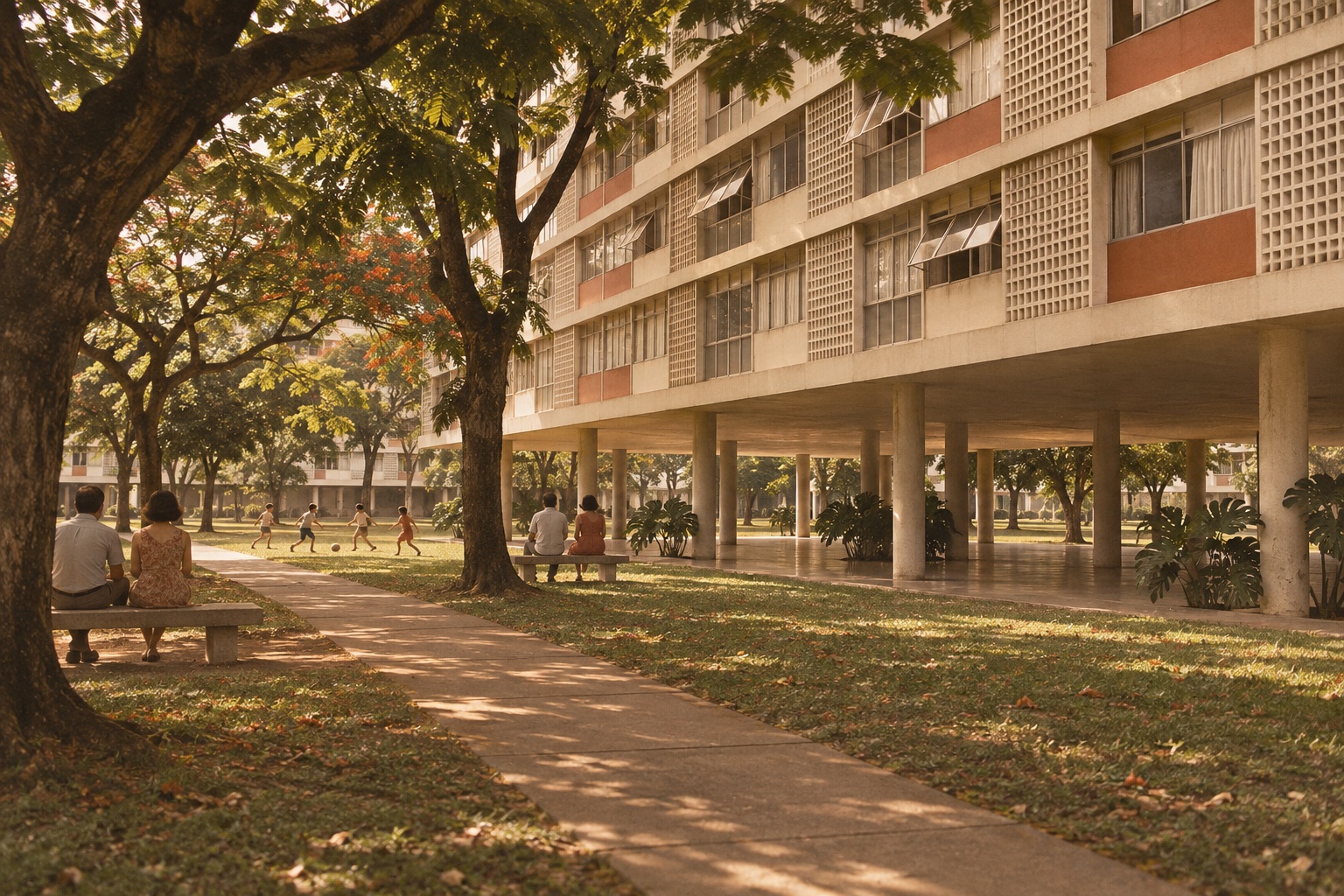
The residential superquadras offer another scale: housing blocks raised above open ground, landscape and neighborhood facilities. They should not be confused with the ceremonial spaces of the ministries and palaces. Brasília was planned through different urban scales, not simply as a continuous field of monuments.2
But the planned center is not the whole metropolitan city. UNESCO’s conservation account connects inadequate public transportation, social-spatial segregation and the concentration of jobs and services in the protected center. For a resident commuting from beyond it, a generous space may also be a long distance to cross. The everyday city has to be read through movement, housing and access as well as composition. Its adaptations and communities deserve attention alongside the canonical view.
A promise that criticism cannot finish
The 1959 violence at the Pacheco Fernandes camp remains contested in the relationship between workers’ testimony and official memory, including the death toll. We do not supply a definitive number. The dispute belongs to Brasília’s history because uncertainty does not erase the voices that carried it.10
Ada Louise Huxtable’s 1988 Pritzker essay defended Niemeyer’s enduring architectural quality while recognizing failures in modernist urban theory. The distinction leaves a more demanding inheritance than either unqualified celebration or rejection. Brasília can be a collective artistic achievement and a city marked by unequal access. Its buildings can move us while its founding promise remains unfinished. The dictatorship beginning in 1964 would soon transform Niemeyer’s own relationship to the country whose new capital he had helped make.1112
Sources for this story +
Numbered links beside passages lead directly to the supporting source. Experiential readings are editorial interpretations; generated scenes are labeled artistic reconstructions.
- Fundação Oscar Niemeyer · 1955–1960 ↗
- UNESCO · Brasília: significance and conservation ↗
- EBC / IBGE · The 1959 census and the candangos ↗
- Brazilian Senate · Brasília and the contribution of women, 2022 ↗
- Brazilian Senate · Candangos na construção da capital, 2020 ↗
- Tempos Históricos · Candangos: uma história de trabalho e exclusão ↗
- Fundação Oscar Niemeyer · Alvorada: project and architect’s text ↗
- São Paulo Legislative Assembly · Brasília 50 years ↗
- Pritzker Architecture Prize · Niemeyer biography and own account ↗
- University of Brasília · Vida Candanga, 2018 ↗
- Ada Louise Huxtable · On Awarding the Prize, 1988 ↗
- Fundação Oscar Niemeyer · 1960–1965 ↗